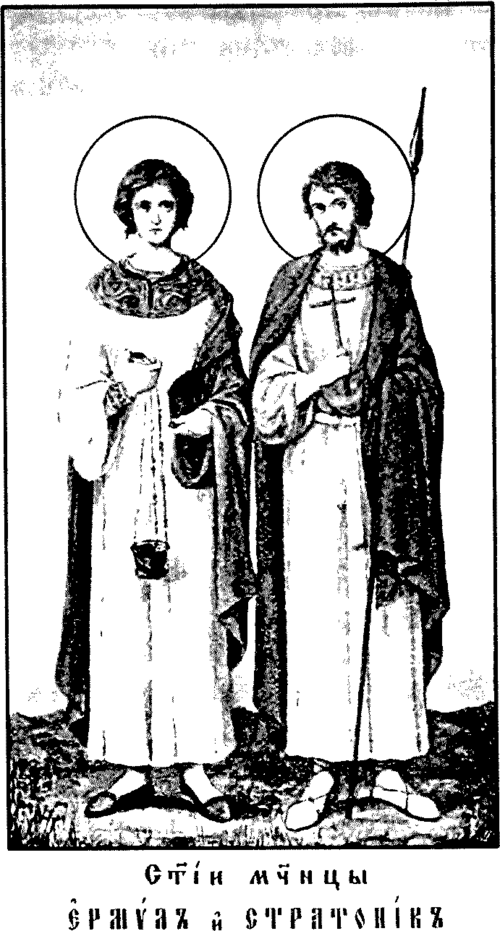
Holy Martyrs
Hermylus and Stratonicus
Martyrs of Singidunum
Hermylus, a deacon at Singidunum, today Belgrade, and Stratonicus, martyred around 315 under Licinius; commemorated on 13 January.
- Era
- unknown
- Order
- Martyrs
Life
Holy Martyrs Hermylus and Stratonicus suffered around the year 314 or 315 at Singidunum (present-day Belgrade), in the province of Upper Moesia, in the time of the emperor Licinius, who ruled the East while Constantine the Great ruled the West. They are among the oldest Christian martyrs known by name in that city. They are saints in both the Orthodox and the Catholic Church. Their commemoration is on 13 January (26 January by the new calendar, in the Serbian Church).
News of them comes from the Martyrology of Usuard, from which they entered the Greek synaxarion. Their martyrdom took place after the Edict of Milan (313), and theologians are not fully certain whether they fell victim to the conflicts already begun between Constantine the Great and Licinius.
Hermylus was a deacon at Singidunum. In the time of Licinius he was forced to renounce the Christian faith, but he resisted, the skin of his cheeks was flayed, and he was thrown into prison. According to the martyrology, an angel visited him in prison. The Serbian source says that the emperor himself questioned him in person, but Hermylus remained unshaken in his faith. He was then beaten with rods by six men, but did not die, and in prison he recited Psalm 27. The next day he was tortured again, still without dying. The jailer, the soldier Stratonicus, who was also a Christian, seeing his patience, openly and publicly joined his friend Hermylus in suffering. According to the Romanian source, Stratonicus became a Christian at that moment.
Both then endured great torments. They were condemned to the same death: they were placed in the same coffin and thrown alive into the Danube. After three days the water cast their bodies up on the right bank of the Danube, eighteen stadia downstream of Singidunum. The Christians found them, buried them with honour, and later a church dedicated to them was built over their tomb. According to the Romanian source, a church was built at Constantinople in which a part of the relics of Stratonicus was laid, and which took its name from him.