Saint
Hubert of Liège
Bishop of Liège
First bishop of Liège, called the Apostle of the Ardennes, who died in 727.
Life
Saint Hubert was the first bishop of Liège and is called the Apostle of the Ardennes. In the Middle Ages he was widely venerated, and today he is regarded as patron of hunters, mathematicians, opticians and metalworkers. He is commemorated on 30 May (the day of his death) and on 3 November (the commemoration of his relics).
Early life
He was born around 656, traditionally in the line of a Frankish duke, Bertrand of Aquitaine. At ten he came close to dying of fever. As a young man he was sent to the Neustrian court of Theuderic III in Paris, where his charm and fine manners brought him the dignity of “count of the palace”. Like many nobles of his time he was fond of hunting. In 682 he married Floribanne, daughter of Dagobert, count of Leuven. He moved to the Austrasian court, where he was warmly received by Pepin of Herstal, who named him almost at once grand master of the royal household.
Turning to God
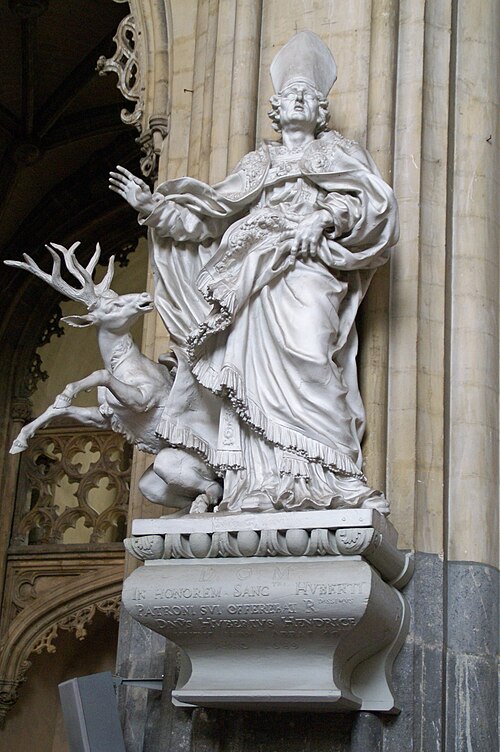
His wife died in childbirth, giving birth to their son Floribert, and grief made him withdraw from the court. He went into the forests of the Ardennes and gave himself wholly to hunting. According to a legend, written down later and borrowed from the life of Saint Eustace, one Good Friday morning, while the faithful were in church, Hubert was hunting in the forest. Pursuing a splendid stag, he saw a shining cross between the animal’s antlers and heard a voice calling him to turn to the Lord and lead a holy life. Hubert dismounted, bowed to the ground and was told to go to Lambert. The story of the stag was attributed to Saint Hubert only in the fifteenth century.
He went to Maastricht, to Bishop Lambert, who received him kindly and became his spiritual father. Hubert gave up all his honours, gave his younger brother Odo his rights over Aquitaine and made him guardian of the little Floribert, and distributed his wealth to the poor. Lambert sent him to live in the Ardennes, among the people and the forest creatures. Hubert studied for the priesthood, was ordained, and soon became one of Lambert’s chief helpers.
Bishop
At Lambert’s request he went on pilgrimage to Rome in 708. During his absence Lambert was killed at Liège by followers of Pepin. According to the sources of Hubert’s life, the pope learned of this in a vision and ordered that Hubert himself be made bishop of Maastricht. He gave the revenues of the see to the poor, fasted and prayed much, and became known for his preaching. In 720, obeying a vision, he translated the relics of Saint Lambert from Maastricht to Liège with great pomp, with the help of neighbouring bishops. A basilica was built on the site of Lambert’s martyrdom and consecrated as a cathedral the next year; the see was moved from Maastricht to Liège, then a small village. This laid the foundation of the city’s later greatness, with Lambert as its patron and Hubert as its founder and first bishop. Hubert preached to pagans in the wide forests of the Ardennes and in Toxandria.
He departed this life on 30 May 727 at Fura; it was later thought to be Tervuren near Brussels, but scholars today favour Voeren, closer to Liège. His son Floribert succeeded him in the see.
Relics and veneration
Hubert was first buried at Liège, and in 825 his relics were taken to the abbey of Andage, later called Saint-Hubert. That abbey wrote the first lives of him, and his relics stayed there until 1568, when they were destroyed by Protestants. An old custom called on him as healer of rabies, with the help of “Saint Hubert’s Key”, used until the early twentieth century. The stag with the cross between its antlers remains his sign. The hunting lodge of Hubertusburg, the Order of Saint Hubert and an asteroid bear his name. The Russian Orthodox Church in Belgium honours him as a local saint, on 3 November in the old style.
Commemorated the same day May 30
 John of KochetovkaFool-for-Christ · Fool for ChristMay 30
- AgapiusMartyrMay 30
- Anastasius of PaviaSaint · Bishop of PaviaMay 30
- AphrodisiusMartyrMay 30
- BarlaamVenerableMay 30
- Basil SmolenskyHieromartyrMay 30
- CrispulusMartyrMay 30
- CyprianVenerable · Venerable of AntiochMay 30
- EuplusMartyrMay 30
- EutychesHieromartyrMay 30
- Exuperantius of RavennaSaint · Bishop of RavennaMay 30
- Gabinus and CrispulusHoly MartyrsMay 30