Martyr
Hyacinth of Rome
Martyr of Rome, who suffered for Christ.
- Feast
- December 24old style January 6
- Reposed
- 2623rd century
- Order
- Martyrs
Life
Holy Martyr Hyacinth of Rome was a slave and companion of Holy Venerable Martyr Eugenia of Rome, together with Holy Martyr Protus. The calendar commemorates together Eugenia, Protus, Hyacinth and Claudia.
Eugenia, a Roman by birth, lived at Alexandria, where her father, Philip, had been sent by Emperor Commodus (180-192) as governor of Egypt. She received a choice education and was distinguished by good character and beauty. Many young men of noble birth sought her hand, but she did not wish to marry. Coming to know the Epistles of Saint Paul, she yearned with all her soul for Christianity and, in secret from her parents, accompanied by her two slaves, Protus and Hyacinth, dressed in men's clothing, withdrew to a men's monastery. There she and her companions received Holy Baptism from Bishop Helenus, to whom it had been revealed about her in a vision, and he blessed her to struggle in the monastery in the guise of the monk Eugenius.
By her labours Eugenia gained the gift of healing. Once a rich young widow, Melantia, came to her for help. Seeing the young monk, the woman was inflamed with unclean passion, and, being rejected, devised a slander about an attempted assault. Saint Eugenia appeared at the trial before the governor of Egypt, that is, her father, and was forced to reveal her secret. Her family rejoiced to find her whom they had long mourned. After a time all received Holy Baptism. But Philip was removed from office by a denunciation of the pagans, and the Christians of Alexandria chose him as their bishop. The new governor, fearing the people's anger, did not put him to death openly but sent assassins. During the bishop's solitary prayer they wounded him, and from these wounds he died as a martyr after three days. Widowed, Claudia left with her daughter and servants for her estate in the environs of Rome. There Eugenia continued her monastic life. She brought many virgins to Christ, and Claudia set up a guest house and served widows. After several quiet years Emperor Gallienus (260-268) began persecution of Christians again, and many found refuge with Saints Claudia and Eugenia.
At that time a young orphan Roman woman of imperial stock, Basilla, hearing of the Christians and of Saint Eugenia, wished to meet her and wrote her a letter. In reply, Eugenia sent her friends and companions, Protus and Hyacinth, who enlightened Basilla, and she received Holy Baptism. Basilla's maid told her fiance, Pompey, that his bride had become a Christian, and Pompey complained to the emperor about the Christians who preach celibacy. Brought to trial, Basilla refused to marry Pompey and for this was put to death with the sword. Saints Protus and Hyacinth were dragged into the temple of the idols to sacrifice, but as soon as they set foot there, the idol fell and broke. The holy martyrs Protus and Hyacinth were beheaded. Saint Eugenia was also forcibly brought to the temple of Diana, but before she could enter, the whole shrine with the idol collapsed. The martyr was thrown into the Tiber with a stone tied to her neck, but the stone fell off and she remained unharmed. She remained unharmed also in the fire. Then they threw her into a ditch, where she stayed ten days. At that time the Saviour Himself appeared to her and announced that she would enter the Kingdom of Heaven on the day of the Nativity of Christ. When in the year 262 that bright feast came, the executioner killed the martyr with the sword. Soon Saint Claudia also received the crown of martyrdom. Venerable Martyr Eugenia had warned her of the day of her death.
The saints are commemorated on 6 January (new style).
Commemorated the same day December 24
 AdamRighteous · The First-CreatedDec 24
 EveRighteous · The First MotherDec 24
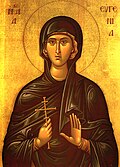 Eugenia of RomeVenerable MartyrDec 24
 Innocent BedaVenerable Martyr · ArchimandriteDec 24
- Nicholas the MonkVenerableDec 24
- Socius and TheocliusHoly MartyrsDec 24
- AchaicusMartyrDec 24
- Agapios PapantonopoulosSaintDec 24
- Agapius the YoungerVenerableDec 24
- Alberic of GladbachVenerableDec 24
- AphrodisiusVenerableDec 24
- BitimionVenerableDec 24