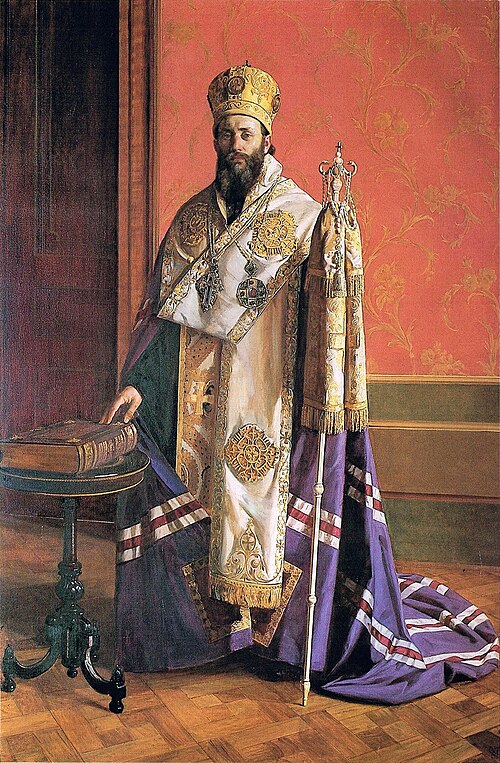
Saint
Irinej Ćirić
Bishop of Bačka
Born Jovan Ćirić in Karlovci, Bishop of Bačka in the Serbian Church; he died in Novi Sad in 1955.
Life
Saint Irinej, Bishop of Bačka (in the world Jovan Ćirić, 1884 to 1955), was bishop of Timok and then, from 1922 until his death, bishop of Bačka in the Serbian Orthodox Church. He was a scholar of the Old Testament, a translator, a poet, a preacher and a voice of Orthodoxy in the ecumenical movement of his day. During the war he saved thousands of children from a camp, and after it he was stoned during a procession and for years afterwards bore the illness brought on by that blow. The Serbian Church numbered him among the saints in 2022.
Youth and studies
He was born on 19 April (1 May) 1884 in Karlovci (today Sremski Karlovci), in Austria-Hungary, to Isidor, church secretary of the Serbian people, and Evelina, born Krečarević. He finished gymnasium at Novi Sad in 1902 and was then accepted into the Moscow Theological Academy, from which he graduated in 1906. He studied philosophy at the University of Vienna, where he defended a doctorate in Semitic languages.
In 1909 he directed the library of the Patriarchate at Karlovci, and in September of that year he was elected lecturer at the Karlovci Seminary for the Old Testament, archaeology and the Hebrew language. He also taught liturgics for a time, and in 1911 and 1912 religion at the Karlovci gymnasium. Later, on the strength of his scholarly works, he became associate and then full professor.
The monk
He was tonsured a monk at the Hopovo monastery by Archimandrite Augustin Bošnjaković, before Christmas. The sources do not agree: some give 1908, others 1910. Patriarch Lucian ordained him deacon at a Christmas, and he was soon raised to protodeacon, and in 1912 became patriarchal archdeacon.
When the Holy Synod of the Serbian Church formed a commission to translate Holy Scripture into Serbian, Irinej joined it. As a professor he translated Old Testament texts from Hebrew and accompanied them with notes of his own.
The bishop
On 5 June 1919 he was elected bishop of Timok by the Council of Bishops of the former Kingdom of Serbia. He was first ordained priest and archimandrite by Bishop Georgije Letić of Timișoara, and on 15 June, in the cathedral of Belgrade, he was consecrated bishop by Archbishop Dimitrije of Belgrade together with Bishops Varnava of Veles and Debar, Dositej of Niš, Nikolaj of Žiča (Velimirović) and the vicar Ilarion. He remained at Timok until the end of 1921, then, at his own wish, moved to Bačka. He ascended the throne of the bishops of Bačka on 9 February 1922.
He enriched Serbian theology with many articles in journals and was a poet, translator and preacher, proclaiming Orthodoxy in London, Glasgow, Oxford, Paris, Bern, Stockholm, Vienna, Avignon, Sofia and Constantinople. In 1927 he was sent to Subcarpathian Rus and eastern Slovakia to organize Orthodox dioceses. He also administered the dioceses of Vršac, Banat and Timișoara.
He represented the Serbian Church in the Faith and Order movement, in the Universal Christian Council for Life and Work and in the World Alliance for Promoting International Friendship through the Churches. The last elected him twice chairman of its executive board, and in 1939 president of the whole organization. In 1930 he was the Serbian Church's representative on the commission of the Lambeth Conference for rapprochement between the Anglican and Orthodox Churches, and in 1931 on the joint Anglican and Orthodox commission. He sat on the committee of the movement "Peace through Religions", founded in 1928, and on the honorary committee of the first international congress of religious psychology at Vienna in 1930. In 1936 he organized at Novi Sad the preparatory conference of the Orthodox Churches for the Oxford assembly of 1937.
On 18 October 1931, in London, together with several metropolitans of the Ecumenical Patriarchate and in the presence of Anglican bishops, he served the Liturgy of Saint John Chrysostom. After it, Irinej delivered in Russian a fervent sermon on the sufferings of the Russian Church and its crown of martyrdom, translated piece by piece into Greek. On 27 and 28 October 1931 he represented the Serbian Church at the Orthodox and Old Catholic conference in Bonn, and at the end of 1933 he visited, on an official mission, the Patriarch of Constantinople and the Holy Synod.
The war years
The Second World War brought hard times to Bačka. Through Bishop Irinej's effort, about 2,800 children and 180 mothers with infants were moved from the Hungarian camp at Sárvár into the diocese, and at Novi Sad he founded the diocesan children's hospital, which treated those who fell ill with tuberculosis in the camp. Later he also worked to free adults from the camp and settle them in the homes of his flock. Under the Hungarian occupation he was a member of the upper house of the Hungarian parliament.
The Serbian sources record that during the occupation he called on the local Serbian population to avoid cooperating with the partisans and to cooperate with the Hungarian authorities. In January 1942 he went to Budapest and met the regent Miklós Horthy. He protested there that the massacres in southern Bačka had also struck the Serbian Orthodox clergy, whom he regarded as wholly anti-communist. In February 1943 he accepted to be a deputy in the Hungarian parliament.
Suffering after the war
Immediately after the war he was placed under house arrest, where he stayed for seventeen months, accused of failing to defend the Serbs. Demonstrations were organized against him, and the episcopal residence was pelted with stones. On the feast of the Transfiguration in 1946 the bishop went to the village of Odžaci to consecrate a new church. When he came out of the church in episcopal vestments and began the procession around it, a crowd rushed at him and the clergy around him, shouting, blaspheming and throwing stones. One stone struck him on the back of the head. The bishop fell, and the attackers went on striking him. Deacon Ružić lay over the bleeding hierarch to shield him with his body. Priest Milenko Cvejanov of Sivac tried to stop the mob but fell under the blows of a knife.
Bishop Irinej never recovered from his injuries and developed an illness of the spinal cord. For the rest of his life he spent most of his time in bed. When the pain grew, he would say: "The more I suffer, the more I pray to God." Even afterwards, agents of the regime often broke into his house, threatened him and, one night, tied him to his bed. He fell asleep in the Lord in April 1955, on 5 or 6 April according to the sources, and was buried on the day of the Annunciation in the crypt of the cathedral at Novi Sad.
His work
Rarely has a professor of the old Karlovci seminary come to it with so many hopes as he did. He was the first in the Serbian Church to treat Old Testament problems scientifically, and his works still hold a visible place in the Church's theology. From youth he wrote poetry and prose and worked on iconography. For years he studied church chant, not only Serbian but Byzantine, Russian and Romanian, and prepared a chant textbook for the Faculty of Theology which was never published. He translated from Hebrew, Latin, Greek, French, Russian, German and Hungarian. He understood early the need to translate the services from Greek into Serbian and translated, among others, the service of Meatfare Sunday, the evening prayers, the service of Pentecost Sunday and the Octoechos, that is, the Sunday resurrection services.
Glorification
In May 2022 the Holy Assembly of Bishops of the Serbian Orthodox Church numbered him among the saints. The solemn canonization took place on 2 October 2022 at Novi Sad, at the Liturgy celebrated by Patriarch Porfirije of Serbia, together with the holy martyrs of Bačka. On 24 August 2023 the Holy Synod of the Russian Church entered him in its calendar. The saint is commemorated on 24 March (6 April by the new calendar).
Commemorated the same day March 24
- Parthenius III of ConstantinopleHieromartyr · Patriarch of ConstantinopleMar 24
- Zacharias of ScetisVenerable · Monk of ScetisMar 24
- Flavius Latinus of BresciaHieromartyr · Bishop of BresciaMar 24
 Agapitus of SynnadaSaintMar 24
- Alexander FleginskyHieromartyrMar 24
- Alexander of Caesarea MaritimaMartyrMar 24
- Artemon of SeleuciaSaint · Bishop of SeleuciaMar 24
- Baetan of MonuSaintMar 24
- Bernolfo of AstiHieromartyrMar 24
- BernulfHieromartyrMar 24
- Caimin of Inis CealtraVenerableMar 24
- CaorlanSaintMar 24