Venerable
Isaiah the Solitary
Monk and ascetic writer
Palestinian monk and ascetic writer known from the Sayings of the Desert Fathers, who died in 491.
- Reposed
- 4915th century
- Order
- Venerables
Life
Saint Isaiah the Solitary (Isaiah of Scetis, Isaiah of Gaza, Abba Isaiah) the venerable was a monk, ascetic and spiritual writer, known from the Sayings of the Desert Fathers and from Palestinian sources. He is said to have died on 11 August 491. The Orthodox Church commemorates him in the synaxis of all the venerable fathers, on the Saturday of Cheesefare, and the Serbs also on 3 July. He is also regarded as a saint in the Coptic Church, on the 11th of the month of Epip (Abib) in the Coptic calendar.
His life and the scholars' views
The sources do not agree about his life, and scholars do not agree whether he was one person or two. Some sources say he was born in Egypt, in a poor family, that he had learned almost only by reading the Holy Scripture and that around 431 he settled in the desert of Scetis in Lower Egypt, in the Cells of the desert of Scetes, where he first lived as a monk in the early fifth century. There he is said to have lived on a mountain and then to have moved to Palestine. At the start of monastic life he made use of the instructions of Saint Poemen the Great and put many of his sayings into his writings. He was very humble and had the gift of tears. The monks of his time honoured him and used his teachings; the Patriarch of Alexandria knew him and regarded him as righteous. At the end of his life he struggled in complete solitude, whence the name "the Solitary". He had contacts with intellectuals of Gaza, such as Aeneas of Gaza, of the rhetorical school of the city, who consulted him on the philosophical writings of Plato, Aristotle and Plotinus, and he became a friend of Peter the Iberian, with whom he met from time to time. He is mentioned in the books of Saints Barsanuphius and John of Gaza (Answer 249 and others) as a man of special holiness, so that he is said to have been active at Gaza. He died as a hermit in a monastery near Gaza, on 11 August 491.
Some scholars think that Isaiah of Gaza and Isaiah of Scetis were in fact two different persons: the "Asceticon" would have been first written by Isaiah of Scetis (died in the early fifth century) and later edited by Isaiah of Gaza (died 491). Others date his life in the second half of the fifth or the first half of the sixth century. Bishop Ignatius Brianchaninov gives him a long chapter in his "Patericon".
His writings
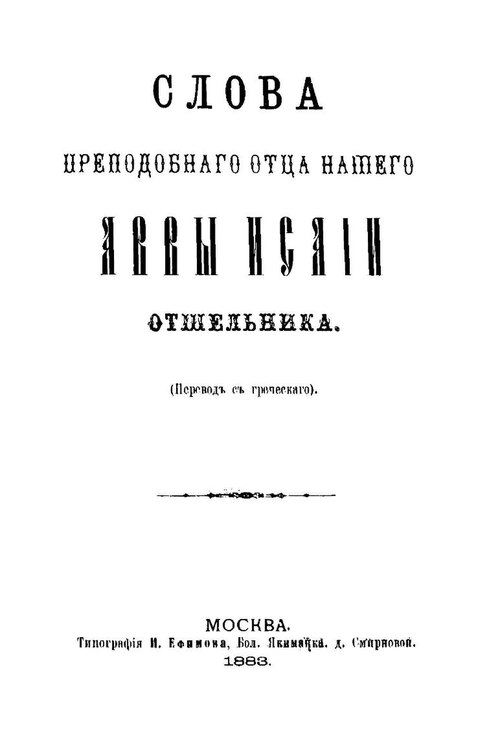
Isaiah combined solitary life with fruitful literary activity, of an ascetic tone. The language of the original is Egyptian (Coptic), and a large part of the writings is lost (according to some sources destroyed by Muslims). What is known includes an incomplete collection of ascetic words and sayings, rules for novice monks and chapters on struggle and stillness. He is the author of the most important ascetic collection written in Greek, the "Ascetic Discourses", called the "Asceticon", about thirty discourses on Christian asceticism, noted down without thematic order by one of his disciples. The "Asceticon" was especially loved in eastern Christian monasticism and survives in many translations into Syriac (sixth century, only partial, translated into French), Coptic (sixth), Ethiopic (eighth, from Coptic), Armenian (eighth), Arabic and Georgian (of which only discourses 3, 7, 23 and 27 survive). In the West it was almost unknown; only in medieval Spain was a Latin abridgement used, based on the Arabic version, and a full Latin translation was made only for its first printed edition, at Venice, in 1558.
Later, part of his words entered the collection "Evergetinos", compiled in the eleventh century by the Constantinopolitan monk Paul Evergetinos. They also entered the "Philokalia": the first volume contains twenty-seven chapters "On Guarding the Intellect" by Isaiah the Solitary, and from there they passed into the Slavonic version. Another work is sometimes wrongly attributed to Isaiah, the "Miterikon, a collection of instructions of Abba Isaiah for the most honoured nun Theodora"; this was written much later by another Byzantine monk named Isaiah (twelfth-thirteenth centuries), probably for Theodora Angelina, daughter of Emperor Isaac II Angelos, who took the veil after her father's death.