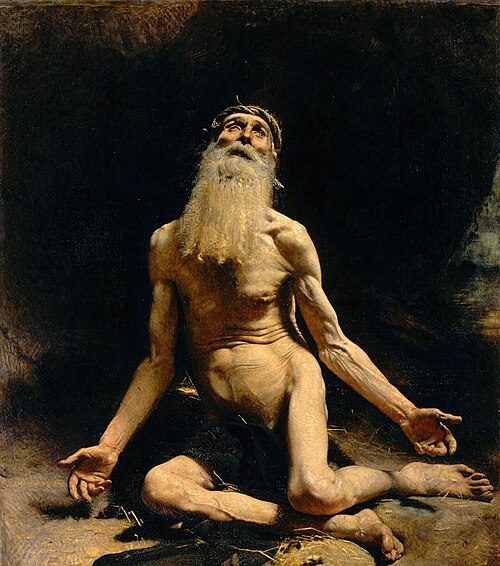
Righteous
Job
The Righteous and Long-Suffering
The righteous man of Uz, tried by the loss of wealth, children, and health, who stayed faithful to God.
- Feast
- May 6old style May 19
- Era
- unknown
- Order
- The Righteous
Life
The holy and righteous Job the much-suffering is the man of the land of Uz whose story is told in the Book of Job in the Old Testament. Struck in turn by the loss of his wealth, his children and his health, he did not curse God, and he remains for all ages the image of patience and unshaken faith. The Orthodox Church commemorates him on 6 May (old style Menaion; 19 May in the civil calendar of the Julian Churches).
Who he was
The Book of Job does not say when he lived, and opinions differ. The Greek Orthodox Synaxarion places him around 1900 BC, others around 1400 BC, and the OCA synaxarion calls him the fifth generation from Abraham. The Septuagint, at the end of the book, calls him a son of Zareh and of Bosorra and identifies him with Jobab, a king of Edom mentioned in Genesis. His country, called Uz or Ausitis, lay between Idumea and Arabia. Another opinion, recorded by a Russian calendar, makes him a nephew of Abraham, a son of Abraham's brother Nahor. The Prophet Ezekiel names him together with Noah and Daniel as one of the righteous, and the holy Apostle James holds him up as an example of patience.
Scripture presents him as blameless and upright, a man who feared God and turned away from evil. He had seven sons and three daughters and great possessions, so that he was the greatest of all the people of the East. Every time his children had feasted together, he rose early and offered sacrifices for them, saying that perhaps they had sinned and cursed God in their hearts.
The trial
God allowed Satan to test him. In a single day he lost his flocks, his servants and all his children. Job tore his robe, shaved his head, fell on the ground and worshipped, saying that naked he came out of his mother's womb and naked he would return, that the Lord gave and the Lord had taken away, and blessed be the name of the Lord. In all this he did not sin or charge God with wrong.
Then Satan was allowed to strike his body, and Job was covered with terrible sores from head to foot. He left the company of men, sat on an ash heap and scraped himself with a potsherd. According to the Greek Synaxarion he lived out his days in a cave, praying and scraping his wounds. Orthodox sources speak of seven years of this trial, while others reckon only one year. His wife, who had also lost everything, urged him to curse God and die. He answered that she spoke like one of the foolish women, and asked whether we shall receive good from the hand of God and not receive evil.
His friends and God's answer
Three friends, Eliphaz, Bildad and Zophar, came to console him. The Greek text calls them the king of the Temanites, the tyrant of the Shuhites and the king of the Minaeans. They sat with him in silence seven days and seven nights, and then spoke, insisting that his suffering must be the punishment of hidden sins. Job defended his innocence and cried out to God from the depths of his pain. In the midst of it he confessed that his Redeemer lives and that in his flesh he would see God, words which the Church has always understood as a prophecy of the resurrection of the dead. Another voice, that of the young Elihu, speaks before the Lord answers.
At last the Lord answered him out of the whirlwind, showing him the greatness and wisdom of creation, and Job humbled himself and repented in dust and ashes. God rebuked the three friends and told them to bring a sacrifice, for only Job's prayer would He accept on their behalf. Job prayed for them, and the Lord restored his health and gave him twice as much as he had before. Seven sons and three daughters were born to him, the daughters called Jemimah, Keziah and Keren-happuch, and none in the land were more beautiful than they.
His death
After his trial Job lived another 140 years according to the Greek tradition, and 170 years according to others, and he saw his descendants to the fourth generation. Some sources give his whole life as 240 or 248 years. The date of his death is given in different ways: about 1650 BC in the Greek Synaxarion and about 1350 BC in the synaxarion of the Orthodox Church in America, while a Russian calendar places his whole life between 2000 and 1500 BC. He fell asleep in peace, full of days.
Veneration
The Church reads the Book of Job, the first of the wisdom books of the Old Testament, in Holy Week, and sees in him a type of Christ: a righteous man who suffered without fault, as the sinless Lord suffered freely for our sins. The Septuagint adds to Job 42:17 that he will rise again with those whom the Lord raises, a verse read in the Church on Great and Holy Friday, when the Gospel speaks of the tombs opened at the death of the Saviour. Saint John Chrysostom held him up as a man firmer than adamant, who tasted hunger, poverty, sickness, the death of his children, the loss of riches, the scorn of his wife and the insults of friends and servants, and stood firm through them all, before the Law and before Grace. Saint Anthony the Great teaches in this spirit that without temptations no one can be saved.
Besides 6 May, the Roman Catholic Church keeps his memory on 10 May and the Armenian Church on 6 May and 26 December, and the Coptic Church on 27 April and 29 August. A pseudepigraphal Testament of Job tells his story in a late form. In Orthodox hymnography he is called a tower of valour that no assault could overthrow.
Commemorated the same day May 6
 Lucius of CyreneApostle · Of CyreneMay 6
 Venerius of MilanSaint · Archbishop of MilanMay 6
 Maurelius of ImolaHieromartyr · Bishop of ImolaMay 6
- Justus of VienneSaint · Bishop of VienneMay 6
- Valerianus of AuxerreSaint · Bishop of AuxerreMay 6
- Eadberht of LindisfarneSaint · Bishop of LindisfarneMay 6
- Seraphim of DomvosVenerableMay 6
- Barbarus the SoldierMartyr · SoldierMay 6
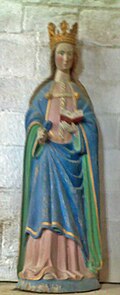 AvoyeMartyrMay 6
- Bacchus of ThraceMartyrMay 6
- Barbarus of LucaniaMartyr · Former robberMay 6
- Barbarus of ThraceMartyrMay 6