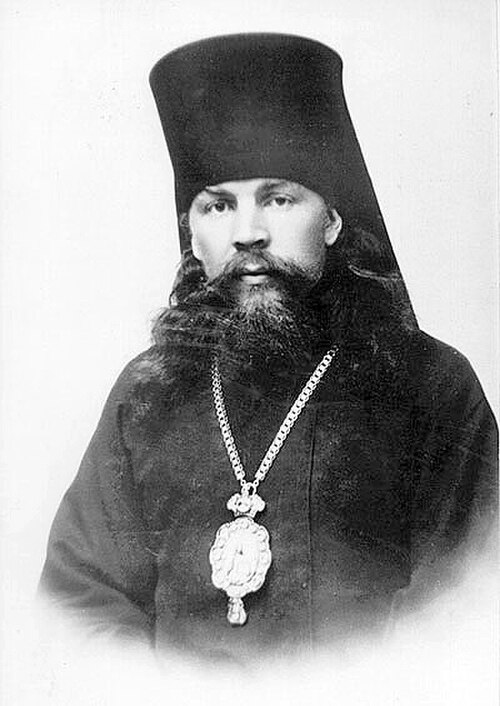
Saint
John Bulin
Russian bishop in Estonia
Russian bishop in Estonia, head of Pechory Monastery from 1920 to 1932 and an Estonian MP, who died at Leningrad in 1941.
- Reposed
- 194120th century
- Place
- Saint Petersburg
- Order
- Hierarchs
Life
Bishop John (Bulin) of Pechory was a Russian Orthodox bishop in Estonia, abbot of the Pskov-Pechory (Petseri) Monastery from 1920 to 1932, which he raised from ruin, and a member of the Estonian parliament. After years of exile abroad he returned home, was arrested by the NKVD in 1940 and shot in Leningrad in 1941. He has not yet been numbered among the saints, though proposals to that end have been made.
Childhood
In the world he was Nicholas Alexandrovich Bulin, born on 16 February 1893 in the settlement of Veps (today Võõpsu) near Räpina, in present-day Estonia, into a family of Russian workers. His ancestors came from the Don region and had been resettled under Empress Elizabeth, together with 220 other families, to work at the paper mill in Räpina. They formed their own village with an Orthodox church of the Holy Righteous Zachariah and Elizabeth.
From the age of six he helped at the services, and at eight he recited the Trisagion from memory. He studied at the school in Võõpsu (1901-1903) and then for two years at the school in Raadama. In 1905 he entered the theological school in Riga, and in 1909 the Riga Seminary, from which he graduated with distinction in 1915.
Student, soldier and monk
In 1915 he entered the Petersburg Theological Academy, where his classmates entrusted him with preaching at services and giving speeches at solemn occasions. Although exempt from military service, in the patriotic surge of the war he entered the officers' school at Peterhof, which he completed in 1916, and fought at the front. In December 1917 he was released from the army and returned to the academy.
On 21 May 1918, in the church of the Twelve Apostles, the rector of the academy, Bishop Anastasius (Alexandrov), tonsured him a monk with the name John, in honour of Saint John of Tobolsk, and on 23 May he was ordained hierodeacon. On 12 August 1918, in the Trinity Cathedral of the Alexander Nevsky Lavra, Saint Benjamin (Kazansky), Metropolitan of Petrograd, ordained him hieromonk. He was sent to the Protection Convent at Vedrilovo, where his uncle was a reader. Persecution was intensifying, clergy were being arrested and the academy had closed. Fearing arrest, in January 1919 he fled across the ice of Lake Peipus to newly independent Estonia.
Abbot of Pechory
Archbishop Eusebius of Pskov appointed him parish priest at Zacherenye, and in January 1920 dean of the Pechory district. On 20 February 1920 he arrived as vicar at the Pskov-Pechory Monastery, which lay in ruin after the years 1917-1919. Its lands had been taken, its buildings were crumbling, the roofs leaked and walls had collapsed. The refectory served as barracks for a company of Estonian soldiers, and the abbot's house was occupied by a magistrate and a land commission, so the new abbot lived at first in a tiny room. The brotherhood consisted of a few old monks, deacons and novices.
That same year he was proposed for the episcopate, but Patriarch Tikhon declined because of his youth, only twenty-seven. On 6 December 1920 he was raised to archimandrite. Through his labours the monastery recovered its proper appearance: all the buildings were repaired after the lay tenants left, as were the refectory and the abbot's house; in 1924 the church of the Meeting of the Lord, in 1927 the Dormition Cathedral, and then the Cathedral of Saint Michael. The old peal of bells from the time of Boris Godunov was restored, and in 1930 a stone staircase was built from Saint Michael's Cathedral to the centre of the monastery. The money came from benefactors and from the Estonian ministry of education. The inner life of the monastery was also set in order.
Bishop of Pechory
In 1926 the Synod of the Estonian Autonomous Orthodox Church called him to the episcopate while keeping him abbot of the monastery. On 25 April 1926 he was consecrated Bishop of Pechory by Metropolitan Alexander (Paulus) of Tallinn and Archbishop Eusebius (Grozdov) of Narva. After Archbishop Eusebius's death in 1929 he also administered the diocese of Narva until 1932. From 1929 to 1934 he was a deputy in the Riigikogu, the Estonian parliament.
In August 1929 he hosted at the monastery the Second Congress of the Russian Student Christian Movement, of which he was the soul; one participant wrote that the congress became a great upsurge of faith and love that melted the ice of the coldest souls and made believers of unbelievers.
He was a man of prayer with a fine voice and preached a great deal. He kept the old practices of the Church and revived forgotten ones. For the faithful of many languages who came to the monastery he arranged for the Paschal Gospel to be read in nine languages: Greek, Slavonic, Estonian, Russian, Latin, Polish, German, Latvian and Hebrew. He renewed and founded processions that drew crowds of pilgrims from all the Baltic lands and beyond, so that he became one of the best-known churchmen in Estonia in those years.
Conflict and retirement
The Estonian authorities interfered in the monastery's affairs, and the bishop had disagreements with the Synod of the Estonian Church over the monastery's property. He opposed innovations introduced in some churches and the new calendar. On 16 June 1932 a council in Tallinn decided, by the votes of its Estonian majority, to transfer him to the see of Narva and Izborsk and required him to leave the monastery. Bishop John did not accept the new see and on 30 December 1932 was retired, with the right to serve only by special permission.
Years of exile
In January 1934 he went to Constantinople to complain to the Ecumenical Patriarchate against Metropolitan Alexander and the Estonian Synod, but without success. He then spent a month on Mount Athos, serving at the monasteries of Saint Panteleimon, Saint Andrew and Saint Elijah, and travelled to Jerusalem, Palestine, Lebanon and Syria; a stay in Bulgaria is also mentioned. From September 1934, at the invitation of Patriarch Varnava of Serbia, he lived at the Rakovica Monastery near Belgrade, where he lectured on the situation of the Church in the Soviet Union and studied icon painting in the workshop of Pimen Sofronov.
Return and death
After Patriarch Varnava's death in 1938 he returned to Estonia and was allowed to live with his mother and then with his brother in Pechory. In October 1940, after the Soviet occupation, he urged the clergy of Pechory to join the Moscow Patriarchate, and Metropolitan Sergius (Stragorodsky) recognised him as Bishop of Pechory in a letter of 13 December 1940.
The metropolitan did not know that Bishop John had already been arrested by the NKVD in Pechory on 18 October 1940 and taken to Leningrad in November. He was charged with anti-Soviet agitation and propaganda and sentenced to death by the Leningrad regional court on 8 April 1941. He was shot in Leningrad on 30 July 1941; his burial place is unknown. On 22 April 1992 he was rehabilitated.
Proposals for canonisation
In 2003 Archpriest Valentin Asmus expressed his confidence that the Church would certainly consider the canonisation of Bishop John. On 7 October 2015, at a meeting chaired by Patriarch Kirill to harmonise the calendars of the Russian Church and the Russian Church Abroad, Metropolitan Hilarion (Kapral) proposed that the numbering of Bishop John of Pechory among the New Martyrs be considered.