Venerable
John of the Caves
Abbot of the Kiev Caves Lavra
Abbot of the Kiev Caves Monastery in the late eleventh century, who died after 1097.
- Born
- 110011th century
- Order
- Venerables
Life
Venerable John of the Caves (died after 1097, probably before 1108) was abbot of the Kyiv Caves Monastery in the last quarter of the eleventh century. He is mentioned in the Kyiv Caves Paterikon and in the "Tale of Bygone Years". Several historians regard him as the author of the "Initial Compilation" of the Rus' chronicle of the 1090s, a disputed hypothesis. He was numbered among the venerable saints by the Russian Orthodox Church in the 1970s. The place of his burial is not known.
Life
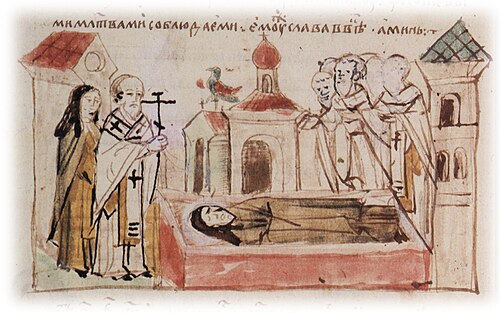
John is mentioned in the "Tale of Bygone Years" under the year 1074, in the account of the ascetics of the Caves Monastery, when he took part in the burial of the venerable Isaacius; the same report is in the Kyiv Caves Paterikon. To the abbacy of Nikon (1078 to 1088) belongs the report in the Paterikon in which John is named among the monks of the caves, "venerable fathers… God-bearers", who drove a demon out of the recluse Nikita (the future bishop of Novgorod).
John became abbot of the monastery probably in 1088 to 1089, after Nikon's death. In the "Tale of Bygone Years", under the year 1089, "John holding the abbacy", it is reported that the clergy, headed by Metropolitan John II of Kyiv, consecrated the Dormition cathedral of the Caves Monastery. According to the Paterikon, this happened "in the first year of John's abbacy". For a long time they could not find a craftsman to make the stone "table" (altar), and "the abbot was in great sorrow". After a few days, beside the sanctuary screen of the cathedral, the monks found "a stone slab laid down and pillars for the building of the table".
In 1091, with John's participation, the finding of the relics of the venerable Theodosius of the Caves and their transfer to the Dormition cathedral took place. "The abbot and the monks, taking counsel, said: It is not good that our father Theodosius lie outside his monastery and his church". Three days before the feast of the Dormition of the Mother of God the abbot ordered a dig "where the relics lie". He came to the author of the chronicle report, who recorded the event, and together they went to the cave in which Theodosius was buried. There, in secret from most of the brethren, with two other monks, they began the excavation. The relics were found incorrupt, and the abbot and some monks brought them out of the cave. On 14 August the relics were transferred to the Dormition cathedral. Bishops, abbots, monks, white clergy and laity took part in the transfer. The author of the chronicle report is traditionally called the venerable Nestor of the Caves; according to Yu. A. Artamonov, he was an unknown compiler of the "Initial Compilation".
To the years 1089 to 1094 belong the events narrated in the "Tale of the Blessed Agapitus the Physician", in the Kyiv Caves Paterikon. Prince Vladimir Monomakh of Chernigov sent a man to John with the request to send to the prince, who was gravely ill, the famous physician, the venerable Agapitus, a doctor who took no pay. The abbot ordered Agapitus to go to Chernigov, but he did not want to leave the monastery, because he had taken a vow. "Compelled by the abbot", Agapitus sent the prince "a remedy from his own food" and he was healed. Vladimir came to the monastery but could not find Agapitus, who avoided glory and had hidden. The prince gave the gifts intended for Agapitus to John. An Armenian doctor who had failed to cure the prince came after Agapitus's death to John, departed from the "Armenian faith" and became a monk.
The "Tale of the Monk Prochorus, called Lobednik" (the orach-eater), also in the Paterikon, narrates the enmity of Prince Sviatopolk Izyaslavich of Kyiv toward John and their reconciliation. John rebuked the prince for "insatiability for wealth and for violence". Sviatopolk "committed much violence: he destroyed the houses of the mighty without cause, took the property of many, for which the Lord allowed the pagans to have power over him and there were many wars with the Cumans"; in 1096 the Caves Monastery was devastated by the Cumans led by Khan Boniak. John was exiled by Prince Sviatopolk to Turov, where the latter had earlier reigned, and imprisoned there. But after a time the prince brought the abbot back to the monastery with honor, fearing a quarrel with Vladimir Monomakh. John's imprisonment at Turov is placed, probably, after 1097, when the joint rule of Sviatopolk and Vladimir Monomakh was established. Sviatopolk was finally reconciled with the brethren of the Caves, headed by John, after the miracle worked by the venerable Prochorus Lobednik, who had been tonsured by John. In 1099, because of the feuds in Rus', bread and salt were gravely lacking. Prochorus distributed to the needy ashes, which became salt in a wondrous way. Sviatopolk, wishing to trade in the scarce commodity, ordered the salt taken from Prochorus, but it again became ashes. Prochorus advised the Kyivans to gather the ashes, which again turned to salt. Seeing this miracle, Sviatopolk "was ashamed of what he had done and, going to the monastery to Abbot John, repented before him… and began to have great love for the Holy Mother of God and for the holy fathers Anthony and Theodosius".
It is not known until when John was abbot of the monastery. In 1108 the chronicle names Theoktistos as abbot. The place of John's burial is unknown.
Author of the "Initial Compilation"?
According to the supposition of the historian M. D. Priselkov, Abbot John was the compiler of the "Initial Compilation", reconstructed by the philologist A. A. Shakhmatov. Priselkov relied on a supposed preface of the "Initial Compilation" and on its last entry, where the princes are accused of injustice and greed, similar to the reproaches that the Kyiv Caves Paterikon attributes to John toward Prince Sviatopolk. Priselkov wrote that if in the earlier "compilation of Abbot Nikon", a hypothetical chronicle compilation of 1073, the compiler criticized the princes for internal wars that hindered the struggle against the nomads, then "in John's compilation the reproach follows the line of the social policy of the princes", who, forgetting the practice of the old princes of covering the cost of the retinue by subduing other "lands", shift this expense onto the shoulders of the "people" of the Rus' land, ruining the population with invented, unjust fines and levies. John's fall from Sviatopolk's favor is linked by the historian directly with the abbot's compiling a new chronicle compilation.
Shakhmatov supposed a link between the "Initial Compilation" and the Caves Monastery but wrote that "the book tradition has not preserved for us the name of the compiler". Shakhmatov and his follower Priselkov attributed to John's authorship the insertions in the chronicle of 1073 concerning the early history of the Caves Monastery, in which the slackening of asceticism under Abbot Nikon is condemned. The historian A. N. Nasonov allowed John's participation in compiling the "Initial Compilation".
According to Shakhmatov's hypothesis, the first Rus' chronicle, which he called the "Oldest Compilation", was compiled at the metropolitan see of Kyiv in 1039. In the 1070s the "Oldest Compilation" was continued and supplemented by the monk Nikon, one of the founders of the Caves Monastery. Nikon's compilation, supplemented with reports up to and including 1093, formed the basis of the "Initial Compilation", compiled, in Shakhmatov's supposition, in 1093 to 1095. The "Initial Compilation" was composed under the influence of the Cuman invasion of 1093 and in conditions of estrangement between the Caves Monastery and Prince Sviatopolk Izyaslavich, and so the compilation has a publicistic character, most strongly expressed in its introductory part, where the princes contemporary with the chronicler, who ruined the Rus' land with levies, are contrasted with "the ancient princes and their men", who "did not gather much wealth", cared for their own land, subdued the surrounding countries and were generous to the retinue. The present princes neglected the "older retinue" and "loved the counsel of the young". It is supposed that these ideas were conveyed to the chronicler by Yan Vyshatich, who expressed the interests of the older retinue. It also contained a call to end the feuds and unite against the Cuman threat.
Shakhmatov's hypothesis of the "Initial Compilation" was supported in its main features by many followers: M. D. Priselkov, L. V. Cherepnin, A. N. Nasonov, D. S. Likhachev, Ya. S. Lurie, O. V. Tvorogov and others. The philologist A. A. Gippius regards as the best founded link of Shakhmatov's construction the reconstruction, as the direct predecessor of the "Tale of Bygone Years", of the Kyivan "Initial Compilation" of the 1090s, reflected in the oldest part (to 1015) of the younger version of the Novgorod First Chronicle. The earlier stages of the history of the text of the "Tale of Bygone Years" can, in his view, be restored only hypothetically. Several scholars rejected the hypothesis of the "Initial Compilation": the literary scholars V. M. Istrin (1921), N. K. Nikolsky (1930), the art historian S. A. Bugoslavsky (1941), the historians M. Kh. Aleshkovsky (1967), T. L. Vilkul (2003).
Veneration
As "the venerable John the abbot" he is mentioned among the "saints of the city of Kyiv" in the "Description of the Russian Saints", a monument known from copies of the eighteenth and nineteenth centuries. As an uncanonized ascetic he is given in the hagiographical handbooks of N. P. Barsukov, Archimandrite Leonid (Kavelin) and Archbishop Sergius (Spassky). These hagiographers wrongly indicated the Kyiv caves as the place of the abbot's burial. Archbishop Sergius (Spassky) used the synaxarion of the Kyiv Saint Sophia cathedral. The canonization of Abbot John is regarded as the fact of the inclusion of his name in the Synaxis of All the Saints who shone forth in the Russian land, compiled in the mid-1970s in the process of preparing the edition of the liturgical Menaia. His memory is kept on the second Sunday of Great Lent, in the Synaxis of All the Venerable Fathers of the Kyiv Caves.