Right-Believing
Josiah
King of Judah
Sixteenth king of Judah, who renewed the covenant with the Lord and cleansed the land of idols.
- Reposed
- 609 BC7th century BC
- Place
- Jerusalem
Life
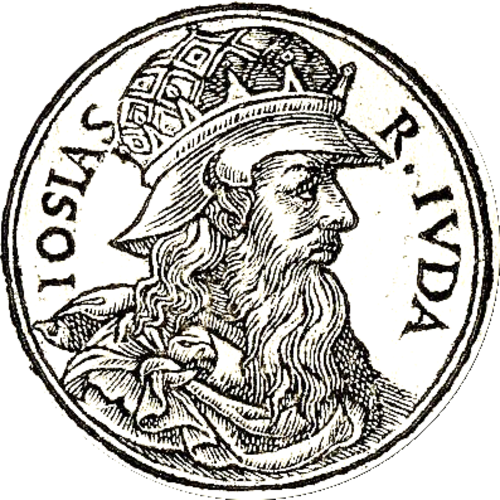
The Holy Right-Believing Josiah was the sixteenth king of Judah, a righteous king who cleansed the land of idols, found the Book of the Law and renewed the covenant of the people with the Lord. He reigned at Jerusalem for thirty-one years, in the time of the prophets Jeremiah and Zephaniah, between about 640 and 609 before Christ. Scripture gives him a praise that no other king of Judah receives. The Orthodox Church commemorates him on the Sunday of the Holy Forefathers of the Lord, before the Nativity, because his name stands in the genealogy of Christ.
The boy king
Josiah was the son of King Amon and of Jedidah, daughter of Adaiah of Bozkath. His grandfather Manasseh had been a king who filled Jerusalem with idols and even turned the temple into a place of worship of pagan gods, although near the end of his life he repented. His father Amon was killed by his servants after only two years of reign. The people of the land punished the murderers and made Josiah king, when he was eight years old.
Scripture says of him that he did what was pleasing to the Lord and walked in all the ways of David his father, turning aside neither to the right nor to the left (4 Kings 22:2).
Turning to the Lord
The Second Book of Chronicles tells that in the eighth year of his reign, while he was still young, Josiah began to seek the God of David. In the twelfth year he began to cleanse Judah and Jerusalem of the high places, the Asherim, the carved and molten images, and he broke down the altars of Baal. His work extended also to the northern lands, to the cities of Manasseh, Ephraim, Simeon and as far as Naphtali.
The Book of the Law
In the eighteenth year of his reign Josiah ordered the temple to be repaired, using the money gathered from the people. During the work the high priest Hilkiah found in the temple the Book of the Law of the Lord, given through Moses. The scribe Shaphan read it before the king. Hearing its words, Josiah tore his clothes and sent to seek the counsel of the Lord through the prophetess Huldah, who lived at Jerusalem. She declared that the calamities written in the book would come upon the land, but not in his days, because his heart had been tender and he had humbled himself before the Lord.
Then the king gathered the elders of Judah and Jerusalem, went up to the temple with all the people and read in the hearing of all the words of the book of the covenant. Standing by the pillar, he made a covenant before the Lord to walk after Him and keep His commandments with all his heart and all his soul. All the people joined in the covenant.
The reform and the Passover
Then Josiah brought out of the temple all the vessels made for Baal, for Asherah and for the host of heaven, removed the idolatrous priests, and defiled the place called Topheth, in the valley of Ben-Hinnom, where sons and daughters were passed through the fire in honour of Molech. He went to Bethel and destroyed the altar made by Jeroboam, burning the bones of the idolatrous priests on it. This fulfilled the word spoken nearly three hundred years before by a man of God from Judah, who had cried out that a son named Josiah would be born in the house of David (3 Kings 13:2). The king ordered the tomb of the man of God, and of the prophet who had buried him, to be left in peace.
Then he commanded the people to keep the Passover of the Lord in Jerusalem, as it is written in the Book of the covenant. The books say that no Passover like that one had been kept since the days of the judges, and even since the time of Samuel. The king himself gave the people thousands of animals for the sacrifice. The Book of Kings closes with the words that before him there was no king like him, who turned to the Lord with all his heart, all his soul and all his might, and after him none arose like him (4 Kings 23:25).
The end at Megiddo
According to Scripture, in 609 before Christ Pharaoh Necho set out with a great army toward the Euphrates, to help the Assyrians against Babylon. Josiah went out to meet him at Megiddo. The Book of Chronicles says that Necho sent messengers to say that he was not coming against him and that God had sent him, but Josiah did not listen. Struck by archers, he was brought to Jerusalem and died there. The Book of Kings says briefly that Necho killed him at Megiddo and that his servants brought his body in a chariot to Jerusalem. He was buried in the tomb of his fathers, and all Judah and Jerusalem mourned him. Jeremiah composed a lament for him.
After his death the people made his son Jehoahaz king, then his successors, Jehoiakim and Zedekiah, led the land toward the ruin of which the prophetess had spoken. The Gospel of Matthew names Josiah in the genealogy of the Lord, as the father of Jechoniah.
Veneration
For his faithfulness to the Law of the Lord the Church numbers him among the righteous of the Old Testament and remembers him on the Sunday of the Holy Forefathers. Scholars today hold that his reform left deep marks on the writings of the Old Testament, especially Deuteronomy and the historical books, but they discuss its extent and the time at which those books were written.