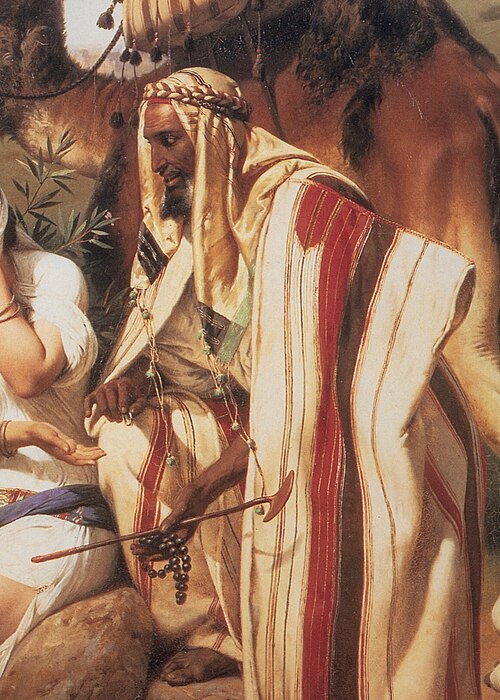
Righteous
Judah
Son of Jacob
Fourth son of Jacob and Leah, from whose line the Lord Jesus Christ descends.
- Born
- 1566 BC15th century BC
- Place
- Paddan Aram
- Order
- The Righteous
Life
Judah was, according to the book of Genesis, the fourth son of Jacob and Leah, the ancestor of the tribe of Judah, from which the Lord Jesus Christ descends according to the flesh. His name is linked with the names of Judea and of the Jews. The Church remembers him among the ancestors of Christ, on the Sunday of the Holy Forefathers, before the Nativity of the Lord.
His name and birth
The Hebrew name Yehudah means "praise" or "thanksgiving". Leah, when she bore him, said: "This time I will praise the Lord" (Genesis 29:35). He was born in Paddan-Aram, where Jacob served his uncle and father-in-law Laban. He was the grandson of Isaac and the great-grandson of Abraham. His full brothers were Reuben, Simeon and Levi, who were older, and Issachar and Zebulun, who were younger, and their sister was called Dinah.
When Simeon and Levi took vengeance on Shechem for Dinah, Judah did not take part with his brothers.
Judah and Joseph
When the brothers plotted to kill Joseph, the beloved of their father, Judah said: "What profit is it if we slay our brother and conceal his blood?" He proposed to sell him to the Ishmaelite traders on their way to Egypt, and the brothers agreed. Joseph was sold, and the brothers brought their father his bloodied coat.
Later, when the brothers went down to Egypt for grain, Joseph, whom they did not recognize, demanded that Benjamin, the youngest, be brought. Judah became surety to Jacob for Benjamin, saying that he himself would bear the blame if he did not bring him back.
Judah and Tamar
Genesis 38 tells that Judah separated from his brothers, settled near an Adullamite named Hirah, and married the daughter of a Canaanite, Shua. By her he had three sons: Er, Onan and Shelah. Er, the husband of Tamar, died; Onan also died, since he would not give offspring to his brother. Judah then put off the marriage of Tamar to Shelah, fearing for his life.
Tamar veiled her face and sat by the road, and she conceived by her father-in-law, who did not recognize her. When Judah learned the truth, he said: "She is more righteous than I." From Tamar were born the twins Perez and Zerah. From Perez descends David and, through him, the Lord Jesus Christ. The Gospel of Matthew mentions Tamar at the beginning of the genealogy of the Lord.
The intercessor
When Joseph proposed to keep Benjamin as a slave, Judah came near and said: "Please let your servant remain instead of the boy as a slave to my lord, and let the boy go up with his brothers. For how shall I go up to my father if the boy is not with me?" These words show that his soul had changed. Christians have seen in them a foreshadowing of the sacrifice of Christ for all. After this Joseph made himself known to his brothers.
On the way to Goshen, Jacob sent Judah ahead of him to Joseph. From Judah descend Nahshon, Boaz and David.
Jacob's blessing
Before his death Jacob blessed Judah: "Judah is a lion's whelp. The sceptre shall not depart from Judah, until He comes to whom it belongs" (Genesis 49:8 to 12). The Church has understood these words as a prophecy about Christ, the Lion of the tribe of Judah, as He is called in the Apocalypse. The symbol of the tribe of Judah is the lion.
His descendants made up one of the twelve tribes of Israel, one of the most numerous. It received the first lot at the division of the Promised Land. From the name of Judah come the name of the region of Judea and of the kingdom of Judah, as well as the name of the Jews.
Scripture says nothing about the end of his life. In the Orthodox Church Judah is remembered on the Sunday of the Holy Forefathers, before the Nativity of the Lord, and on the following Sunday, that of the Holy Fathers.