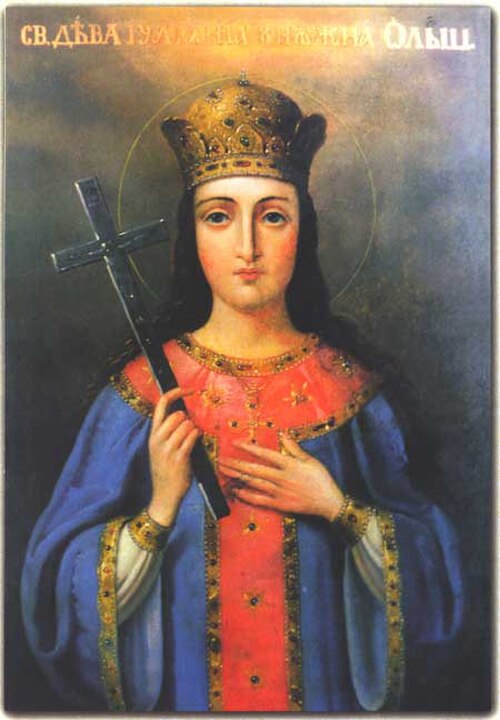
Right-Believing
Juliana of Olshanka
Princess of the Olshansky family
Ukrainian princess of the Olshansky family, born around 1525, who died young.
- Feast
- July 6old style July 19
- Reposed
- 156616th century
- Place
- Kyiv
Life
Saint Juliana (Iuliania) Olshanskaya, the Righteous, in the world Juliana Yuryevna, was a princess of the Olshansky-Dubrovitsky family, a virgin who died at sixteen, honoured as a saint in the Kyiv Caves Lavra, where her relics are kept in the Near Caves. The years of her birth and death are not known with certainty: the sources give 1534 to 1550 or 1550 to 1566, or speak of a death around 1540, and we know only that she died no later than 1566. Her commemoration is on 6 July (19 July in the new calendar), and the sources give other days too.
Family and life
She was born in the family of Yuri (George) Olshansky of Dubrovitsa, one of the most generous benefactors of the Kyiv Caves Lavra, a known military commander who fought the Tatars many times. The Olshansky family was one of the most distinguished of the Grand Duchy of Lithuania, related to the Gediminids. The family bore the name of the estate at Olshany (now in the Grodno region, Belarus). From the beginning of the fifteenth century the Volhynian branch was called Dubrovitsky (Dombrovsky), after the town of Dubrovitsa, now in the Rivne region of Ukraine. A relative of the Saint was Sophia Olshanskaya, queen of Poland, fourth wife of King Jagiello, founder of the Jagiellonian dynasty. Her father, Yuri Ivanovich Olshansky, was a high dignitary and benefactor of the Lavra, and his name was entered in the old commemoration book of the Caves. The family's piety is attested by the father's will, by which six monasteries and sixteen great churches of Kyiv, Vilnius, Lutsk and Vladimir received gifts, and his sons were bidden to build a new church.
Juliana lived a short life and died at sixteen, as a virgin. The princess's body was buried near the Lavra. Her life attributes to her virtues suited to her age, sex and rank: chastity, obedience to her parents, kindness toward those of lower rank and, above all, works of Christian charity. In her short earthly life the young girl showed high Christian qualities, keeping God's commandments.
The finding of the relics
At the beginning of the seventeenth century (in the time of Archimandrite Yelisei Pletenetsky, 1599 to 1624), at Kyiv, beside the great cathedral church of the Lavra, a grave was being dug for a deceased girl and a coffin was struck. To it was fixed a silver plate with the inscription: "Iuliania, Princess Olshanskaya, daughter of Prince George Olshansky, who fell asleep a virgin in the sixteenth year of her birth", and on the stone were also the Olshansky arms. When the coffin was opened, the princess was seen incorrupt, clothed in costly silks and cloth of gold, with a crown of gold beads and gold earrings with stones. The coffin with the body was then carried into the church. It is told that once a deceiver came to the church, an Arian named Basil, who pretended piety and asked leave to venerate the relics of Saint Juliana. He was allowed to open the shrine and kiss her hand. Leaving the church, he began to shout in a dreadful voice and fell dead. When his body was examined, it was seen that he had taken the ring from the princess's finger. The ring was placed by Pletenetsky beside the holiest relics of the church, at the icon of the Mother of God. From then the Church began to venerate Juliana.
Abbot Theodosius Safonovych of the Saint Michael monastery in Kyiv, visiting, viewed the relics, and later said that the Saint appeared to him in a vision and made him pray with more devotion. The Saint also appeared to an abbot of Saint Michael's, saying: "I am Juliana, whose relics lie in the church of the Caves. But you regard my relics as of no account. For this reason the Lord sends you a sign, that you may understand that I have been numbered by the Lord God among the holy virgins who were pleasing to Him." From then her veneration grew. At her shrine many miracles and healings were wrought.
In the time of Metropolitan Peter Mohyla (1633 to 1646) a new shrine was made for the relics, because the Saint appeared in a dream to the archimandrite, rebuking him for his little faith and neglect of her relics. Then the inscription was placed on her tomb: "By the will of the Maker of heaven and earth Iuliania lives through all the years, helper and great intercessor in heaven. Here the bones are a remedy against all sufferings… With yourself you adorn the dwellings of paradise, Iuliania, like a beautiful flower." An epitaph on the gravestone is also recalled by Afanasy Kalnofoysky.
The relics were partly burned in the fire of 1718 at the Caves Lavra, and the remains were put in a shrine and placed in the Near Caves. By order of Empress Anna Ioannovna they were moved there in 1730. Juliana is one of the two holy virgins buried in the caves of the Lavra; until 1910 the relics of Saint Euphrosyne of Polotsk also rested there. Her miracles are described in a book, perhaps written by Saint Demetrius of Rostov, "The Tale of the Finding of the Honourable Relics of Saint Juliana Olshanskaya" (Lavra, 1705).
Veneration
The Church honours her as the first helper of Orthodox women in healing ailments of the soul and as protector of innocent virgins. On icons she is shown in the synaxis of the Venerable Fathers of the Kyiv Caves Lavra. The sources give varied days of commemoration: 6 (19) July, her individual commemoration; 4 (17) June; 28 September (11 October), in the synaxis of the Venerable Fathers of the Near Caves; and 10 October, in the synaxis of the saints of Volhynia. In 2005 a monument in her honour was opened at Dubrovitsa, in the Rivne region.
Commemorated the same day July 6
 Sisoes the GreatVenerable · Hermit in EgyptJul 6
 Sexburga of ElyVenerable · Abbess of ElyJul 6
 Quirinus of TegernseeMartyr · Martyr of RomeJul 6
 Romulus of FiesoleSaint · Bishop of FiesoleJul 6
 Dorotheus of RadonezhVenerable · Monk of St Sergius LavraJul 6
 Sisoes the SchemamonkVenerableJul 6
- Euthymius LyubovichevVenerable Martyr · Hieromonk of OptinaJul 6
 Vassian RyloSaint · Archbishop of RostovJul 6
- Dometios the MercifulVenerable · Archimandrite of RâmețJul 6
- Ferapont of BorovenskVenerable · Hieromonk and monastery founderJul 6
 Michael II of SmolenskSaint · Bishop of SmolenskJul 6
- Philotimia of RâmețVenerable · Nun of Râmeț MonasteryJul 6