Saint
Julius of Novara
Missionary priest in northern Italy
Missionary priest in northern Italy who died in 401; his cult centers on the island of San Giulio in Lake Orta.
- Feast
- January 31old style February 13
- Reposed
- 3904th century
- Place
- Isola San Giulio
Life
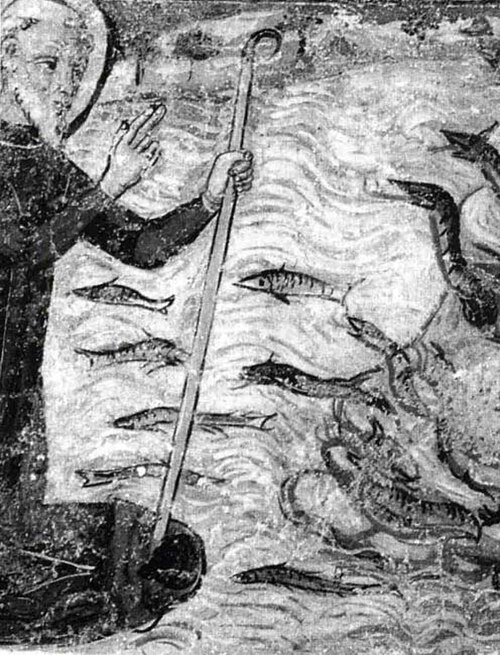
Saint Julius of Novara, also called Julius of Aegina or Julius of the island of Orta, was a missionary priest in northern Italy, who died in the year 401 (according to some notes 390). His cult is centred at Lake Orta in the Novarese highlands, above all on the island that has borne his name since at least the eighth century, Isola San Giulio, where his presumed relics are kept in the crypt (the "scurolo") of a basilica dedicated to him. He is commemorated on 31 January, and the Serbian Orthodox Church commemorates him with Julian on 21 June by the old calendar (4 July by the new).
Few facts are known about his life. The earliest Life, from the eighth century or later, is as much legend as history, and tells his life interlaced with that of his brother Julian (Giuliano), a deacon. Their names are so similar that it was thought they might be the same person, but recent archaeological finds in the former parish church of San Lorenzo at Gozzano show that both existed. The Roman Martyrology commemorates only Julius. It has been said that his name was recited in the Ambrosian Rite in the fifth and sixth centuries, but it has also been claimed that this Julius was Pope Julius I. Julius and Julian may have been Greeks who came to Rome before settling at Lake Orta. The Russian sources say they were from the island of Aegina, and the Serbian from the Greek region of Myrmidonia. Their legend says they were brought up in the Christian faith by their parents, with a vow to live always in virginity and serve the Church: Julius was a priest and Julian a deacon. From Emperor Theodosius (the Great in one source, the Younger in another) they are said to have received the order, or the permission, to destroy pagan altars and sacred groves and build Christian churches throughout the empire. According to their tradition they built one hundred churches. The ninety-ninth, at Gozzano, was dedicated to Saint Lawrence, and Julian was buried there. The hundredth was built by Julius on the island that bears his name, and he dedicated it to Saints Peter and Paul. Like two apostles, the brothers brought many unbelievers to Christianity in the East and West of the empire. According to the Serbian source they died near Milan, and the people of Milan call on Saint Julius for help against wolves.
Commemorated the same day January 31
 Marcella of RomeVenerableJan 31
 Cyrus and JohnHoly Unmercenary Healers · Unmercenary physiciansJan 31
 Nicetas the RecluseSaint · Bishop of NovgorodJan 31
 Máedóc of FernsSaint · First Bishop of FernsJan 31
 Cyrus of AlexandriaUnmercenary · Unmercenary physicianJan 31
 TryphaenaMartyr · of CyzicusJan 31
- Metras of AlexandriaMartyrJan 31
- Elias ArdounisNew MartyrJan 31
- AdamnanVenerableJan 31
- Athanasia of CanopusMartyrJan 31
- Bobinus of TroyesSaint · Bishop of TroyesJan 31
- Cainneach son of UaVenerableJan 31