Martyr
Justus of Trieste
Martyr of Trieste
Martyr of Trieste, put to death in the Diocletian persecution and honored as patron of the city.
- Feast
- November 2old style November 15
- Reposed
- 3034th century
- Place
- Trieste
- Order
- Martyrs
Life
Saint Justus the Martyr was a citizen of Trieste in Italy, put to death for the Christian faith in the time of the persecution of Diocletian, according to tradition on 2 November 293. He is the patron of the city and diocese of Trieste. He is venerated in the Orthodox and Roman Catholic Churches. The Church remembers him on 2 November.
According to the account of his martyrdom he was known for his works and almsgiving. When fellow citizens accused him of being a Christian, he was tried by Roman law. Because he refused to sacrifice to the Roman gods, he was found guilty of sacrilege and sentenced to death by drowning. According to a local tradition he was thrown from a small boat into the Gulf of Trieste, off the present promontory of Sant'Andrea. On the night of his death the presbyter (or bishop) Sebastian learned in a dream that Justus's body had been washed ashore despite the weights meant to hold it down. Sebastian gathered the faithful and they searched for the body, which they found at the place now called Riva Grumula. Justus was buried not far from the shore where he was found.
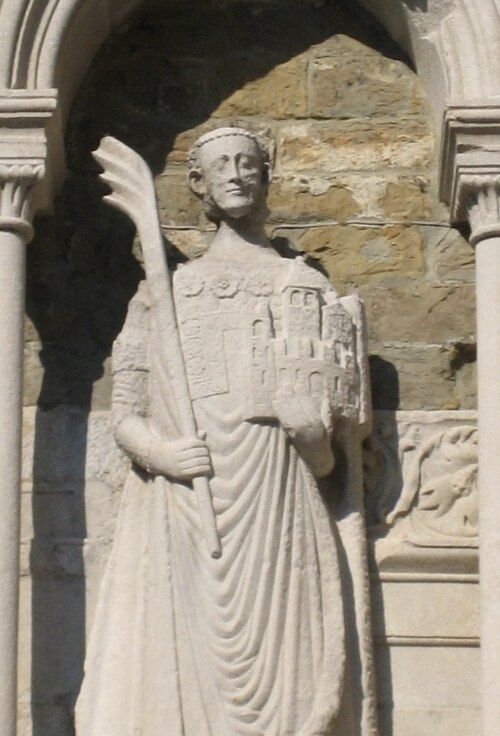
In late antiquity the area near Piazza Hortis was a cemetery, and it is likely that the former basilica of the Holy Martyrs was built over his tomb. In the Middle Ages his body was moved to a chapel beside the church of the Mother of God, attested from the sixth century. When, in the tenth or eleventh century, the chapel was joined to the church, the cathedral, dedicated to the Mother of God, came to be called the Cathedral of Saint Justus. He is also patron of Albona in Istria, San Giusto Canavese and Misilmeri in Sicily. In 1918, on his feast day, the destroyer Audace was the first Italian ship to enter the port of Trieste. The earliest depictions of him are at Trieste: the silk icon in the cathedral treasury, the twelfth-century mosaic in the left apse, the Romanesque statue on the bell tower and the frescoes discovered in 1959.
Commemorated the same day November 2
 Victorinus of PettauHieromartyr · Bishop of PoetovioNov 2
- Acindynus of PersiaMartyrNov 2
- Aedh of FoibrenSaintNov 2
- Aedhan of Cill Mor AedhainSaintNov 2
- Ainmire of Rath NuadhaVenerableNov 2
- AmbroseVenerableNov 2
- AmbrosiusVenerable · Monk of Saint-Maurice AbbeyNov 2
- Amicus of CamerinoVenerableNov 2
- Ananias AristovHieromartyrNov 2
- Anempodistus of PersiaMartyrNov 2
- Anthony the ConfessorConfessorNov 2
- AphthoniusMartyr · Martyr of PersiaNov 2