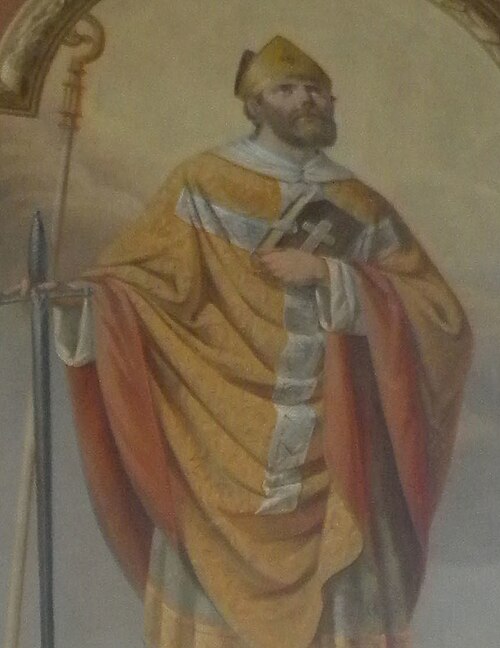
Hieromartyr
Victorinus of Pettau
Bishop of Poetovio
Bishop and commentator on Scripture, killed in the persecution of Diocletian around 303.
- Feast
- November 2old style November 15
- Reposed
- 3034th century
- Place
- Ptuj
- Order
- Martyrs
Life
The holy hieromartyr Victorinus was bishop of Poetovio, today Ptuj, in Pannonia, and an interpreter of Holy Scripture, killed in the persecution of Diocletian, around the year 303. He is commemorated on 2 November.
His life
Victorinus was born, it seems, in Roman Greece, on the border between the two halves of the empire, or at Poetovio, a city of mixed population. He spoke Greek better than Latin, and for that reason, according to Saint Jerome, his writings in Latin are more remarkable for their content than for their style. He was the first theologian to use the Latin language for the interpretation of Scripture. Jerome gives him a place of honour in his catalogue of church writers, but judged that he had been touched by the views of the chiliasts, who awaited a thousand-year rule on earth. Also according to Jerome, he died as a martyr in 304.
His writings
His works are mostly commentaries on Scripture: on Genesis, Exodus, Leviticus, Isaiah, Ezekiel, Habakkuk, Ecclesiastes, the Song of Songs, Matthew and the Apocalypse, as well as writings against heresies, among them Against All Heresies. Of all these only two have come down to us: the Commentary on the Apocalypse and the short treatise On the Construction of the World. Victorinus was much influenced by Origen and made use of the writings of Greek authors, among them Papias of Hierapolis and Irenaeus of Lyons. His commentary on the Apocalypse was written around 260, after the persecution of Valerian, and is chiefly allegorical in understanding. Victorinus sees in the four living creatures the Gospels and in the twenty-four elders the twelve tribes and the twelve apostles, and in the harlot of Babylon, Rome persecuting the Christians.
In the sixth century the Gelasian Decree, attributed to Pope Gelasius, placed his writings among those to be avoided. Until the seventeenth century he was sometimes confused with the Latin rhetorician Victorinus Afer. The Church commemorates him as a shepherd who ended his life for Christ.
Commemorated the same day November 2
 Justus of TriesteMartyr · Martyr of TriesteNov 2
- Acindynus of PersiaMartyrNov 2
- Aedh of FoibrenSaintNov 2
- Aedhan of Cill Mor AedhainSaintNov 2
- Ainmire of Rath NuadhaVenerableNov 2
- AmbroseVenerableNov 2
- AmbrosiusVenerable · Monk of Saint-Maurice AbbeyNov 2
- Amicus of CamerinoVenerableNov 2
- Ananias AristovHieromartyrNov 2
- Anempodistus of PersiaMartyrNov 2
- Anthony the ConfessorConfessorNov 2
- AphthoniusMartyr · Martyr of PersiaNov 2