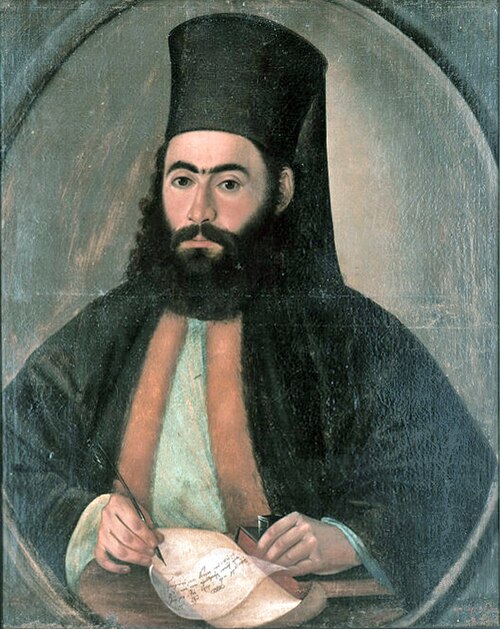
Hieromartyr
Kyprianos of Cyprus
Archbishop of Cyprus
Archbishop of Cyprus in the early 19th century, martyred in 1821 as the Greek revolution began.
- Reposed
- 182119th century
- Place
- Nicosia
- Order
- Martyrs
Life
Kyprianos of Cyprus was Archbishop of New Justiniana and All Cyprus from 1810 to 1821, one of the most important primates of the Church of Cyprus under Ottoman rule. He was hanged by the Turks in Nicosia on 9 July 1821, as the Greek Revolution broke out, together with the other hierarchs of the island and hundreds of leading Cypriots. Cypriots honour him as a hieromartyr and national martyr, and historians describe him as a man of broad vision, energy and wide learning.
Childhood at Machairas
He was born in 1756 at Strovolos, then a village and today a suburb of Nicosia. His parents were named George and Maria, but his father's surname and the name Kyprianos bore in the world have not been preserved.
At the age of seven he followed his maternal uncle, the hieromonk Charalambos, to the Monastery of the Mother of God at Machairas, where he received his first schooling. A pupil of the scholar Eugenios Voulgaris also taught there. Kyprianos later said that under his uncle's guidance he grew up and was spiritually reborn, learning obedience, poverty and chastity, the first virtues of monastic life.
From 1769 he lived at the monastery's dependency in Strovolos and for three years attended the archdiocesan school in Nicosia, known as the "Hellenic Museum", housed in the old archbishopric building. He then returned to the monastery and was ordained deacon at about the age of 25 to 27. The sources give 1781 or 1783 for his ordination.
The years in Moldavia
The Machairas monastery was weighed down by heavy debts, and Abbot Ioannikios sent Kyprianos' uncle, Archimandrite Charalambos, then steward of the monastery, to collect alms in the Danubian Principalities. Kyprianos went with him on this journey, which began in 1783, or in 1784 according to other sources. Charalambos returned after two years, but Kyprianos remained in Moldavia.
At the initiative of the Phanariot prince Michael Soutsos he was ordained priest and served at the princely church in Iași, according to some sources the Church of the Three Hierarchs. With the prince's support he studied theology and Greek philology at the Princely Academy of Iași, concentrating especially on church history.
He did not forget his monastery. In 1795, at the urging of Charalambos and Kyprianos, the prince issued a chrysobull granting the Machairas monastery an annual subsidy. In the same year the two obtained for the monastery a sigillion from Ecumenical Patriarch Gerasimos III, himself a Cypriot.
Return to Cyprus
In 1802, after almost twenty years, Kyprianos returned to Cyprus with Charalambos, their mission accomplished. He was put in charge of the dependency at Strovolos, today the Church of the Panagia Chrysaliniotissa, and worked there so well that the notables of Nicosia recommended him to Archbishop Chrysanthos as steward of the archdiocese. He became close to the archbishop and to the dragoman Hadjigeorgakis Kornesios.
In 1804 he founded in Nicosia a dependency of the Machairas monastery, whose church was consecrated in 1806 to the Hieromartyr Eleutherios and Saint Stylianos. For a long time he hid the building of the church from the Turks, telling them he was putting up a granary for wheat.
In March 1804, amid food shortages and rising taxes, the Turks of the capital and the surrounding villages rose up, seized Nicosia, killed Christians and threatened the life of the aged Archbishop Chrysanthos. The Ottoman government sent some 2,000 soldiers to besiege the city. Kyprianos mediated, together with the consuls of France, Britain and Russia, between the sultan's troops and the rebels inside the walls, and helped bring about peace. In this way he protected the Christians, rescued the archbishop from the enraged crowd and saved the archiepiscopal residence from plunder. An English traveller writing as Ali Bey called him "the saving angel of his nation".
These troubles nevertheless left a heavy burden on the Christians, who were made to bear the cost of the troops, and the debt of the archdiocese rose from one and a half to two million piastres.
Election as archbishop
In the last years of Archbishop Chrysanthos, who was ill and immobile, the actual government of the Church of Cyprus passed into the hands of Kyprianos. The old hierarch would not give up his see, and the other metropolitans, Chrysanthos of Paphos and Chrysanthos of Kition, were his relatives. The opposition, to which Kyprianos belonged, appealed to the Ecumenical Patriarchate and the Sublime Porte.
In May 1810 the sultan ordered the archbishop into exile, and he was sent to Chalkis on Euboea together with his nephew, the metropolitan of Kition. A senior Ottoman official then demanded that Kyprianos be consecrated archbishop. Judging that an appointment imposed by the secular power violated church order, Kyprianos declined it and waited for the decision of the Patriarchate of Constantinople.
After the elderly Chrysanthos died in exile and the Patriarchate gave its approval, Kyprianos was consecrated on 30 October 1810 as Archbishop of New Justiniana and All Cyprus. The consecration was performed by Archbishop Constantius of Sinai together with the other bishops then in Cyprus. Some sources also mention an episcopal ordination in 1809.
Pastoral work
He inherited an archdiocese with ruined finances and debts of more than three million piastres. He nevertheless managed to restore them, to bring peace to the Church and to face serious social problems. He regained the right to collect taxes, which his predecessors had lost, cut the costs of collection and moved the upkeep of the tax collectors onto the administration, lightening the burden on taxpayers. In a letter of 7 February 1812 the consuls at Larnaca congratulated him on taking over tax collection for the relief and benefit of all the inhabitants.
In 1811-1812 he founded the "Hellenic School" in Nicosia, opposite the archbishopric, today the Pancyprian Gymnasium, the first school of its level on the island. He pressed for a broader curriculum that included Greek language and literature. He also supported the school in Limassol: in 1819 he pledged it 500 piastres a year, in 1820 he gave 6,000 piastres for its building, and he enlisted donors among the town's notables.
He helped the monasteries as well. In 1813 he gave the Machairas monastery an estate at Tymbou and lands in the village of Prastio on the Mesaoria plain. He assisted Kykkos Monastery after the fire of 1813, the monastery of Saint Neophytos the Recluse near Paphos and that of the Apostle Barnabas near Famagusta. He endowed churches such as Saint Thekla at Mosfiloti and Saint Sabbas in Nicosia with books, icons and sacred vessels.
In his time Cyprus suffered a great plague of locusts that threatened the harvest of the whole island. The archbishop wrote a pastoral letter rebuking the popular belief that the locusts were immortal and urging the faithful not merely to wait for a miracle but to act to destroy them. In 1820-1821 he had hundreds of icons of the Martyr Tryphon, protector of the fields, painted and distributed to the churches of the worst affected districts. More than a hundred survive today. In another circular, of 2 February 1815, he condemned Freemasonry and declared Freemasons cut off from the Church.
The Philiki Etaireia
In 1818 the merchants Sterios Hadjikostas and Dimitrios Ipatros, members of the Egyptian and Cypriot branch of the Philiki Etaireia, the secret society preparing the liberation of the Greeks from Ottoman rule, came to Nicosia. The archbishop, other clergy and leading Cypriots joined the society. Neither the date of his initiation nor the person who initiated him is known, and his correspondence on the matter has not survived, a sign that he himself destroyed every trace. Members of the society visiting Cyprus were lodged as students in the basement of the Hellenic School.
In 1820 Alexander Ypsilantis asked him through his envoys whether Cyprus would join the armed struggle. Kyprianos replied realistically: the island, isolated and far from mainland Greece, had neither a navy nor the fighting tradition of the klephts found in other Greek lands, and a rising would end in tragedy. He promised instead help in money and supplies. The society's general plan of 1820 recorded that the Archbishop of Cyprus had promised money and provisions and was to consider how to protect his flock.
In October 1820, after the archbishop had made a substantial contribution, Ypsilantis sent him through Antonios Pelopidas a letter of thanks announcing that "the opening of the school" was near. By this he meant the beginning of the Revolution.
The year 1821
At the end of February 1821 Ypsilantis crossed the Prut and raised Moldavia and Wallachia, and on 25 March the Peloponnese rose. Reprisals against the Greeks followed throughout the Ottoman Empire, and on Easter day, 10 April, Patriarch Gregory V was hanged in Constantinople.
In Cyprus the sultan ordered the Christians disarmed. The archbishop tried to shield his people from massacre: in a circular of 22 April he urged Cypriots to hand over their weapons, and in one of 16 May to act with great caution so as to give no pretext for reprisals. He assured the pasha, Küçük Mehmet, of the submission of the Greeks. Even so, many Cypriots secretly left to fight in Greece, and Archimandrite Theophylaktos Theseus, the archbishop's nephew, distributed proclamations at Larnaca calling them to arms. The archbishop had no part either in these proclamations or in the shipping of gunpowder.
Küçük Mehmet called in reinforcements, seized weapons and arrested many notables. He drew up a list of 486 Greek Cypriots he intended to kill: the archbishop, the metropolitans, abbots of monasteries, priests, notables and village elders. The Sublime Porte approved the plan, along with the confiscation of the victims' property and the sale of their wives and children into slavery.
His friends urged the archbishop to flee the island or take refuge in the consulates of the European powers. He refused, wishing to stay with his people to the end and to offer himself for them. In early July the Turks captured a shepherd, Hadji Petros, carrying a letter from the Etaireia. According to some sources the pasha three times offered the archbishop his life if he would renounce the Christian faith, but Kyprianos rebuked his cruelty and injustice.
Martyrdom
On Saturday 9 July 1821 the hierarchs and notables of the island were summoned to an assembly in Nicosia, and the gates of the walled city were shut. That day 470 leading Cypriots were put to death by beheading or hanging. Metropolitans Chrysanthos of Paphos, Meletios of Kition and Lavrentios of Kyrenia were beheaded. Archbishop Kyprianos was publicly hanged from a mulberry tree in the square before the Serai, the former palace of the Lusignan kings of Cyprus.
Among those killed that day were two of the archbishop's brothers, Hadji Savvas, steward of the archdiocese, and the protosyncellus Lavrentios. According to some sources the heads of the hierarchs were sent to the sultan. In the following months thousands of Christians perished on the island. The Swedish traveller Berggren wrote that the city was in mourning and that many houses were spattered with blood.
The events were sung by the poet Vasilis Michaelides in the epic poem "The Ninth of July 1821", written in the Cypriot dialect and counted among the chief works of Cypriot literature.
Veneration
The bodies of the martyrs were buried behind the altar of the Church of the Panagia Phaneromeni in Nicosia. After the church was rebuilt in 1873 their remains were placed in a stone tomb beneath the altar. In 1930 a mausoleum of Pentelic marble was raised beside the church, and in its crypt rest Archbishop Kyprianos and Metropolitans Chrysanthos, Meletios and Lavrentios. Cypriots commemorate them every year on 9 July as hieromartyrs of the nation, and the Pancyprian Gymnasium he founded still stands opposite the archbishopric.