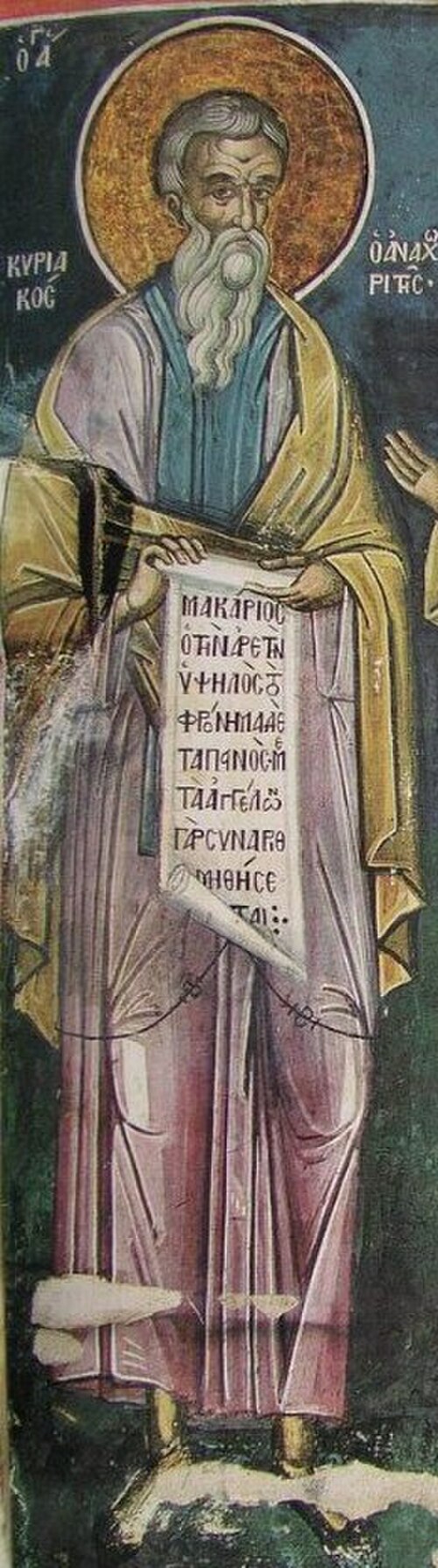
Venerable
Kyriakos the Anchorite
Hermit of the Judean desert
Greek monk and hermit venerated as a venerable, who by tradition lived from 448 to 557.
- Feast
- September 29old style October 12
- Reposed
- 5576th century
- Order
- Venerables
Life
Venerable Kyriakos the Anchorite was a Greek monk and hermit of the Judean desert, who according to tradition lived from 448 to 557, that is, a hundred and nine years. The Church remembers him on 29 September (12 October on the new calendar).
He was born at Corinth, to the priest John and Eudoxia. A relative of his, Bishop Peter of Corinth, made him a reader in the church. Before he turned eighteen he heard at a service the words of the Gospel of Matthew 16:24 (“If any man will come after me, let him deny himself, and take up his cross, and follow me”), and they moved him so deeply that, instead of going home, he went to the harbour, boarded a ship and sailed for Jerusalem. After visiting the holy places he stayed several months in a monastery near Sion, under the abbot Eustorgius. With his blessing he went to the lavra of Euthymius the Great, in the wilderness. Euthymius tonsured him and placed him under the guidance of Gerasimus, at the Jordan, in the monastery of Theoctistus. Gerasimus saw that Kyriakos was still young and had him live in community with the brethren. He took to the monastic obediences: he prayed fervently, slept little, ate only every other day, feeding on bread and water. After the death of Gerasimus, Kyriakos, aged twenty-seven, wished to return to the lavra of Euthymius, but Euthymius had died, so he asked for a solitary cell, in which he struggled in silence. For ten years he lived in complete silence, speaking only with the monk Thomas, who was sent to Alexandria as bishop. At thirty-seven he was ordained deacon.
When a split arose between the monasteries of Euthymius and of Theoctistus, Kyriakos withdrew to the Souka lavra of Chariton. He was ordained priest and was canonarch for eighteen years, and he spent thirty years at the monastery of Chariton. Strict fasting and prayer distinguished him even among the ascetics of the lavra. In his cell he read the Psalter each night, interrupting the reading only to go to church at midnight. He slept very little. At seventy he went to the Natoufa wilderness, taking his disciple John. In the desert the hermits fed only on bitter herbs, which, according to the life, became edible through the saint's prayer. One day the disciple again boiled the herb brew without the elder's command and it came out so bitter that the disciple lost his speech; Kyriakos prayed, gave him communion and healed him. He explained to the disciple that God worked miracles when they had nothing to eat, but now that they had bread, the miracle did not happen. When the bread ran out they again ate bitter herbs, which again became sweet. A man from Pheoukas brought his demon-possessed son, and Kyriakos healed him. From that moment many began to come to the monk with their needs, but he wanted complete solitude and fled to the Rouva wilderness, where he stayed five years more. But the sick still came, and he helped as he could.
At eighty he fled to the hidden Sousakim wilderness, through which two dried-up streams passed. The brethren of the Souka monastery came to him seven years later, begging for spiritual help in a time of famine and disease. After his intervention seemed to improve things, they wished him to return to the monastery, so he settled in a cave where Chariton had once lived. He worked against the Origenist movement: by prayer and by word he led many to abandon it for a strengthened Orthodox faith. According to tradition the Mother of God appeared to him to strengthen him in his struggle against Origenism. After the deaths of Nonnus and Leontius, which he is said to have foretold, the movement ceased to spread. His biographer relates that he was large and strong in body, even in deep old age, despite fasting and vigils; he said of himself that since he became a monk the sun had never seen him eating or angry with anyone. At ninety-nine he again went to Sousakim with his disciple John. This period is full of legends about his saving people from lions or his prayers bringing rain. For the last two years of his life he returned to the monastery, again settling in the cave of Chariton, ceaselessly at prayer and work. Before his death he summoned the brethren and blessed them all. He fell asleep in 557 and was buried at the monastery of Chariton. Among the Serbs his feast is known as Miholjdan, the end of the grape harvest, and is celebrated as a slava.
Commemorated the same day September 29
 John of RigaHieromartyr · Archbishop of Riga and MitauSep 29
 Cyprian of UstyugVenerable · Founder of the Archangel Michael MonasterySep 29
 GabdelasMartyr · Martyr of PersiaSep 29
- 150 MartyrsHoly MartyrsSep 29
- AlaricSaintSep 29
- Alaric of EinsiedelnVenerableSep 29
- Catholdus and CompanionsHoly VenerablesSep 29
- ColmanSaintSep 29
- ColummSaintSep 29
- ComghallSaintSep 29
- Dadas of PersiaMartyrSep 29
- Dionysius ISaint · Patriarch of ConstantinopleSep 29