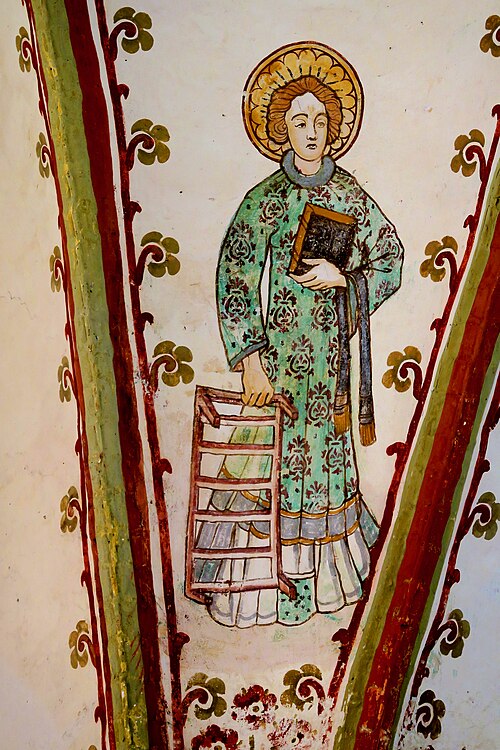
Hieromartyr
Lawrence of Rome
Archdeacon of Rome
One of the seven deacons of Rome under Sixtus II, killed for his faith in 258.
Life
Lawrence of Rome was the archdeacon of the Church of Rome, one of the seven deacons of Rome under Pope Sixtus II, killed for the faith in the persecution of the emperor Valerian on 10 August 258. His name, in Latin Laurentius, means crowned with laurel. He is honoured by the Orthodox Church and by the Roman Catholic Church, and his feast is on 10 August, together with Pope Sixtus. He is remembered as the deacon who showed the poor as the true treasure of the Church.
Youth
According to tradition he was born on 31 December 225 at Huesca in Aragon, then in the Roman province of Hispania Tarraconensis (some say at Valencia), of the parents Orentius and Patientia, also honoured as martyrs. At Caesaraugusta (Zaragoza) he met Sixtus, a scholar of Greek descent, and they went together to Rome. When Sixtus became bishop of Rome in 257, he ordained the young Lawrence, only thirty-two years old, a deacon, and later made him archdeacon, the first of the seven deacons of the cathedral church. The office demanded great trust: the archdeacon cared for the treasure of the Church and distributed alms to the poor.
The martyrdom of Sixtus
Saint Cyprian of Carthage notes that at the time Christians who were denounced were put to death and their goods taken by the imperial treasury. At the beginning of August 258, Valerian issued an edict that bishops, priests and deacons be put to death without delay. Pope Sixtus was seized on 6 August in the cemetery of Callixtus while celebrating the service, and killed at once by beheading, together with the deacons Felicissimus and Agapitus.
When the pope was being led to trial, Lawrence followed him and cried, the account says, with tears: Where are you going, father? Why do you leave your archdeacon, with whom you always offered the bloodless Sacrifice? Take your son with you, that I too may share in shedding blood for Christ. Sixtus answered that he was not leaving him, that he was old and faced an easy death, but that harder sufferings awaited Lawrence, and that in three days he would follow. He commanded him to sell the treasures of the Church and to give them to the poor and persecuted Christians.
The treasure of the Church
Lawrence carried out the command with haste. The prefect of Rome then demanded that the riches of the Church be handed over. Lawrence asked for three days, and in that time he gathered a crowd of the poor, blind, lame and sick, fed from the alms of the Church, and presented them to the prefect, saying, according to Saint Ambrose: Here are the treasures of the Church. The Church is truly rich, far richer than your emperor. The Synaxarion puts the words this way: Here are the vessels in which the treasures are laid; whoever places his treasures in these vessels receives them back many times over in the Kingdom of heaven. Saint Ambrose adds that he also showed the widows and virgins as the crown of the Church.
Prison and torments
Lawrence was sentenced at the temple of Antoninus and Faustina and imprisoned in the house of the centurion Hippolytus, on the site where the church of San Lorenzo in Fonte now stands. There, the Synaxarion says, he healed by prayer the sick who came to him and baptized many, and Hippolytus believed and was baptized with all his household. He was beaten with scorpions, thin iron chains with barbs, his wounds were burned with fire, and he was struck with rods of lead. During the tortures the soldier Romanus cried out that he saw a bright youth standing by him and wiping his wounds, asked for Baptism and was beheaded on the spot, on 9 August.
Then Lawrence was laid on an iron grill heated with burning coals, and the servants pressed his body down with forks. It is told that he said to his tormentors: See, you have roasted one side of my body; turn the other and eat. As he died he thanked Christ for counting him worthy to enter His gates. He was killed on the Esquiline Hill, where the church of San Lorenzo in Panisperna now stands.
Some historians, such as Patrick Healy, doubt the story of the grill. They point out that the edict commanded beheading, and that the phrase passus est (he suffered), used in the Liber Pontificalis for Lawrence as for Sixtus, may have been misread as assus est (he was roasted). As for the year of death, the Greek synaxarion gives 253, while the Latin sources give 258.
Tomb and veneration
Hippolytus took the body by night, wrapped it in cloths with spices and informed the presbyter Justin. They kept a vigil and the Liturgy, and the body was buried in the catacomb of Cyriaca on the Via Tiburtina. The Almanac of Filocalus of 354 records that he was buried there by Hippolytus and the presbyter Justin. Hippolytus suffered too, three days later, on 13 August, as Lawrence had foretold. According to tradition, Constantine the Great raised a small oratory over the tomb, and Pope Damasus rebuilt the church. It is today the basilica of San Lorenzo fuori le mura. In Rome there are churches of Lawrence at the places where he served, was condemned and died. The grill is kept, by tradition, at San Lorenzo in Lucina.
The oldest testimonies are those of Saint Ambrose and of the poet Prudentius, in the second hymn of the Peristephanon. Gregory of Tours, in the sixth century, tells of a priest, Sanctulus, who was rebuilding a church of Lawrence and, having nothing to feed his workmen, found in his basket a white loaf that multiplied and fed the workers for ten days. In the Roman Catholic Church it is said that his blood, kept in an ampulla at Amaseno, liquefies each year on his feast. He is regarded as patron of archivists and librarians because he guarded the writings of the Church. In icons he is shown as a beardless deacon with the grill in his hand, and the oldest known image is a fifth-century mosaic at Ravenna, in the mausoleum of Galla Placidia. The Orthodox Church sings in his troparion that Lawrence received the incorruptible crown in his suffering.
Commemorated the same day August 10
 Sixtus IIHieromartyr · Bishop of RomeAug 10
 Laurentius of KalugaFool-for-Christ · Fool for ChristAug 10
- Agapitus of RomeHieromartyr · Deacon of the Church of RomeAug 10
- Agathonica of CarthageMartyrAug 10
- Agilberta of JouarreVenerable · Abbess of JouarreAug 10
- Aredius of LyonSaint · Bishop of LyonAug 10
- Asteria of BergamoMartyrAug 10
- Athanasius KislovHieromartyr · Archpriest of TverAug 10
- Bassa, Paula and AgathonicaHoly MartyrsAug 10
- Bertram of StaffordVenerableAug 10
- BlaneSaintAug 10
- Cuimmin of Druim BoVenerableAug 10