Venerable
Makaria of Tyomkino
Schemanun
Russian schemanun born in 1926 in the Smolensk region, who died in 1993 at Tyomkino; revered by the faithful.
- Reposed
- 199320th century
- Order
- Venerables
Life
Schemanun Makaria of Tyomkino (in the world Theodosia Mikhailovna Artemyeva, 11 June 1926 - 18 June 1993) was a schemanun of the Russian Orthodox Church, born in a village of the Smolensk region and dead at Tyomkino, where she lived fifty years. She is revered by the faithful as a blessed elder; the sources at our disposal show no canonization of her, so she is not a canonized saint. Her life also has disputed parts, shown below.
Life
Theodosia was born in the village of Karpovo in the Vyazma district, Smolensk province, on 11 June 1926. The Russian source says she was born on the Leave-taking of Pascha, when the Church celebrates the icon of the Mother of God "Surety of Sinners" and commemorates the virgin martyr Theodosia; the Serbian source says only that she was born on the day of Pascha. She was born with a twin brother. Her parents, Mikhail Artemovich and Theodosia Nikiforovna Artemyev, fifty years old, lived in Karpovo. The father was then a head worker on the railway, and the mother worked with her husband on the railway; she also did tailoring, sewed quilts, wove linen, and many people came to her with orders.
The children were baptized in the church of the Great Martyr George in the village of Kulishi. The priest of the church was then Hieromonk Basil, who had the gift of foresight and knew the Artemyev family well. Hieromonk Basil baptized the boy first, giving him the name Ivan, then the girl, giving her the name Theodosia, which means "given by God". Taking the child out of the font and handing her to the godmother on a cloth, he said that the girl was good, would live, but would not walk. The boy Ivan died as soon as he was baptized. The Artemyev family was the largest in the neighborhood: the parents, four sons with wives and children, six daughters, one of them married, twenty persons in all.
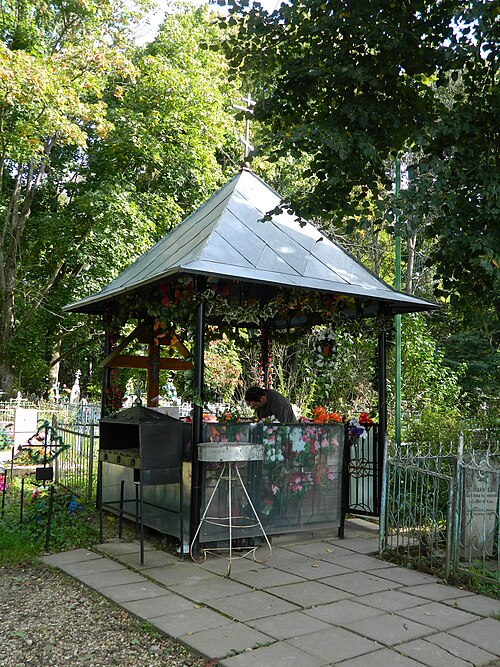
From a year and a half Theodosia's legs hurt, and from three she no longer walked but only crawled; at eight she fell into a lethargic sleep for two weeks. After this she received the gift of healing. In the war years the girl was left on the street, where she lived seven hundred days. Soon an old nun took her in, who brought her to live with her in the village of Tyomkino. In 1946, at twenty, Theodosia was tonsured a novice with the name Tikhona, in honor of the venerable Tikhon of Medyn, Kaluga. Thirty years later she received monastic tonsure, and two years after that, in 1978, Tikhona received the highest degree of monasticism, the schema, with the name Makaria. She departed to the Lord in 1993 and was buried in the village cemetery of Tyomkino, where she had lived fifty years. In the years of her life, many people came to the village, from the surroundings and from cities, to receive healing from illnesses of body and soul.
Disputed parts
The book "Given by God" by G. P. Durasov, who knew the schemanun personally, was criticized by Andrei Kuraev for describing non-Orthodox practices: the struggle with "spoiling" and with sorcerers, visions, "charging" of water and the like. In his opinion, the holiness of the life of Schemanun Makaria cannot be excluded, but the book about her was written in a state of spiritual delusion. According to that book, the mother of the first cosmonaut, Anna Timofeevna Gagarina, came several times to Elder Makaria, and Yuri Gagarin himself called. Schemanun Makaria left many prophecies, among them eschatological ones, and is said to have foreseen three wars in Chechnya. These accounts rest only on that book and have not been confirmed by anything else.
Her memory
After the death of Schemanun Makaria a People's Museum of Schemanun Makaria was built in the village of Tyomkino; the most valuable exhibits are the photographs and portraits of the ascetic. A church of the Smolensk icon of the Mother of God was built. It was also decided to build a chapel over the holy spring in honor of the Prophet of God Elijah, and a bathing place where the numerous pilgrims could pour holy water over themselves. A two-flight metal staircase was built and the river Pchelka itself was cleared. The memory of the elder is regularly marked with the arrival of the local bishop and a great gathering of people.