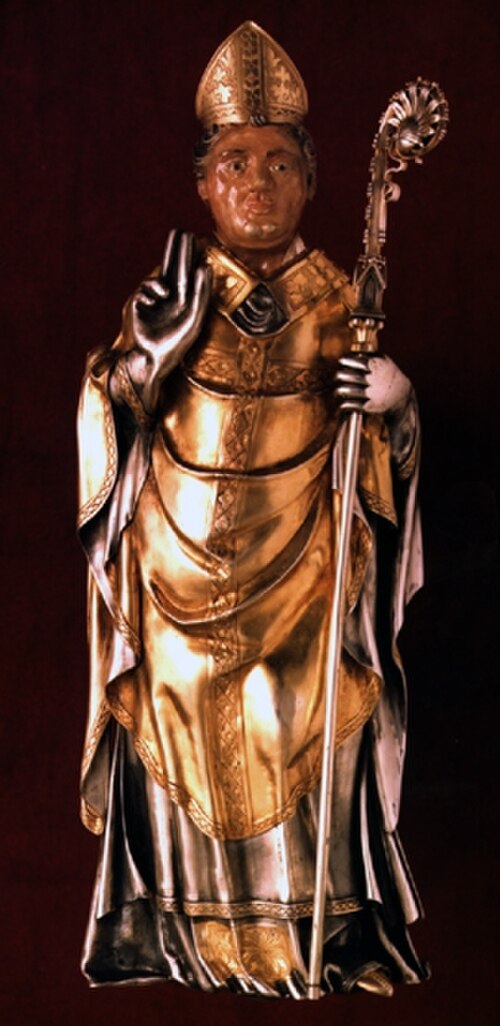
Saint
Martyrian of Albenga
A hierarch venerated at Albenga in Liguria, of around 301.
Uncertain source. We are looking to verify this information as soon as we can.
- Era
- 4th century
- Order
- Hierarchs
Life
Holy Hierarch Martyrian of Albenga is a bishop venerated as patron of the town of Banyoles in Catalonia. His historical existence is doubtful: the first attested bishop of Albenga dates from the year 451, and none of the known bishops is called Martyrian, nor is his supposed predecessor, Junctus. He may be a legendary figure, created in the Middle Ages to give a story to the relics at Banyoles.
According to tradition he was born in Florence, into a noble pagan family, in the middle of the 4th century. Drawn to Christianity, he was baptized by Abbot Fructuosus of the Benedictine monastery of Magdala and gave his wealth to the poor. At 22 he was ordained a priest, and after the death of Fructuosus he was elected abbot. With Bishop Junctus of Albenga he made spiritual retreats of fasting and contemplation. The first miracle attributed to him is the deliverance of a woman possessed by the devil. After the death of Junctus he was elected bishop of Albenga for three years, then went to Egypt and lived as a hermit in the desert. Hearing that idolatry was growing again in Albenga, he returned and brought the faithful back to Christianity. Then the pagan lord of Florence seized him and, after many torments, had him beheaded. Dead, he worked a new miracle: he healed his executioner of leprosy, and the man believed. His body was taken to Florence, where it was long venerated.
The relics were already at Banyoles when the third church of Saint Stephen was consecrated in 1086; the monks from Albenga probably arrived shortly before the 11th century, in connection with the Hungarian and Muslim raids in Italy in the 10th century. A legend says that two young monks carried the relics on a mule, hidden in a barrel, up to a hill where the mule stopped; the bells began to ring by themselves, and the relics miraculously returned to the hill, where a chapel was built. He is honored as a saint of the undivided Church.