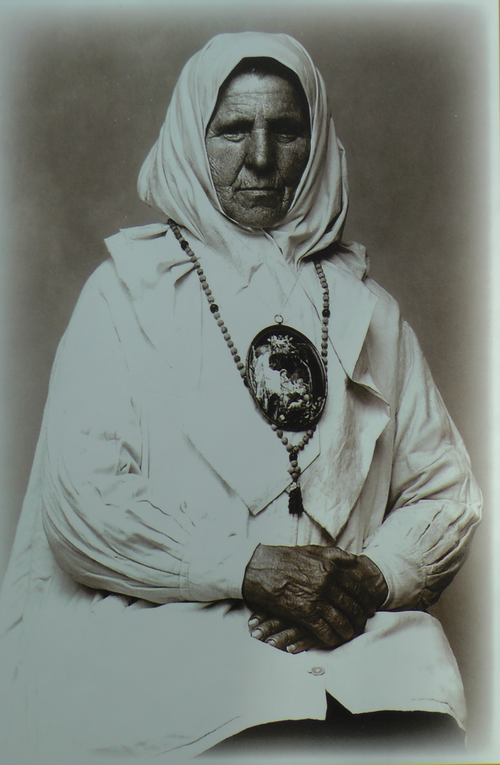
Saint
Matrona the Barefoot
Wanderer
Blessed wanderer of Saint Petersburg, born in 1833 and died in 1911.
- Reposed
- 191120th century
- Place
- Saint Petersburg
Life
Blessed Matrona the Barefoot, also called Matrona of Petersburg or "barefoot Matryonushka", was a wanderer and fool for Christ who lived in Saint Petersburg at the end of the nineteenth and beginning of the twentieth century. Thousands of people came to her for counsel, consolation and prayer. Metropolitan Barsanuphius of Saint Petersburg wrote that she chose the path of foolishness for Christ and of wandering, and received from God, for her labours and humility, the gift of foresight and of working wonders, and that her life shows believers one of the many paths that lead to salvation.
Childhood and two marriages
Born Matrona Petrovna Shcherbinina, she came into the world in 1833 in the village of Vanino in the Nerekhta district of Kostroma province, into a peasant family. Her parents were named Peter and Agafya. She was baptised on 27 March 1833 and given the name of the Martyr Matrona of Thessalonica. She had an older brother, Alexander, and two younger ones, Ivan and Makar. Scholars suppose that as a child she heard the stories of Blessed Simon of Yuryevets, the fool for Christ venerated in that region.
In 1850, at seventeen, she was married to Ivan Fyodorov Rumyantsev, aged eighteen, and they lived in his village of Antonovo. They had two sons, Andrei and Ivan. In 1855 her husband was taken into the army, and Matrona became a soldier's wife, which, according to some scholars, also freed her from serfdom. Ivan returned in 1865 and died in 1870, apparently from drink.
Left a widow, Matrona took out a passport and went to work in Kostroma. There she married a townsman, Yegor Tikhonovich Mylnikov, who seems to have kept a grocery and a house on Saint Sergius Street. Her biographers say this marriage was a heavy trial for her and that she suffered many sorrows. They had no children.
A nurse in the war
When the Russo-Turkish War of 1877-1878 broke out, Yegor Mylnikov was called up, and Matrona went with him to the front as a sister of mercy. She received a wage of 25 roubles, which, according to her first biographer, she gave to wounded soldiers. Her name does not appear in the lists of nurses from Kostroma, but among the things she gave the heir to the throne in 1904 was the commemorative medal for the consecration of the church at Shipka. For this reason it is thought that she went to the front as a volunteer.
The barefoot wanderer
During the war her husband died. When peace came, Matrona sold her property, gave away the money and vowed to walk barefoot as a pilgrim. She herself said she had been to Jerusalem four times and dozens of times to the Solovetsky Islands, her first goal, to Valaam, the Trinity Lavra, Sarov and other monasteries. She went barefoot in every weather and wore only white summer clothes. She was a friend of two other famous wanderers of the time, Vasily the Barefoot and Alexander Dyomin.
She wandered in this way for about three years, and in 1881 settled in Saint Petersburg, where one of her sons apparently lived. At first she lived on the Petrograd Side, then on Vasilyevsky Island, where she regularly attended Saint Andrew's Cathedral, and later on Bolshaya Morskaya Street.
The police stopped her several times for walking barefoot through the city, so she asked the Holy Synod for permission to keep her vow. In her petition she wrote that the police accused her of troubling the people, but that God's keeping from frost the bare feet of those who had made Him this vow could only strengthen the Orthodox faith in people's souls.
Counsellor and healer
The first reports of her healings and foresight date from the late 1890s. Matrona became known throughout the city as a counsellor in trouble and a healer. On Mondays and Thursdays she received up to 500 people a day at her lodging, and the police reported that up to three hundred admirers gathered round her in the street. People also asked her help in finding work or getting out of difficulties, and some attributed to her prayers the cure of hardened drunkards.
A priest of Saint Andrew's Cathedral related that when some asked her to tell their future, she refused, saying she was neither a witch nor a fortune-teller, and invited them instead to pray quietly with her before the icons. She took no payment for prayer, though she accepted, if offered, something for lamp oil and candles. She confessed and received communion from Saint John of Kronstadt, and a photograph of 1906 shows them together at the laying of the foundation of a merchant's house.
Her fame alarmed the church authorities and the police. In October 1897 the consistory examined her case and ordered the parish clergy to keep close watch on her beliefs, forbidding her to receive visitors or collect money for oil and candles. In January 1898 she was tried for collecting money for churches and monasteries without permission, but was acquitted, since there had been no fraud.
Ascetic life
For almost all her life she enjoyed robust health, though she lived very austerely. A journalist wrote that she lived on a broth cooked in a small cup, which she ate over several days, and on soaked bread, and that she mixed tea with coffee to quench her thirst. Apart from prosphora, that was all her food. Money she received she gave away at once, saying she lived only for God and did not want money found on her after her death. Gifts ranging from a few kopecks to 500 roubles she sent to the poor, to monasteries and to needy parishes.
She spent her last fourteen or sixteen years near the chapel of the "Joy of All Who Sorrow" icon in the grounds of the glass factory beyond the Neva gate. It was a workers' district with more than thirty factories, wooden houses and no sewers, where cholera and typhus raged and people lived in poverty and drunkenness. Her room in a log house was poorer than a prison cell, its walls blackened with soot, with an iron bed covered in rags, lit only by the lamps burning before ancient icons.
Together with Vasily the Barefoot she collected money to build there a church of the "Joy of All Who Sorrow" icon with the coins. She also raised money for a church in the village of Feryazkino in Tver province.
Contemporary witness
Her contemporaries believed she had the gift of foresight. Most of those who sought her were poor, but intellectuals, merchants and people of high society came too. Prophecies about the fate of Prime Minister Pyotr Stolypin and of the Governor-General of the Amur region, Nikolai Gondatti, are attributed to her. In 1910 she is said to have remarked that seven of her lamps had gone out and that something bad would happen to Russia. She often sprinkled visitors with holy water and blessed them with an icon. Letters came to her from all over Russia.
The writer Evgeny Poselyanin described a chance meeting with her: a barefoot woman with bright eyes, dressed in white, carrying a large wicker basket and leaning on a heavy metal-tipped staff. He was struck by her simplicity. They spoke of the death of someone dear and of the orphans she was bringing to the capital. Poselyanin believed that people saw in her endurance, detachment from material things and freedom from worldly ties.
From 1909 Matrona prepared for death, receiving communion often, and in her last two years she received holy unction several times.
Ties with the imperial family
Records of the empress's chancery and of the Ministry of the Court show that between 1896 and 1911 Matrona sent the imperial family gifts for the feasts: icons, prosphora, lamp oil and other church items. A long correspondence between her and the imperial family has survived, and there is evidence of a meeting between her and Emperor Nicholas II.
Death and burial
Blessed Matrona reposed on 30 March 1911, in the seventy-eighth year of her life. For several days great crowds gathered outside her house: beggars and workers, merchants, officials and aristocratic ladies, and many priests, and the major newspapers of the capital wrote about her death day after day. An archimandrite said at her funeral that her piety embodied the simple faith of the Russian people and that she had taken upon herself the struggle of foolishness for Christ.
On 4 April 1911 she was buried behind the chapel of the "Joy of All Who Sorrow" on the bank of the Neva, in the presence of more than 20,000 people. The grave had a crypt and a cross, and later a wooden chapel was built over it, holding many of the icons from her room. The cross bore an inscription saying that there rested the body of the servant of God, the eldress Matryona Petrovna Mylnikova, barefoot Matryonushka. In Soviet times the site was levelled and covered with rubble.
Memory
Immediately after her death a pamphlet about her life was printed, and a year later the biography written by Alexander Plotnikov, who had known her. She was photographed by the great photographers of the day, among them Karl Bulla. Present-day historians note that many legends grew up around her, so that her real figure is interwoven with the image kept by popular piety. In the 2010s the question of her canonisation was raised, two books of archival documents on her life were published, and documentary films brought her to a wide audience.