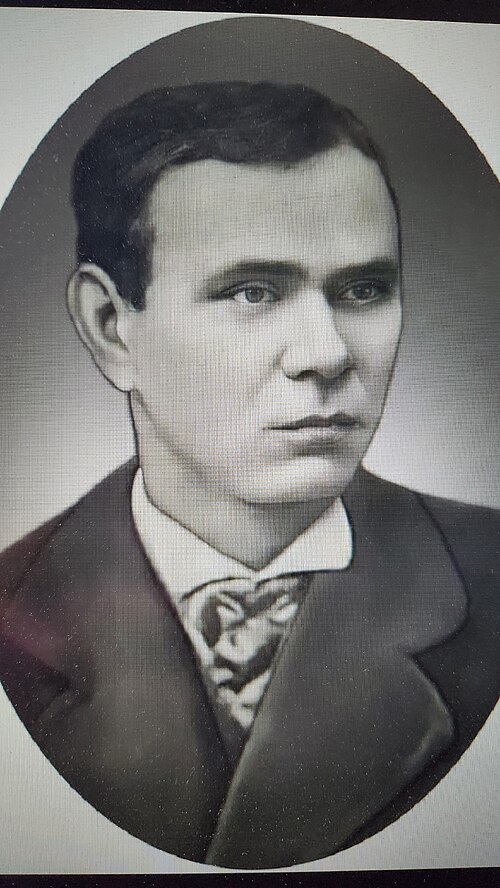
Saint
Matthew Tatomir
Local saint of the Saint Petersburg diocese, born in 1848 into an archpriest's family and died in 1904.
- Reposed
- 190420th century
- Place
- Saint Petersburg
Life
Matthew Klimentievich Tatomir (10 [23] August 1848 - 17 [30] September 1904) was a recluse of Saint Petersburg, born in Kamianets-Podilskyi province in the family of Archpriest Clement, regarded by some venerators as blessed. The source at our disposal calls him a locally venerated saint of the Saint Petersburg diocese, but shows no secure act of canonization, and the same text says that according to unofficial data the request for canonization is expected to be approved by the synodal commission in 2026. We therefore cannot say that he is a securely canonized saint. For his life the Russian source is the only one at our disposal, with no other source to confirm it, and so what follows should be read with reserve.
Studies
From childhood it was seen that he wished to follow in his father's footsteps. In 1867 he finished the Kamianets-Podilskyi seminary early. In 1874 Fr. Clement was transferred to serve in the Saint Petersburg diocese and took both sons with him; there the future recluse entered a higher school, the oriental languages faculty. From his university file it is seen that he had almost no means of living, since for personal reasons he refused his father's material support. In 1876 he spoke at a meeting in defense of his favorite professor, who had been unjustly condemned for rebuking the clergy that showed too evident an attraction to Western ideas of fictitious freedoms and democracy. Most of the students were expelled and his secular education ended here. Bishop Leontius (the future Metropolitan of Moscow) did not personally bless him to go the monastic way, after his social speeches. These events, especially the unjust punishment, were the impulse for choosing another path, in which his ascent of the spiritual Ladder was to be seen.
Ascetic labor
He set out on pilgrimage to the Holy Land, where he was for several years an ascetic living in the desert. Then he traveled in Syria, where he took over the experience of the local recluses. Returned to Saint Petersburg, the place of his next labor of prayer was the Nikolskoe cemetery of the Alexander Nevsky Lavra, where he lived in the street and in crypts very ascetically. He read prayers regularly in any weather, without care for bodily needs. About fourteen months of such life led him to a grave kidney illness. Refusing to leave the post of prayer, the ascetic locked himself in an old crypt, but he was saved by an unexpected visit of the emperor Alexander III, who learned by chance of the grave condition of an unknown recluse. After a short audience, living quarters were allotted to the sick man, into which he moved in 1888; around 1899 he became the owner of a three-room apartment at 22 Ioannovskaya Street. After Nikolskoe he suffered several months from grave illness, and was nursed by a parishioner of the Lutheran church, who very much wished to serve God. After a year the future blessed one declared himself a recluse receiving visitors, and persuaded Lyubov to receive the Mystery of Baptism in Orthodoxy and to help him until death. Later she was to pass through great trials, helping to organize Liturgies during hard repressions, together with Bishop Gregory (Lebedev), who three years before her death tonsured her a nun. The service was performed by Hieromonk Matthew (Chelyuskin), a former guards officer. His brother died and he remained the last heir of the hereditary priestly line of the Tatomirs.
For more than eleven years the recluse received all who wished, in his apartment. Without feasts or days off he received in his cell both poor wretches and nobles, officers of merit, bishops. For each he could find a Christian word and, as eyewitnesses say, with God's help never erred. The well-known priest of the time John (Sergiev) of Kronstadt visited him. At the start of autumn 1904 he warned his cell-attendant that he would soon have to leave this world. On 16 September Matthew Tatomir asked Lyubov to read a prayer, and he himself, in full health, sat in an armchair for an ordinary short sleep.
Death and later veneration
On 17 September (30 September) 1904 he died in his sleep, from heart stoppage. Fr. Clement arranged the burial of his son at the Nikolskoe cemetery of the Alexander Nevsky Lavra, in a wooden coffin, in the tomb over which a crypt-chapel was built. From 1911 the place gained great veneration and was famed for the frequent help given to parishioners. From 1925, in the time of persecution, venerators of the blessed Matthew celebrated the Eucharist in this chapel. In 1985 Metropolitan Anthony (Melnikov) is said to have presented to the bishops the number of miracles attested at the recluse's grave; after that Matthew Tatomir is said to have been canonized as a locally venerated saint, and the hierarch, for safety, to have found the relics of the blessed one and kept them under his bed until his own death. From 1999 the vicar of the Alexander Nevsky Lavra, Nazarius (Lavrienko), took care of the tabernacle-chapel. In 2019 the sponsor Vera Anatolievna Agiyan began the restoration of the chapel. In 2021 the keeper of the chapel, an Orthodox blogger, organized active informational work, which helped more people learn of Matthew Tatomir. According to unofficial data of the Synodal Commission for the Canonization of Saints, the request for the blessed Matthew Tatomir will probably be approved in 2026. These statements about the canonization of 1985 and the relics kept under a bed rest on no published decision and we cannot confirm them.
Other reports from the source
His name day was 29 November, in honor of the Evangelist Matthew. It is said that, after a clinical death, he received the gift of foresight and could at times help in the healing of children under eleven. The emperor Nicholas II is said to have wanted to call him to Moscow to help serve the state, but he said that he would not leave the apartment until death. His grave was especially venerated in the time of the siege of Leningrad. It is said that Hieromartyr Metropolitan Benjamin (Kazansky) of Petrograd and Gdov, and the future Seraphim of Vyritsa, prayed there regularly. The chapel was made in the likeness of his own cell: people sit on a bench before the portrait of the recluse and the icons and begin a spiritual conversation with the blessed Matthew.