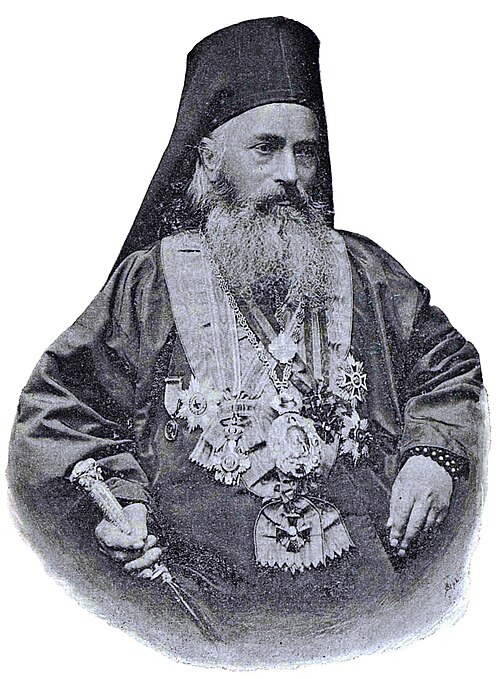
Saint
Melchisedec Stefanescu
Bishop of Roman
Bishop of Roman, who reposed in 1892, his relics kept at Roman; not yet canonized, his cause under way.
- Reposed
- 189219th century
- Place
- Roman (Neamț County); relics in the Episcopal chapel of St Antipa of Calapodești
- Order
- Hierarchs
Life
Melchisedec Ștefănescu, born Michael in 1823 at Gârcina, in Neamț, was bishop of the Lower Danube (1865-1879) and of Roman (1879-1892), a historian, professor and author of theological works. He died on 16 May 1892. He is named in the Romanian Paterikon and venerated by the faithful, without synodal canonization.
He was the firstborn of eleven children of the priest Petrache and the priest's wife Anastasia Ștefănescu, five of whom embraced monastic life. He attended the Socola Seminary between 1834 and 1838, was a teacher four years, then, in 1843, professor of rhetoric, pastoral studies, history and geography at the seminary. The same year he received monastic tonsure with the name Melchisedec, and the following year was ordained hierodeacon. Between 1848 and 1851 he studied at the Theological Academy of Kiev, then was ordained hieromonk and taught patrology, canon law, liturgics and comparative theology at Socola until 1856. From 1856 he was rector of the Seminary at Huși, which he reorganized.
Between 1857 and 1859 he upheld from pulpit and chair the union of the Principalities. At the end of 1862 he was consecrated bishop, locum tenens at Huși, and in January 1865 bishop of the Lower Danube, where he built churches, appointed enlightened priests, made canonical visits and cared for widows, orphans and poor peasants. In 1879 he was called to Roman, where he shepherded more than thirteen years, gave scope to the Seminary, supported poor pupils, renewed monasteries and sketes, among them Bogdana, Sihastru, Măgura, Buluc, Tarnița and Lepșa, and helped build schools and support the poor sick at the hospital in Roman.
He had a role in the life of the Romanian Church: he contributed to the gathering in 1865, in Bucharest, of the first general synod of the Church, to the Organic Law of 1872, which constituted the Holy Synod, to the consecration of the Holy Chrism in the country, in 1882, after his memorandum to the Ecumenical Patriarchate, and to the synodal act of 1885 by which autocephaly was recognized. He wrote works of liturgics, dogmatics, pastoral theology, apologetics and history: the Chronicle of Huși and of the Bishopric (1869), the Chronicle of Roman (1874-1875), Papacy and the Present State of the Orthodox Church in Romania (1883), Historical and Archaeological Notes from 48 Ancient Monasteries and Churches in Moldavia (1885), the Life of Metropolitan Anthimos the Iberian (1886) and others. He died on 16 May 1892. From his bequest a kindergarten and a school of cantors were built, with free upkeep for orphans.