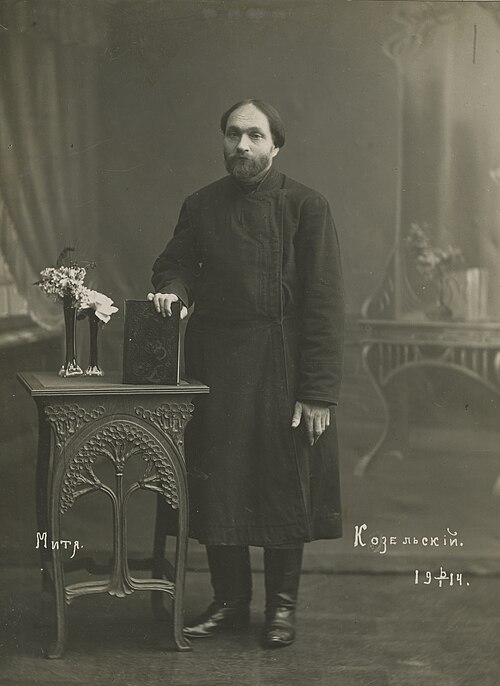
Fool-for-Christ
Mitya Kozelsky
Fool for Christ
Fool for Christ from Kozelsk, esteemed by Tsar Nicholas II, who died in 1929 on the Solovetsky Islands.
- Reposed
- 192920th century
- Place
- Solovetsky Islands
- Order
- Fools-for-Christ
Life
Mitya Kozelsky, whose real name was Dmitry Popov, was a fool for Christ from the town of Kozelsk near the Optina Monastery who in the early twentieth century enjoyed the trust of Emperor Nicholas II and Empress Alexandra. Sick and almost unable to speak, he was regarded by many as a man of God with the gift of prophecy. He later became a determined opponent of Grigory Rasputin, and he ended his life in 1929 in exile on the Solovetsky Islands.
Name and illness
He was known among the people by several nicknames: Mitya Kolyaba, Mitya the Stammerer, or Mitya Kolebyaka. Later he received papers in the name of Dmitry Andreyevich Znobishin, and under that name he appears in a police file of 1912. He was born in 1865 at Kozelsk in Kaluga province and, according to the hieromonk Iliodor, who knew him well, came from the class of townspeople.
Mitya suffered from epilepsy and a grave disease of the bones and muscles. Until 1900, according to the same witnesses, he was mute and wholly crippled: almost deaf and blind, with crooked legs, a bent spine and stunted arms. He could barely pronounce words, so he usually appeared with an "interpreter" who explained to others what he meant.
The Optina years
For several years he lived at the Optina Monastery near his town. Some historians believe he was cared for by Saint Ambrose of Optina himself, who lovingly received the sick and infirm. In 1900, as his contemporaries believed, after a thunderbolt he began to walk and to speak more clearly, though he remained gravely afflicted in body. At the same time a cross appeared in his right hand, which was taken as a miracle. From then on he was believed to have power to cast out demons, and his words began to be received as prophecies.
Some writers hold that after the death of Saint Ambrose in 1891 the pilgrims coming to Optina saw in Mitya a kind of successor to the elder and spread the fame of the "new blessed one" throughout Russia. Others, more sceptical, point out that his unintelligible speech left room for every interpretation, and that some monks, seeing him in a seizure, concluded that he had the gift of prophecy and began to present him to church authorities. The French ambassador Maurice Paléologue wrote that his states of ecstasy alternated between agitation and stupor.
Pilgrimages and Saint John of Kronstadt
From Optina Mitya set out on pilgrimage across the empire. In 1901 he came to Kronstadt, where he was presented to Saint John of Kronstadt. At first they got on well, but later a disagreement arose between them because Father John had not told the emperor about Mitya's gift of prophecy. The former hieromonk Iliodor, a hostile and unreliable witness, left accounts of this quarrel full of slanders against Saint John, which history does not confirm.
At the imperial court
According to Iliodor, in 1902 Mitya was received at the Saint Petersburg Theological Academy by Archimandrite Theophan, the academy's inspector, who introduced him to Grand Duchess Militsa Nikolaevna and then to the emperor. Another account says the emperor's attention was drawn to him by Prince Nikolai Obolensky, a landowner of Kozelsk, by Grand Duke Konstantin, who had for years had a summer house near Optina, and by the prince's brother Alexei Obolensky, briefly Chief Procurator of the Holy Synod. It was said that Mitya had healed a princess of barrenness. He was first received in the salon of Countess Sofia Ignatieva, from which some of her friends decided to bring him to court to pray for the birth of an heir. The historian Mikhail Bogoslovsky considered him a protégé of Bishop Hermogenes of Saratov.
At court he usually came with an old man from Kozelsk, the former merchant Elpidifor Kananykin, who said that having understood the vanity of the world he had given himself to serving the blessed one and had received from God the grace to understand his words. Elpidifor often sought gifts to build at Optina a church dedicated to the blessed one. Contemporaries left very different descriptions of these visits: some portrayed them as quiet meetings, others as scenes in which Mitya fell into a seizure before the imperial family while his interpreter explained his cries.
In the diary of Emperor Nicholas II for 14 January 1906, Old Style, is this entry: at four o'clock the man of God Dmitry from Kozelsk, near Optina, came to them, bringing an icon painted according to a vision he had recently had, and they talked with him for about an hour and a half. On the icon the emperor and empress stand surrounded by angels, while below the heavenly hosts strike down demons with fiery swords.
Iliodor wrote that the blessed one gave the sovereigns advice, warned them of revolution and of mutinies in the army, and, coming in by the back door, limping and waving his withered hand, carried bilberries or wild strawberries in his pockets for the emperor's children. Paléologue noted that during the war with Japan Mitya seemed destined to play an important role. It is said that the habit of those close to the imperial family of calling the emperor and empress "papa" and "mama" came from Mitya, who could pronounce only these two words clearly.
The historian Alexander Bokhanov held that a modern person must set aside the judgements of his own age to see in the emperor's meetings with an unlettered fool for Christ the spiritual joy that contact with divine light gave to a believer. Others explained the closeness by the deep and complete faith with which Empress Alexandra had embraced Orthodoxy. The historian Douglas Smith wrote that the emperor was enchanted by Mitya, and other scholars call him the "mystical friend" of the imperial family.
A letter to the emperor
A letter from Mitya to Nicholas II, in which he calls the emperor "daddy", was preserved in the archive of the physician Pyotr Badmaev. It states that the Orthodox Church is the support of the throne and the monasteries the stronghold of the Church, and calls the Mother of God the abbess of the holy houses. It recalls the icon which, according to tradition, the Mother of God gave in 1073 for the Dormition Cathedral in Kyiv and which had been in Moscow since 1667. Mitya informed the emperor of an embezzlement of 200,000 roubles uncovered at Optina and asked him to see personally that the guilty were brought to account.
Iliodor said the courtiers preferred Mitya to Rasputin. His friends included Prince Mikhail Putyatin, head of the palace administration at Tsarskoye Selo, Prince Vladimir Orlov, head of the emperor's military chancellery, and the palace commandant, Vladimir Dedyulin. Among his admirers was Ivan Fedchenkov, then a student at the Theological Academy and later Metropolitan Benjamin.
Against Rasputin
According to police records, Mitya and Rasputin had for years been close friends until they quarrelled. After he was distanced from the court, Mitya became one of Rasputin's fiercest opponents. On 29 December 1911 he took part, with Bishop Hermogenes and the hieromonk Iliodor, in the failed attempt by senior clergy to force Rasputin to leave Saint Petersburg and break off his contact with the imperial family. Afterwards he had to go into hiding. He was close to the Christian temperance movement led by Ivan Churikov.
Last years and memory
Little is known of the last years of his life. He died in 1929 on the Solovetsky Islands, where the Soviet authorities then held clergy and believers in the special-purpose camp.
The figure of this "righteous man of the people" lives on in the memoirs of many contemporaries, among them Ambassador Maurice Paléologue, the Chairman of the Council of Ministers Vladimir Kokovtsov and the Chairman of the State Duma Mikhail Rodzianko. Mitya Kozelsky appears as a character in Valentin Pikul's novel "Unclean Power" and in Andrei Amalrik's documentary book on Rasputin. No canonisation of him is known, but his name remains linked with Optina, with the family of the last emperor and with the Russian tradition of the fools for Christ.