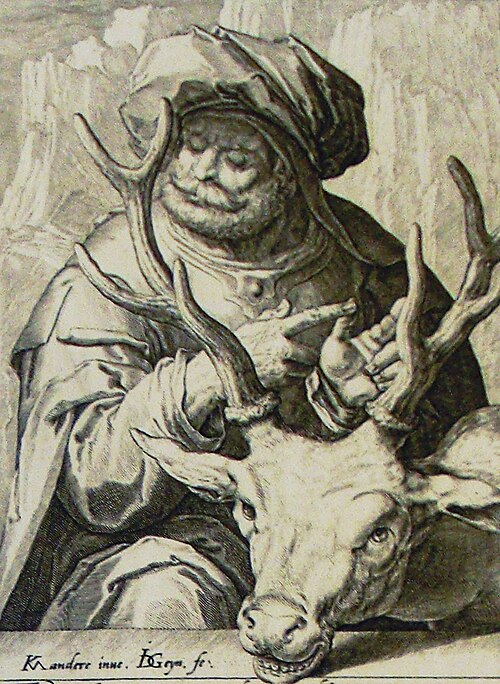
Righteous
Naphtali
The Patriarch
Sixth son of Jacob, born of Bilhah, ancestor of the tribe of Naphtali.
- Era
- unknown
- Order
- The Righteous
Life
Naphtali was, according to the Book of Genesis, the sixth son of the patriarch Jacob and the second of the two sons born to him by Bilhah, Rachel's maidservant. From him descends the tribe of Naphtali, one of the twelve tribes of Israel. The Orthodox Church honours him among the patriarchs and ancestors of the Lord, on the Sunday of the Holy Forefathers.
Birth
His birth is told in Genesis 30:7-8. After Bilhah bore Dan, Rachel, who had no children, had a second son through her maidservant. She said, "With mighty wrestlings I have wrestled with my sister and have prevailed," and named him Naphtali, a name which comes from these words and means "my wrestling."
Naphtali and his tribe
Naphtali had four sons: Jahzeel, Guni, Jezer and Shillem. He went down into Egypt with his father and brothers. Jacob, in the blessing before his death, said: "Naphtali is a doe let loose, who gives beautiful words" (Genesis 49:21). The text is read in several ways; in the Greek translation the words speak of a shoot that multiplies the fruit of beauty. At the exodus the tribe numbered 53,400 men able to bear arms, and 45,400 near the end of the journey through the wilderness.
After the conquest of Canaan, Naphtali received the northernmost part of the land, around the Sea of Galilee and the river Jordan, a fertile region but exposed to invasion. In the days of Barak of Kedesh-naphtali and the prophetess Deborah, the tribe took part in the fight against Sisera (Judges 4 and 5), and the Song of Deborah praises those of Naphtali, who risked their lives on the heights of the field. The Assyrian king Tiglath-pileser III conquered the region in 733 before Christ and took the people into captivity. Tobit descended from Naphtali.
In the Gospel
The prophet Isaiah announced that the land of Zebulun and the land of Naphtali would see a great light (Isaiah 9:1-2). The holy Evangelist Matthew shows that the prophecy was fulfilled when Jesus dwelt at Capernaum and began to preach (Matthew 4:13-16). In Revelation (7:6), twelve thousand of Naphtali are sealed.
Veneration
The Church recalls Naphtali together with the other patriarchs on the Sunday of the Holy Forefathers. It is not known with certainty how and where he died; the apocryphal Testament of Naphtali says that he died in Egypt.