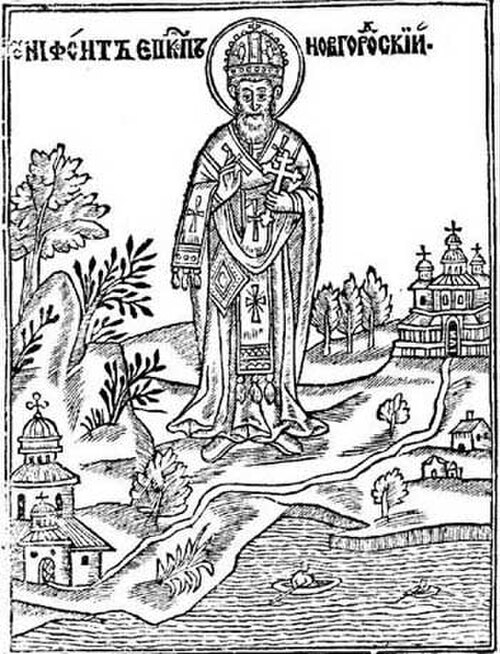
Saint
Nifont of Novgorod
Bishop of Novgorod
Bishop of Novgorod from 1130 to 1156, the first prelate of the city to bear the title of archbishop.
Life
Saint Nifont was bishop of Novgorod from 1130 to 1156, the first prelate of Novgorod to carry the title of archbishop, though the title was personal to him and became attached to the see only in 1165. The Russian Church honours him as a hierarch and remembers him on 8 April.
He is said to have been born at Kyiv, with the name Nikita. Some documents show that he visited Constantinople and perhaps studied there. He was tonsured a monk at the Caves monastery, in the time of Abbot Timothy (1124-1132). In 1130 (or 1131), at Kyiv, he was consecrated bishop of Novgorod. He came to the diocese as a worthy man, well known in the Church, and proved a worthy hierarch, a fervent and uncompromising defender of the canons. In his time the prince of Novgorod was first dismissed and “shown the road,” beginning in 1136 the period of Novgorod's independence, which was to last until 1478. He was the first Novgorodian bishop to carry out great building projects: according to the Novgorod chronicle he built ten churches, among them the church of the Assumption in the Marketplace and the church of Saint Clement at Ladoga, and he adorned the cathedral of Saint Sophia. He supported the church of the Transfiguration in the Mirozh monastery in Pskov, built in Greek style, to his taste. In his first year he made Anthony of Rome abbot of the Antoniev monastery, which Anthony himself had founded before 1108.
He enjoyed great respect also outside his diocese, which allowed him to act as mediator in disputes between the Russian princes. In 1135 he calmed the feud between the Monomashichi and the Olgovichi in the south of Rus'. In 1147 Metropolitan Clement Smolyatich had been set in the see of Kyiv, on the initiative of Grand Prince Izyaslav, without the consent of the patriarch of Constantinople, and Nifont did not recognize him; for this he was shut up by Izyaslav in the Caves monastery, and he returned to his see after the capture of Kyiv by Yuri Dolgoruky in 1149. For his loyalty to Constantinople he received from Patriarch Nicholas IV a letter comparing him to the holy fathers of old who defended the interests of Christianity, and the title of archbishop, which gave him autonomy from the metropolitan of Kyiv. He is the author of answers to the questions of Kirik of Novgorod, preserved in “Kirik's Questioning.” He founded the Mirozh monastery at Pskov.
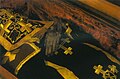
In 1155 a new canonical metropolitan, the Greek Constantine, had been appointed to Rus'. Nifont, who went to meet him at Kyiv in 1156, stayed at the Caves monastery, where he fell ill and died, after thirteen days of illness, on 21 April 1156 (8 April in the old style). According to the Paterikon, before his death the Venerable Theodosius appeared to him in a vision and announced his passing to the Lord and his joining the other venerable ones of the Caves. He was buried in the cave of Theodosius, and later his relics were moved to the Near Caves of Anthony, where they lie beside those of Abraham the Hard-Working and of Silvester the Wonderworker. He was numbered among the saints at the second Council of Makarios, in 1549.
Commemorated the same day April 8
Celestine I of RomeSaint · Bishop of RomeApr 8
 AgabusApostle · Apostle of the SeventyApr 8
 Asyncritus of HyrcaniaApostle · Bishop of HyrcaniaApr 8
 Rufus of ThebesApostle · Apostle of the Seventy, Bishop of ThebesApr 8
- Phlegon of MarathonApostle · Apostle of the SeventyApr 8
- Hermas of DalmatiaApostle · Apostle of the SeventyApr 8
 Rufus the RecluseVenerable · Monk of the Kyiv Caves LavraApr 8
- AmandusSaintApr 8
- Amantius of ComoSaint · Bishop of ComoApr 8
- Cennfaeladh of BennchairVenerableApr 8
- ConcessaMartyrApr 8
- Diogenes of AntiochMartyrApr 8