Skip to content

Venerable

Niketas Stethatos

Monk and mystic theologian

Byzantine monk and theologian, disciple of Symeon the New Theologian and author of his fullest biography.

Reposed
109011th century
Place
Constantinople

Life

The Venerable Niketas Stethatos was a monk and priest of the Stoudios monastery in Constantinople, a mystical theologian, disciple of Saint Symeon the New Theologian and author of the fullest life of his teacher. He was born around 1005 and fell asleep around 1090. The Orthodox Church honours him as a venerable man. He upheld Symeon's teaching on hesychast prayer and took part, in 1054, in the dispute that led to the great Schism between East and West.

Life At fourteen he entered the Stoudios monastery, became a close disciple of Symeon the New Theologian and, after his death, wrote his life, the fullest of those preserved. Later he became abbot of Stoudios. The nickname "Stethatos", "courageous", was given him because he rebuked Emperor Constantine IX Monomachos for his liaison with Maria Skleraina. He defended Symeon's teaching on hesychast prayer, held dangerous even by some who governed the Church, and had the support of Patriarch Michael Cerularius, who obtained Symeon's canonization. He was also editor of his teacher's writings and discourses; following a vision of Symeon, he distributed an edition of them.

Dispute with the Latins In 1054 Niketas supported Cerularius in the conflict that led to the Schism of East and West, writing works against Latin customs: unleavened bread, the Saturday fast and the celibacy of priests. The writings were known in the West too. Cardinal Humbert wrote against them and, coming to Constantinople as legate of Pope Leo IX, at the emperor's request had a discussion with Niketas at the Stoudios monastery. According to Humbert's account, Niketas admitted defeat and threw his treatise into the fire, but other Latins regard this as boasting. His treatise survives to this day, and he went on opposing the papists.

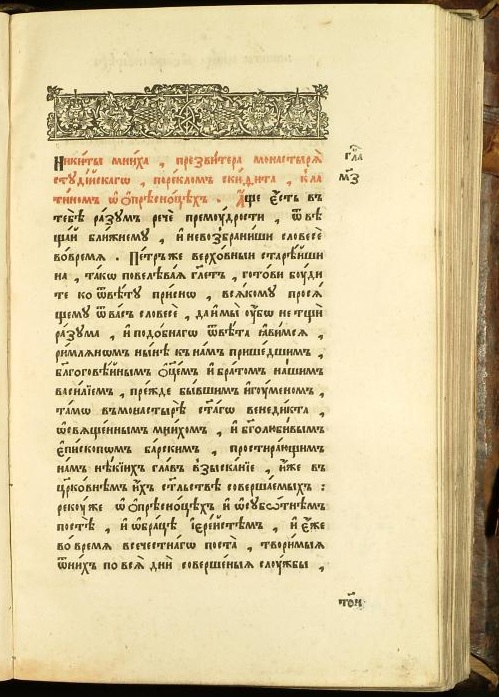
Writings His book on Symeon is the fullest life of him. He wrote treatises on the soul, on paradise, on hierarchy and on the limits of human life, an unpublished hypotyposis on the spiritual life of the Stoudios monks, fifteen discourses on the Hexaemeron, three hundred practical chapters, iambics and a canon to Saint Nicholas, as well as Five Discourses against the Armenians. Widely read is his treatise on ascetic practices, the three centuries of practical, physical and gnostic chapters, in the Philokalia: practice of the commandments, contemplation of creatures and the direct knowledge of God. Like his teacher he writes of the experience of God as divine light, the importance of a spiritual father, love of neighbour above prayer, and the duty of those who have felt grace to share it with others. He also says that the spiritual life is possible in any circumstance, without physical withdrawal from the world, for true renunciation is inward, and that holiness is a return, through grace, to man's natural state. He wrote also Against Those Who Accuse the Saints, against the opinion that it is no longer possible to become a saint. In Russia his writings are known from the thirteenth century, and two entered the Nomocanon of Saint Sava of Serbia.