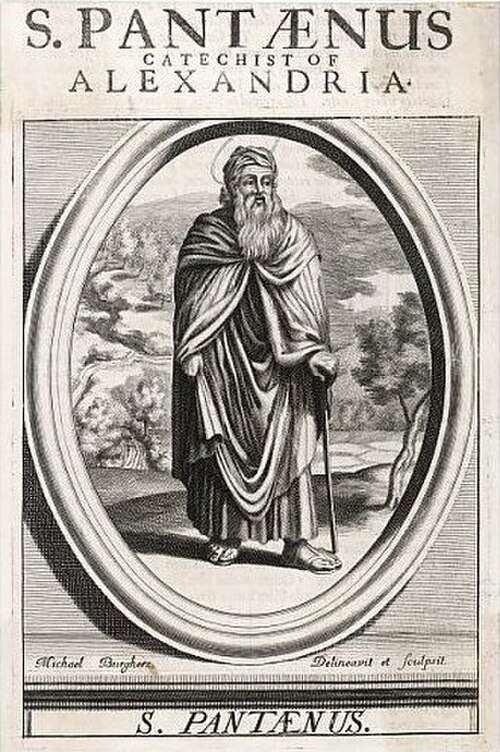
Saint
Pantaenus
Teacher in Alexandria
Sicilian theologian, a leading figure of the Catechetical School of Alexandria, who died around 200.
- Feast
- July 7old style July 20
- Reposed
- 2163rd century
- Place
- Alexandria
Life
Pantaenus was a Christian scholar of the second century, one of the prominent figures of the Catechetical School of Alexandria, who died around 200. He is commemorated on 7 July, and among the Copts on 22 June.
The philosopher
The sources do not agree on his origin: by some he was from Sicily, by others from Athens. Before receiving the faith he was a Stoic philosopher and taught at Alexandria. It is not known when and how he turned to Christianity. From him the Catechetical School of Alexandria began to be named, the oldest school of its kind, which had a great part in the development of Christian theology. From about 180 he taught in this school, which he made a school of theology and which he led until about 190, when his most renowned disciple, Clement, succeeded him. In his school Holy Scripture was interpreted above all and Christian dogmas were set forth, but philosophy was taught too. He sought to reconcile his new faith with Greek philosophy. Clement calls him “the Sicilian bee”.
The missionary
Eusebius says that for a time Pantaenus was a missionary and that he went as far as India, where he found Christian communities that had the Gospel of Matthew in “Hebrew letters”, left them, it is said, by the holy apostle Bartholomew. Some think that this India was southern Arabia, or that Pantaenus misunderstood a mention of Mar Thoma, that is, Saint Thomas, as Bar Tolmai, that is, Bartholomew. According to Jerome the journey was made at the urging of Bishop Demetrius of Alexandria.
His teaching
No writing of Pantaenus survives, but Eusebius says that he gave spoken and written interpretations, and an opinion of his, preserved by Eusebius, holds that the author of the Epistle to the Hebrews is the holy apostle Paul, who out of humility did not call himself an apostle to the Hebrews. His legacy is known by the school’s influence in the early disputes over the interpretation of the Bible, the Trinity and Christ. He was the chief supporter of Serapion of Antioch in the struggle against Gnosticism. The Coptic Synaxarion mentions him with Clement, at the return of the relics of Saint Mark.
Commemorated the same day July 7
 Kyriaki the Great MartyrGreat MartyrJul 7
- AstiusHieromartyr · Bishop of DyrrhachiumJul 7
 Felix of NantesSaint · Bishop of NantesJul 7
 Acacius of SinaiVenerable · Monk of SinaiJul 7
- Hædde of WinchesterSaint · Bishop of WinchesterJul 7
 Apollonius of BresciaHieromartyr · Bishop of BresciaJul 7
 Thomas MaleinosVenerable · Athonite monkJul 7
 Ampelius of MilanSaint · Archbishop of MilanJul 7
- Angelelmus of AuxerreVenerableJul 7
- Astion of HalmyrisVenerable MartyrJul 7
- Blaise of AcarnaniaHieromartyrJul 7
- Bonitus of Monte CassinoVenerable · Abbot of Monte CassinoJul 7