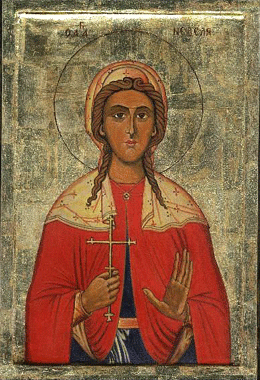
Great Martyr
Kyriaki the Great Martyr
Martyr of Nicomedia, put to death in the reign of Emperor Diocletian.
- Feast
- July 7old style July 20
- Reposed
- 2893rd century
- Place
- Nicomedia
- Order
- Great Martyrs
Life
Saint Kyriaki the Great Martyr, called Nedelya in the Slavic tradition (both names meaning Sunday), was a virgin of Nicomedia who received the crown of martyrdom in the persecution of Diocletian, around 289 or 303.
She was born at Nicomedia, the only daughter of Greek parents, wealthy and devout, Dorotheus and Eusebia, who had no children and, according to her life, obtained her through unceasing prayer. Because she was born on a Sunday, the Lord's day, she was given the name Kyriaki (in Greek, Sunday). From childhood she was consecrated to God. She was beautiful in body and in soul; many asked for her hand, but she refused them all, saying she was betrothed to Christ and wanted nothing more than to die a virgin. A magistrate of Nicomedia wished to betroth her to his son, especially since she came from a wealthy family; when refused, he denounced Kyriaki and her parents as Christians to the emperor Diocletian.
The emperor ordered the family arrested; Dorotheus was beaten cruelly, and then he and Eusebia were exiled to Melitene, between Cappadocia and Armenia, where they died enduring much for Christ. Kyriaki was sent to Nicomedia to Maximian to be questioned. Since she refused to renounce her faith, Maximian ordered her scourged, then sent her to Hilarion, the eparch of Bithynia, at Chalcedon, to make her a pagan or send her back. Hilarion tried with promises and threats, and, seeing that he did not succeed, had her tortured: she was hung by her hair for some hours while the soldiers burned her body with torches, then thrown into prison. That night Christ appeared to her and healed her wounds, and the voice of God told her not to fear. The next day Hilarion said that the gods had healed her and urged her to thank them in the temple. Brought to the temple, Kyriaki prayed that God would destroy the idols, and an earthquake toppled them and shattered them. Hilarion blasphemed and was struck by lightning and died on the spot. His successor, Apollonius, tortured her again: she was thrown into a fire, but the flames went out; then to wild beasts, but they became gentle. Many pagans believed in Christ. In the end Apollonius condemned her to death by the sword. She was given a little time for prayer; she asked God to receive her soul and to remember those who honour her martyrdom, and, finishing her prayer, she gave up her soul before the sword came down. Devout Christians took her relics and buried them. She was twenty-one or twenty-two years old.
In Bulgaria, in the time of the Asen dynasty (twelfth-thirteenth centuries), her relics were brought to the capital, Tarnovo, and Patriarch Euthymius wrote an Encomium of the great martyr. More than seventy churches in Bulgaria bear her name, among them the cathedral in Sofia. In Greece several settlements and an island in the Dodecanese are called Agia Kyriaki, and the saint is patron of the town of Servia. Her feast is on 7 July.
Commemorated the same day July 7
 PantaenusSaint · Teacher in AlexandriaJul 7
- AstiusHieromartyr · Bishop of DyrrhachiumJul 7
 Felix of NantesSaint · Bishop of NantesJul 7
 Acacius of SinaiVenerable · Monk of SinaiJul 7
- Hædde of WinchesterSaint · Bishop of WinchesterJul 7
 Apollonius of BresciaHieromartyr · Bishop of BresciaJul 7
 Thomas MaleinosVenerable · Athonite monkJul 7
 Ampelius of MilanSaint · Archbishop of MilanJul 7
- Angelelmus of AuxerreVenerableJul 7
- Astion of HalmyrisVenerable MartyrJul 7
- Blaise of AcarnaniaHieromartyrJul 7
- Bonitus of Monte CassinoVenerable · Abbot of Monte CassinoJul 7