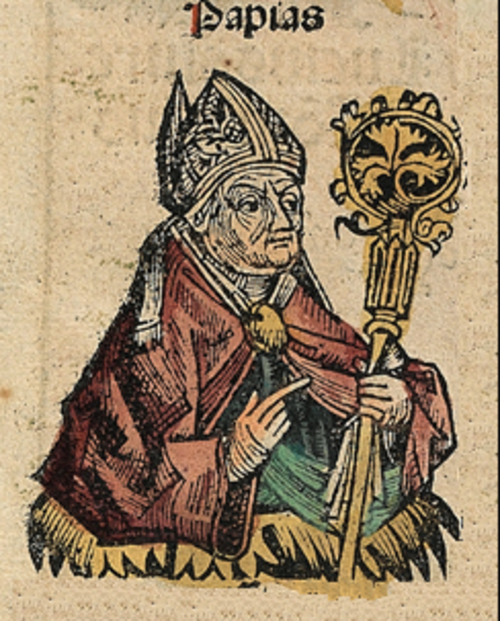
Saint
Papias of Hierapolis
Bishop of Hierapolis
Bishop of Hierapolis in the second century, who gathered sayings of the apostles' disciples about the Lord.
- Feast
- February 22old style March 7
- Reposed
- 1352nd century
- Place
- Hierapolis
- Order
- Hierarchs
Life
Saint Papias was bishop of Hierapolis in Phrygia, in Asia Minor, in the early second century, and is counted among the Apostolic Fathers. He is known for gathering testimony about the Lord from those who had known the disciples of the Apostles. He is commemorated on 22 February, and in some Russian calendars on 7 March.
His life
The dates of his life are not known with certainty. He is thought to have been born around 60 to 70 and to have served as bishop at Hierapolis, the city in the valley of the Lycus, near Laodicea and Colossae. Saint Irenaeus of Lyons, who mentions him in Against Heresies, calls him a hearer of John and a companion of Polycarp, a man of ancient times. Eusebius of Caesarea, reading Papias's own preface, notes instead that Papias was not himself a hearer of the Apostles, but received their teaching from those who had known them.
Papias says that he inquired carefully what Andrew, Peter, Philip, Thomas, James, John, Matthew and the other disciples of the Lord had said, as well as Aristion and the presbyter John. He questioned travellers who came to him, since he judged that "the living and abiding voice" helped him more than books. The daughters of the Apostle Philip also lived at Hierapolis, and he learned some accounts from them.
Exposition of the Sayings of the Lord
Papias wrote an Exposition of the Sayings of the Lord in five books, around 110. The work is lost, and fragments survive in Irenaeus and Eusebius. They are precious for the history of the Gospels. Papias reports, on the authority of the presbyter John, that Mark, the interpreter of Peter, wrote accurately but not in order what he remembered of Peter's preaching. Of Matthew he says that he set the sayings of the Lord in the language of the Hebrews, and each person interpreted them as best he could.
Papias also taught that the righteous would share in an earthly kingdom of a thousand years. Eusebius therefore thought him a man of small understanding, yet admitted that Papias was held in high esteem in the Church, among others by Irenaeus.
His end
The date of his death is uncertain. A late tradition speaks of a martyr's death at Pergamum around 164, but historians regard this as a confusion with the martyr Papylus, and place his death rather in the first half of the second century. Saint Papias is honoured among the Apostolic Fathers as an early witness to how the words and deeds of the Saviour were handed on before they were written down.
Commemorated the same day February 22
- Avilius of AlexandriaSaint · Patriarch of AlexandriaFeb 22
 Exuperius of AgaunumMartyr · Standard-bearer of the Theban LegionFeb 22
- Thalassius of SyriaVenerableFeb 22
 BaradatesVenerable · Hermit in SyriaFeb 22
- LimnaeusVenerable · Syrian hermitFeb 22
- Adarnase of KolaiMartyrFeb 22
- AnthusaMartyrFeb 22
- AristonSaint · Bishop of ArsinoeFeb 22
- Athanasius the ConfessorConfessorFeb 22
- Bakar of KolaMartyrFeb 22
- Barbara LosevaMartyrFeb 22
- Bardzim of KolaMartyrFeb 22