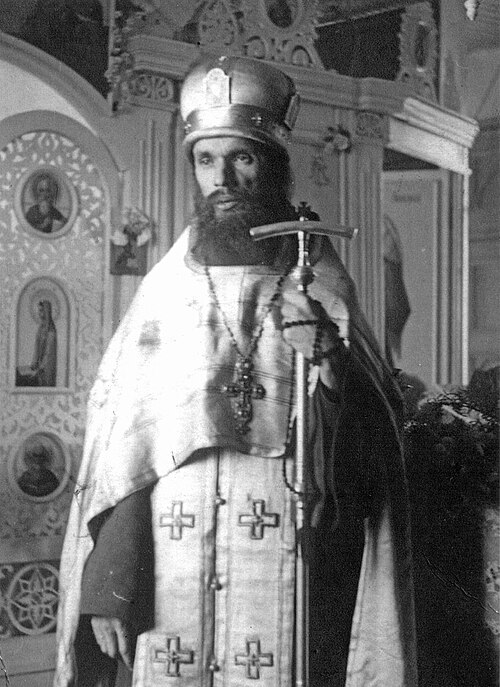
Saint
Philaret Voznesensky
First Hierarch of the Russian Church Abroad
Metropolitan, First Hierarch of the Russian Church Abroad, born in 1903 at Kursk, died in 1985 in New York.
- Reposed
- 198520th century
- Place
- Manhattan
- Order
- Hierarchs
Life
Metropolitan Philaret Voznesensky, born Georgy Nikolayevich Voznesensky, was the third First Hierarch of the Russian Orthodox Church Outside Russia from 1964 to 1985, with the title of Metropolitan of New York and Eastern America. He was born in 1903 in Kursk and reposed in 1985 in New York. He is remembered as a pastor strict with himself and gentle with others, who confessed the faith before the atheist authorities in Manchuria and led the Russian Church of the diaspora through years of weighty decisions.
Family and youth
He was born on 22 March 1903, Old Style, in Kursk, to Nicholas Fyodorovich and Lydia Vasilyevna Voznesensky. The family moved in 1905 to Kharkov, where his father was ordained a priest, and in 1909 to Blagoveshchensk on the Amur, where Father Nicholas became archpriest of the cathedral.
In August 1920, having finished the eight-year gymnasium, Georgy fled with his family from Blagoveshchensk, now under Soviet rule, to Harbin in Manchuria, where his father served at the Cathedral of Saint Nicholas. His mother died in 1921, and his father later became a monk with the name Dimitri and rose to be Archbishop of Hailar. He died in 1947, shortly after returning to the Soviet Union.
Archbishop Nathanael (Lvov), who knew the family well, remembered the rectory of the Iveron Icon church in Harbin as a place full of a bright Orthodox spirit and rich conversation around the evening table. Young Georgy loved mathematics for its pure and dispassionate clarity.
Studies
Since Harbin had no theological school, he attended the Russo-Chinese Polytechnic Institute and graduated in 1927 as an electromechanical engineer. His thirst for theological learning remained unsatisfied. He was accepted at a theological institute in the United States, but the conditions attached led him to give up the plan.
His father then worked to found pastoral and theological courses in Harbin, which the Synod of Bishops recognised as a higher theological school. Georgy completed them in 1931 at the Institute of Saint Prince Vladimir, where he later taught Pastoral Theology, Homiletics, and the New Testament.
Ordination and monastic life
In 1929 his friend Vasily Lvov became a monk with the name Nathanael, and Georgy began to visit the House of Mercy in Harbin often. On 18 May 1930 Bishop Nestor (Anisimov) of Kamchatka ordained him a celibate deacon, and on 4 January 1931 a priest, at the consecration of a new side chapel in the church of the House of Mercy.
On 12 December 1931 he was tonsured a monk with the name Philaret, in honour of Saint Philaret the Merciful. Nathanael wrote that this marked the beginning of a monastic community at the House of Mercy. The two young monks served in turn, read the prayer rule and the Fathers, and two monks who had fled the Holy Trinity Monastery at Shmakovka brought them the Valaam rule.
The canonical standing of ordinations performed by Bishop Nestor in another bishop's diocese was for a time unclear, but the Synod of the Church Abroad recognised them. Father Philaret was raised to hegumen in 1933 and to archimandrite in 1937, and in 1944 he became rector of the Iveron Icon parish, succeeding his father.
A man of prayer
Those who knew him agree that he was a true ascetic. He slept little, fasted strictly, gave alms to all who asked, loved the services, and knew the Gospel by heart. His ascetic life did not make him withdrawn: he was good company, had a gentle sense of humour, knew many stories about the life of the clergy, and composed church music.
Young people followed him gladly. When the Chinese Eastern Railway was sold to Japan in the mid-1930s, many young Russians raised in Soviet schools were left in Harbin without work. Father Philaret, a keen fisherman, took them with him to the banks of the Sungari River, and by the evening fire, in quiet conversation, many of them came to faith.
Confessor in Red Manchuria
After the Soviet army occupied Manchuria in 1945, the aged Metropolitan Meletius (Zaborovsky) of Harbin submitted to the Moscow Patriarchate, and Archimandrite Philaret thus came under its jurisdiction. He firmly refused, however, to take a Soviet passport or to commemorate the atheist government at the services, and urged his flock to do the same. To a journalist who wanted words of gratitude for Soviet citizenship he replied that he knew of no change in the USSR, but knew a great deal about destroyed churches and the persecution of clergy and believers.
Some accounts say that Soviet passports were burned after his services. The hatred stirred by his preaching led to an attempt to burn him alive in his cell. He escaped, but with severe burns. He later called Communist Manchuria a "red cage".
In 1946, at meetings of the bishops, he was three times admonished to stop preaching on political themes. In 1947 he was removed from the Iveron church and sent to the Vladimir Mother of God Monastery at Solnechnaya Pad in the Three Rivers region. In 1949 Bishop Nikandr (Viktorov) brought him back to Harbin but placed him in a remote parish to shield him, and more than once had to defend him before the authorities.
In 1956 he became rector of the church of the Joy of All Who Sorrow icon at the House of Mercy, where he served until he left China. After his departure the services ceased, and in 1964 the church was closed.
Departure for Australia
By then Russians were leaving China in great numbers. The Synod of the Church Abroad, knowing his unyielding stance toward communism, had been trying since 1953 to get him out, but his exit visa was deliberately delayed. Only in 1962 was he able to reach Hong Kong.
Although he was regarded as a confessor, he had to ask forgiveness for having been under the Moscow Patriarchate since 1945 and sign a statement of repentance, which the Synod approved on 29 March 1962. On 3 April 1962 he arrived in Sydney, where a crowd of former parishioners from Harbin met him at the airport and escorted him to Archbishop Sabbas (Rayevsky). He soon went on to Brisbane, where many of his former flock from Manchuria had settled.
At the Council of Bishops in October 1962 it was proposed to send him to the diocese of Brazil, but the ailing Archbishop Sabbas insisted that he remain in Australia as vicar and possible successor. On 26 May 1963 he was consecrated Bishop of Brisbane, vicar of the diocese of Australia and New Zealand, by Archbishop Sabbas and Bishop Anthony (Medvedev). Bishop Dionysius of Nazianzus of the Ecumenical Patriarchate attended but did not concelebrate. When Archbishop Sabbas fell seriously ill, Bishop Philaret was for a time placed in charge of the diocese.
Election as First Hierarch
In the early 1960s the Church Abroad was divided between supporters of Saint John (Maximovitch) and those of Archbishop Nikon (Rklitsky). The first wanted a Church open to all and saw conciliarity as the living foundation of church life; the second put first the preservation of Russian tradition and the old synodal order. On 7 February 1964 the ninety-year-old Metropolitan Anastasy (Gribanovsky) announced his wish to retire.
At the council of 27 May 1964 the votes were split almost evenly between the two archbishops. Metropolitan Anastasy advised the bishops to choose a young bishop who belonged to neither side. Saint John Maximovitch proposed Bishop Philaret, the youngest by consecration, and withdrew his own candidacy to avoid a division. Archbishops Nikon and Averky (Taushev) did the same, and Metropolitan Anastasy approved the election.
On 31 May 1964 the enthronement took place in the Synodal Cathedral of the Icon of the Sign in New York. After the Liturgy the new metropolitan was vested in the white klobuk, and Saint John Maximovitch, as the senior hierarch, handed him the pastoral staff.
The years as First Hierarch
Metropolitan Philaret's twenty-one years at the head of the Church Abroad were a time of significant decisions. In 1970 the Church Abroad anathematised Lenin and the persecutors of Orthodoxy. In 1981 it glorified Tsar Nicholas II with his family and servants, together with the New Martyrs of Russia. The metropolitan also wrote open letters to the Orthodox bishops, known as the "Sorrowful Epistles", expressing his alarm at the ecumenical movement.
In 1982 a bishop, Lazarus (Zhurbenko), was consecrated for the hidden believers in the Soviet Union. In August 1983 the Council of Bishops under Metropolitan Philaret anathematised ecumenism. During these years the Church Abroad drew apart from the other local Orthodox Churches and came closer to Old Calendarist communities.
Repose and veneration
Metropolitan Philaret reposed on 21 November 1985 at his home in Manhattan, in his eighty-second year. He was buried in the cemetery of the Dormition church at Jordanville. In November 1998 the Synod decided to move his remains to a new vault beneath the altar of Holy Trinity Cathedral at the monastery in Jordanville, New York, and when the tomb was opened his body was found incorrupt.
Metropolitan Philaret has not yet been glorified by any local Orthodox Church. Several groups that separated from the Church Abroad and stand outside canonical Orthodox communion proclaimed him a saint between 2001 and 2009 and call him "the Confessor". In 2012 the Eastern American Diocese of the Russian Orthodox Church Outside Russia, under Metropolitan Hilarion (Kapral), formed a commission to gather testimony about his life and miracles toward a possible glorification. Many faithful visit his tomb at Jordanville and read his teachings, which have also been published in English.