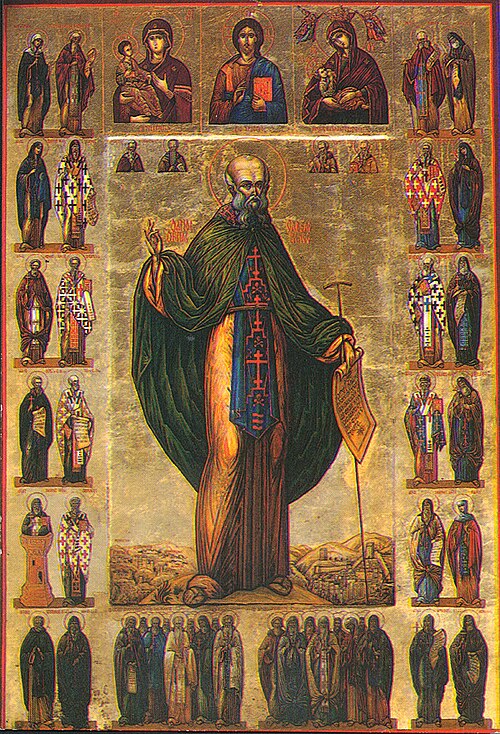
Venerable
Sabbas the Sanctified
Founder of Mar Saba Lavra
Monk from Cappadocia, founder of the lavra near Jerusalem that bears his name, who died in 532.
- Feast
- December 5old style December 18
- Reposed
- 5326th century
- Place
- Holy Lavra of Saint Sabbas
- Order
- Venerables
Life
Saint Sabbas the Sanctified was a monk, priest and father of the hermits of Palestine, founder of the Great Lavra near Jerusalem, today called Mar Saba. He was born in Cappadocia, lived mostly in Palestine and died in 532, on 5 December, the day on which he is commemorated. He is called “the Sanctified” because he was ordained priest and set as guide of the hermits. He is the author of the order of services in the Jerusalem Typikon, still used in the Orthodox Churches today.
Childhood and apprenticeship
He was born in 439 at Moutalaske, near Caesarea of Cappadocia, to John, a military commander, and Sophia, both Christians. When his parents left for Alexandria on military business, Sabbas, five years old, was left in the care of an uncle. At eight he entered the nearby monastery of Bishop Flavian of Antioch. The gifted child quickly learned to read and became a good student of the Scriptures. He resisted his parents’ urging to return to the world and marry, and at seventeen received the monastic tonsure. He spent ten years in that monastery, then went to Jerusalem and to the monastery of Saint Euthymius the Great, who sent him to Abba Theoctistus, father of a nearby monastery with a strict cenobitic rule. He lived there in obedience until the age of thirty.
After Theoctistus’ death, his successor blessed him to withdraw to a cave; on Saturdays he came out to the monastery, to serve and eat with the brethren. After a time he received permission not to leave his hermitage at all, and he lived five years in the cave. Euthymius watched the young monk’s life carefully and, seeing his spiritual maturity, took him with him each year into the wilderness, from 14 January until Palm Sunday, calling him “child-elder”.
Hermit and founder
After Euthymius’ death (around 473), Sabbas withdrew from the lavra and settled in a cave near the monastery of Saint Gerasimus of the Jordan. After some years disciples began to gather around him, and the Great Lavra arose, in the Kidron Valley south of Jerusalem, in 484 by the usual dating. Because some monks opposed his rule and demanded a priest as abbot, he withdrew to the New Lavra, built near Thekoa. In the lavras the young monks lived in community, and the elders in cells of their own, coming to the solemn services. Patriarch Sallustius of Jerusalem ordained him priest and named him archimandrite of the hermits, and Theodosius of those living in communities. Sabbas founded several lavras and monasteries, among them, according to some sources, four lavras, six monasteries and four hostels. His Life tells of many miracles: at his prayer water welled up in the lavra, abundant rain fell in time of drought, and the sick and possessed were healed.
Sabbas defended the faith of Chalcedon against the Monophysites and Origenists; he went to Constantinople in 511 to Emperor Anastasius I, who favoured the Monophysites, and in 531 to Emperor Justinian, to ask his help for rebuilding the churches damaged in the Samaritan revolt, for a hospital in Jerusalem and a fortress in the desert to protect monks from Saracen raiders. He was so esteemed that the emperor and empress asked his blessing and prophecies. On returning from this last journey he died, at ninety-four, on 5 December 532.
The Typikon and his relics
Around 524 the order of services written by him, called the Jerusalem or Palestinian Typikon, was introduced in Sabbas’ Lavra, and spread through the monasteries of Palestine and then the whole Orthodox East. It is a standard work of liturgy, used by all the Orthodox Churches. His Life was written by his disciple Cyril of Scythopolis. His relics were preserved incorrupt, as Cyril says, who saw them. In the Middle Ages they were taken to Italy and placed at Venice, and in 1965 Pope Paul VI sent them back to the monastery of Mar Saba, as a gesture of goodwill toward the Orthodox; they lie there intact. Many renowned monks came out of the Great Lavra, among them Saint John of Damascus. The church of San Saba in Rome, the church of Saint Sabbas in Iași and the National College “Sfântul Sava” in Bucharest bear his name.
Commemorated the same day December 5
 Dalmatius of PedonaHieromartyr · Preacher of northern ItalyDec 5
 Bassus of LuceraHieromartyr · First bishop of LuceraDec 5
 Bassus of NiceHieromartyr · Bishop of NiceDec 5
- Elias ChetverukhinHieromartyr · Archpriest of MoscowDec 5
- Savva of MoshokRighteous · Priest of MoshokDec 5
- AberciusMartyrDec 5
- Aprus of SensVenerable · Monk of SensDec 5
- Basilissa of OerenVenerable · Abbess of OerenDec 5
- CawrdafVenerableDec 5
- Colman ua h-EircSaintDec 5
- Cosmas of Mount AthosVenerable MartyrDec 5
 CrispinaSaintDec 5