Right-Believing
Sebbi of Essex
King of Essex
King of Essex from 664, sole ruler after Sighere's death until 694, venerated as a saint.
- Feast
- August 29old style September 11
- Reposed
- 6947th century
Life
Saint Sebbi (Sæbbi, Sebba), king of Essex, was a Christian king of Anglo-Saxon England, venerated as a saint from the time of the undivided Church. He was the son of King Sexred and ruled in Essex jointly with his cousin Sighere from 664 to about 683 and then alone until 694, when he withdrew to a monastery. He died in 695 (the sources give 29 August 694 or 695) and was buried in Old St Paul's Cathedral in London. The Orthodox Church commemorates him on 29 August, as does the Roman Martyrology.
His reign
Sighere and Sebbi were cousins of their predecessor, Swithelm, who died in 664 during a great plague. In the view of scholars, Sebbi was in a dependent position to Sighere. In 665 Sighere apostatized and fell back into paganism, together with part of the nobility, while Sebbi remained a faithful Christian. A rivalry arose between them: Sighere found support in Wessex, Sebbi in Mercia. Because of this rivalry King Wulfhere of Mercia established himself as overlord of Essex in 665. He sent Jaruman, bishop of Mercia, to reconvert the people of Essex to Christianity. The Ukrainian source says that Sebbi, allied with Wulfhere, attacked Sighere, who was defeated and forced to return to Christianity, and both recognized Mercian overlordship. The Russian source tells it differently: Sighere fled the country in 683, returned in 687 and was reconciled with Sebbi; these sources do not agree either on the date he came to the throne (the Russian source gives 694, which is actually the year of his withdrawal).
In 686 Cædwalla, a Wessex sub-king, established himself as overlord of Essex. He and Sebbi invaded Kent, expelling King Eadric, and Sebbi ruled over West Kent (the Ukrainian source adds that Sighere and Cædwalla went with him). It was then, presumably, that Sebbi founded the original abbey at Westminster; the Ukrainian source says he gave large sums for its restoration and equipment. After the death of Sighere (about 683 according to the English source; 689 according to the Ukrainian), Sebbi remained sole ruler of Essex until 694. He kept up a policy of peace with Wessex and Mercia, manoeuvring between these kingdoms, and gave much support to the clergy, doing much for the full Christianization of Essex.
It is believed that in 694 he abdicated to enter a monastery; he was succeeded by his sons Sigeheard and Swæfred, who ruled jointly over Essex. Another son, Swæfheard, ruled in Kent.
His retirement and end according to Bede
Bede the Venerable relates (IV, 11) that Sebbi was a devout man, much given to acts of religion, almsgiving and frequent prayer. He preferred a private and monastic life to all the wealth and honours of his kingdom, a life he would long before have embraced had his wife not positively refused to be separated from him; for this reason many said that a person of such a disposition ought rather to have been a bishop than a king. After thirty years as king and a soldier of the heavenly kingdom, he fell into a violent sickness. He admonished his wife that they should jointly devote themselves to the service of God, since they could no longer enjoy, or rather serve, the world. With much difficulty he obtained this from her. He went to Waldhere, bishop of London, who had succeeded Earconwald, and with his blessing received the religious habit he had long desired. He brought the bishop a considerable sum of money for the poor, reserving nothing for himself, but wishing to remain poor in spirit for the sake of the kingdom of heaven.
When the illness increased and he felt the day of his death approaching, being a man of royal disposition he feared that, in pain and at the approach of death, he might do something unworthy of his person, in word or in any movement of his limbs. So he called the bishop of London, in which city he then was, and asked that no one be present at his death besides the bishop and two attendants. The bishop promised to do this most willingly. Not long after, the man of God fell asleep and saw a comforting vision, which took from him all his anxiety and showed him the day on which he was to depart this life. Three men in bright garments came to him: one sat before the bed, the others stood and asked about the state of the sick man. The one by the bed said that his soul would leave the body without pain and in a great splendour of light, and declared that he would die on the third day; both came to pass. On the third day he suddenly fell, as it were, into a slumber, and breathed out his soul without sense or pain.
A stone coffin had been prepared for his burial, but the body was a span longer. They cut away the stone and lengthened the coffin by two fingers, but still it would not hold the body. They thought either to find another coffin or to shorten the body by bending it at the knees. But a wonder of Providence prevented these plans: suddenly, in the presence of the bishop, of Sighard, the king's son who had turned monk and was to reign after him jointly with his brother Suefred, and of many men, the coffin was found to match the length of the body, so that a pillow could also be put at the head, and at the feet the coffin was four fingers longer than the body. He was buried in the church of the blessed Apostle of the Gentiles, Paul, by whose teaching he had learned to hope for heavenly things.
His tomb
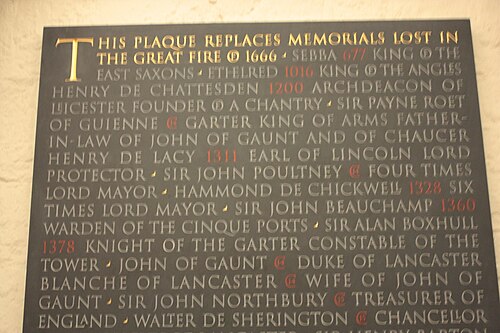
Sebbi's tomb survived the fire of 1087 at St Paul's, and his remains were moved to a black marble sarcophagus in the second half of the twelfth century. The sarcophagus was drawn by Wenceslaus Hollar in the series published in Dugdale's history of the cathedral. The tomb was destroyed in the Great Fire of London in 1666. A plaque to Sebbi was set up in Wren's cathedral.
Commemorated the same day August 29
 Sabina of RomeMartyrAug 29
 Anastasios of StrumicaNew MartyrAug 29
- Adelphus of MetzSaint · Bishop of MetzAug 29
- AlbericVenerableAug 29
- Antim GainaVenerable · Elder of Secu MonasteryAug 29
- ArcadiusSaintAug 29
- Arkadios the WonderworkerSaint · Bishop of ArsinoeAug 29
- Basil I the MacedonianRight-Believing · Emperor of ByzantiumAug 29
- Basil of SirmiumMartyrAug 29
- Basilla of SirmiumMartyrAug 29
- CandidaMartyrAug 29
- Eadwold of CerneVenerableAug 29