Right-Believing
Sergios Niketiates
Byzantine official
Senior Byzantine official of the Amorian dynasty, honored on June 28 for his role in restoring the icons in 843.
- Feast
- June 28old style July 11
- Reposed
- 8439th century
Life
The righteous Sergios Niketiates, also called Sergios the Magistros, was a senior Byzantine official of the ninth century, a close relative of the Empress Theodora, wife of Emperor Theophilos. The Church commemorates him on 28 June for the role he had in 843 in the restoration of the veneration of the holy icons and the end of the iconoclast struggle. Very little is known of his life. The scholar Cyril Mango called him an "enigmatic" figure.
What is known
Sergios is known only from brief references in two hagiographic works, the Acts of Saints David, Symeon and George, and the Synaxarium of Constantinople. According to them he was born in the village of Niketia, near Amastris in Paphlagonia, whence his surname. He was a close relative, probably the uncle, of the Empress Theodora, wife of Emperor Theophilos (829 to 842) and mother of Michael III (842 to 867). Under Theophilos he became one of the leaders of the Senate in Constantinople, rising to the highest court rank, that of magistros. Seals attributed to him show that he rose gradually through the ranks of hypatos, anthypatos, protospatharios and patrikios and that he held the office of General Logothete or Logothete of the Drome, depending on how the seals are read.
The restoration of the icons
In 843 Sergios had a decisive part, with the logothete Theoktistos and Theodora's brothers, Bardas and Petronas, in the final abandonment of iconoclasm and the restoration of the veneration of icons. For this deed he is commemorated as a saint by the Orthodox Church on 28 June. The Greek source calls him "Saint Sergios the righteous, the magistros".
The Cretan expedition and his tomb
In the same year, according to the Synaxarium of Constantinople, he was entrusted with leading an expedition against the emirate of Crete, but all the other sources say Theoktistos led the campaign. It is possible, however, that Sergios was left behind when Theoktistos was forced to return in haste to Constantinople. Sergios died on Crete, where the Byzantine forces were defeated by the Arabs, and was buried first on the island, in a monastery that was called after him "of the magistros". Later he was moved to a monastery of the Mother of God in the Gulf of Nicomedia, which he had founded and which came to be called "of Niketiates".
Rejected conjectures
The French Byzantinist Henri Grégoire supposed that Niketiates should be identified with "Ibn Qatuna", the admiral who, in the Arabic sources, led the Byzantines in the sack of Damietta in 853, and the hypothesis was taken up by some, among them Alexander Vasiliev, but is rejected by present-day scholars. Grégoire also supposed that Sergios was the brother of the later Patriarch Photios, a supposition also rejected, though, according to Mango, he could be Photios's uncle on his mother's side.
Commemorated the same day June 28
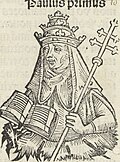 Paul I of RomeSaint · Bishop of RomeJun 28
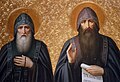 Sergius of ValaamVenerable · Founder of Valaam MonasteryJun 28
 AustolSaint · Cornish saint in BrittanyJun 28
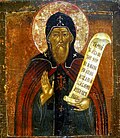 Xenophon of RobeikaVenerable · Russian monkJun 28
- Sergius and Herman of ValaamHoly Venerables · Founders of Valaam MonasteryJun 28
- PotamiaenaMartyrJun 28
- Paraskeva of ToplovkaVenerable · Abbess of Toplovsky ConventJun 28
- Budimir SokolovićNew MartyrJun 28
- Gregory SamarinHieromartyr · PriestJun 28
- 70 Martyrs of ScythopolisHoly MartyrsJun 28
 Argymirus of CórdobaMartyrJun 28
- AttiliusMartyrJun 28