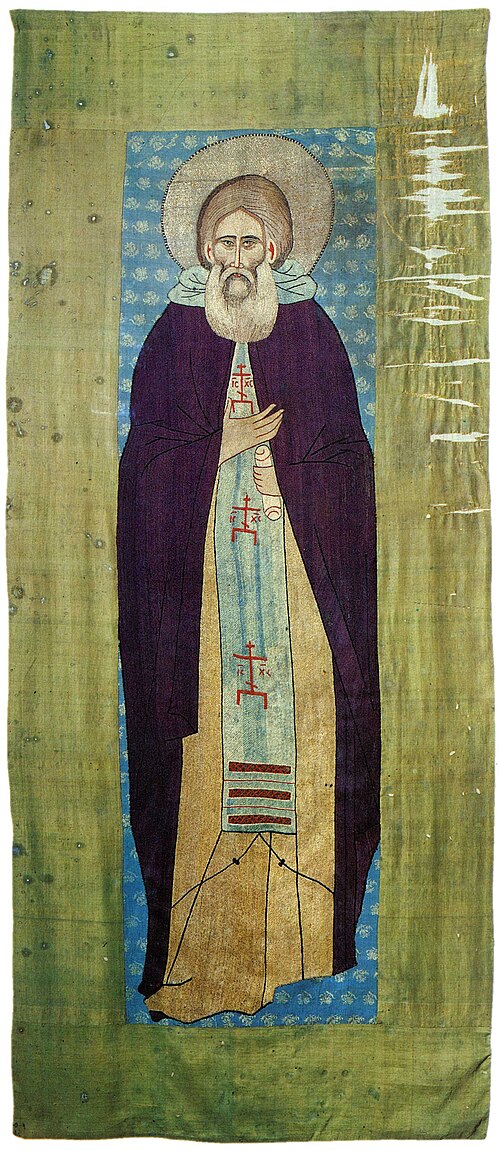
Venerable
Sergius of Radonezh
Founder of the Trinity Lavra
Great Russian ascetic, founder of the Trinity Lavra and father of monastic renewal in Russia.
- Feast
- September 25old style October 8
- Reposed
- 139214th century
- Place
- Sergiyev Posad
- Order
- Venerables
Life
Venerable Sergius of Radonezh is the best loved saint of Russia. He was a hermit, then abbot, and the founder of the monastery of the Holy Trinity, today the Trinity Lavra of Saint Sergius, and he renewed monastic life in north-eastern Russia in the fourteenth century. For his humility, his prayer and his care for his people he is called the abbot of the Russian land. The Church commemorates him on 25 September, the day of his repose, and on 5 July, the finding of his relics.
Almost all we know of him comes from the Life written in the fifteenth century by his disciple Epiphanius the Wise and revised by Pachomius the Serb. It is a work of devotion, and some details are tradition.
Childhood
He was born in a boyar family, Cyril and Maria, near Rostov, in the village generally taken to be Varnitsa, on 3 May (Old Style). The year is given as 1314 by the Church, though historians have also suggested 1319 or 1322. He was baptized Bartholomew. According to the Life, before his birth the child cried out three times in his mother's womb during the Liturgy, and as an infant he would take no milk on Wednesdays and Fridays, so that from the first days he kept the fast.
At the age of seven he was sent to school with his brothers Stephen and Peter. Bartholomew could not learn to read, however much his teacher tried, and he was scolded and laughed at. One day, while looking for his father's horses, he met a monk praying under an oak. The boy asked the old man to pray that he might learn his letters. The monk blessed him and gave him a piece of consecrated bread, saying it was a sign of grace and understanding of the Scriptures. He visited the parents' house, asked the boy to read the Psalter, and foretold that he would be great before God and men. From that day Bartholomew read with ease. The Church understands the monk as an angel. The scene is a favourite subject of Russian painting.
Around 1328 the family, impoverished when the Rostov lands were taken over by Moscow, moved to Radonezh. Cyril and Maria took the monastic schema at the Khotkovo monastery shortly before their death.
The wilderness
After burying his parents, Bartholomew and his brother Stephen went into the deep forest about twelve versts from Radonezh, on Makovets hill. They built a cell and a small church that, with the blessing of Metropolitan Theognostus, was consecrated to the Holy Trinity. Stephen, unable to bear the hardships, soon left for the Epiphany monastery in Moscow. On 7 October 1337 Bartholomew was tonsured by the abbot Mitrofan and took the name Sergius, after the martyr of that day. He lived alone, enduring temptations and visions.
Gradually other monks came, and a brotherhood of twelve formed. Sergius served them all with his own hands, building cells, carrying water, chopping wood, baking bread and sewing clothes, and he joined to this work prayer, vigil and fasting. The brothers were surprised that such labour left his health unharmed. They begged him with difficulty to become their abbot, and in 1354 Bishop Athanasius of Volhynia ordained him priest and made him abbot.
The common life
The fame of Sergius reached Constantinople. Patriarch Philotheus sent him a cross, a paramand and a schema, with a letter of blessing, advising him to establish a strict common life in which monks share everything. Sergius took the letter to Saint Alexis, Metropolitan of Moscow, who counselled the same. When some monks grumbled at the strictness, Sergius left, and founded a new monastery on the river Kirzhach dedicated to the Annunciation. Matters at the Trinity monastery fell into disorder, and the monks asked Alexis to bring him back. Sergius obeyed the hierarch without argument and returned, leaving his disciple Roman at Kirzhach.
The monastery became the model for the renewal of Russian monasticism. His disciples and their disciples founded dozens of monasteries across northern Russia, and some say a quarter of all Russian monasteries came from his school. Among them were Nikon, Savva of Storozhevsk, Andronicus of Moscow, Cyril of White Lake and Athanasius of Serpukhov. Metropolitan Alexis, in his old age, begged Sergius to succeed him, but Sergius refused, preferring to remain a simple monk.
Miracles and visions
Already in his lifetime Sergius was granted the gift of wonderworking. He restored to life a boy whose father had given him up as dead, and people came to him from near and far to be healed and taught. One day Saint Stephen of Perm, who was journeying to Moscow, stopped eight versts from the monastery, bowed in prayer and said, "Peace to you, spiritual brother." At that moment Sergius was at table with the brothers, and he rose, prayed and blessed the bishop in return from afar. Another time, during the Liturgy, an angel of the Lord served with him, and he forbade the brothers to speak of it while he lived. One night, the Mother of God appeared to him with the Apostles Peter and John, touched him, and promised to protect his monastery forever.
For his land
Russia was then under Tatar rule. In 1380 the Grand Prince Dmitry of the Don came to Sergius for his blessing before the battle. Sergius blessed him, foretold his victory, and gave him two monks of the monastery, Alexander Peresvet and Andrei Oslyabya. On 8 September 1380, the feast of the Nativity of the Mother of God, the Russians won on the field of Kulikovo, the beginning of the end of Tatar domination. During the battle Sergius and the brothers stood in prayer. Historians note that he took part in public life only with reluctance and after he was sure that Dmitry had tried every peaceful means.
Repose and veneration
Six months earlier Sergius foresaw his end and named his disciple Nikon abbot. On the eve of his repose he gathered the brothers a last time and told them to keep the fear of God, purity of soul and unfeigned love. He fell asleep in the Lord on 25 September 1392.
In 1408 the Tatars of Edigei burned the monastery. Nikon, in a vision, was warned beforehand, and saved the sacred things. On 5 July 1422, when Nikon was abbot and a new stone church of the Trinity was begun on the site, Sergius appeared to a pious layman and asked why he was left so long in the earth and in water. In digging the foundations his relics were found incorrupt, with even his clothing unharmed. The relics were later placed in the Trinity cathedral, where they remain. The Church placed him among the saints in the middle of the fifteenth century (1448 or 1452 are given).
The Trinity Lavra stands at Sergiyev Posad, some seventy kilometres from Moscow, and is the first monastery of Russia. The icon of the Holy Trinity by Andrei Rublev, who lived there, was painted in praise of Sergius at the urging of Nikon. In the Soviet years the monastery was closed and the relics taken from the cathedral. They were returned to it in 1946, when the Lavra was reopened. The Catholic Church and the Church of England also remember Saint Sergius on 25 September.
Commemorated the same day September 25
 Firmin of AmiensHieromartyr · Bishop of AmiensSep 25
 Finbarr of CorkSaint · Bishop of CorkSep 25
 Paphnutius of EgyptVenerable Martyr · Hermit of EgyptSep 25
- Arsen of SaparaSaint · Catholicos of GeorgiaSep 25
- AbadirMartyrSep 25
- Ainmire of Ross ua ChonnaSaintSep 25
- Anacharius of AuxerreSaint · Bishop of AuxerreSep 25
 Arsenius the GreatSaintSep 25
- Aunarius of AuxerreSaint · Bishop of AuxerreSep 25
- Aurelia and NeomisiaSaintsSep 25
- Aurelia of AnagniMartyrSep 25
- Bardomian, Eucarpus and twenty-six companionsHoly Martyrs · Martyrs of AsiaSep 25