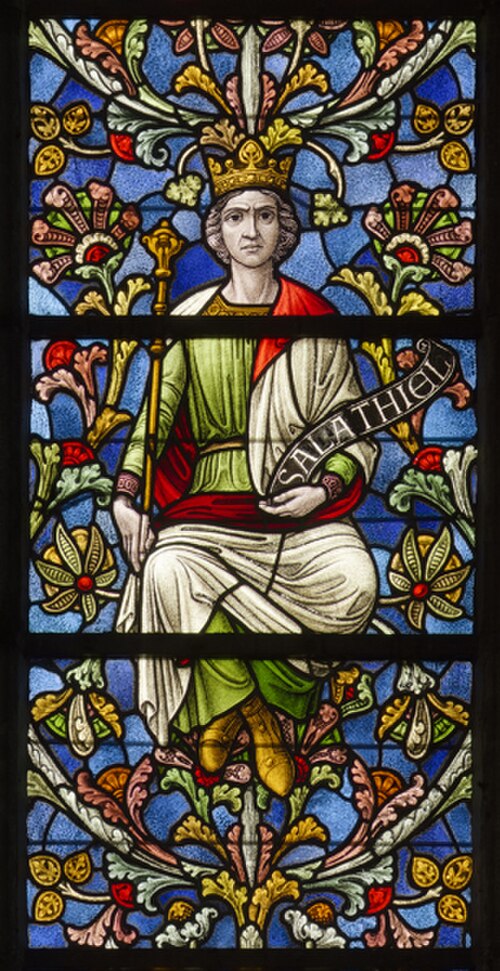
Righteous
Shealtiel
Ancestor of the Savior
Son of King Jeconiah, named in the genealogy of the Savior in the Gospel of Matthew.
- Reposed
- 541 BC6th century BC
- Order
- The Righteous
Life
Saint Shealtiel, called Salathiel in Greek, is an ancestor of the Savior according to the flesh, named in the genealogy of the Lord in the Gospel of Matthew. He was the son of King Jehoiachin, also called Jeconiah, and the father of Zerubbabel. The Orthodox Church honours him among the saints of the Old Testament on the Sunday of the Forefathers, before the Nativity of the Lord.
Name and lineage
In Hebrew the name Shealtiel means "I asked God", that is, his parents regarded him as an answer to their prayer to God for a child. The Gospel of Matthew (1:12) shows Shealtiel as the son of Jeconiah, of the house of David and the line of Solomon, and the First Book of Chronicles also names him as a son of Jehoiachin.
In the Babylonian captivity
After the first siege of Jerusalem, in 597 BC, Nebuchadnezzar II, king of Babylon, carried Jeconiah, Shealtiel and most of the royal house and the leading men of the kingdom into captivity. In the Babylonian exile Shealtiel is regarded as the second exilarch, that is, king in exile, after his father.
The genealogy
Shealtiel is a significant but disputed figure in the genealogies of the house of David and of Jesus. The Hebrew text of the Old Testament calls Zerubbabel the son of Pedaiah, Shealtiel's brother, while other texts, and the Septuagint, call him the son of Shealtiel. Although both genealogies of the Savior list a Zerubbabel son of a Shealtiel, it is possible that they do not refer to the same persons. The two genealogies differ on Shealtiel's father: Matthew makes him the son of Jeconiah, while Luke (3:27) makes him the son of an otherwise unknown Neri. Many explanations have been offered, one common one being that Luke traces the genealogy of Jesus through the Mother of God, in recognition of the birth from the Virgin.
It is also suggested that, if Shealtiel died childless, his brother Pedaiah took his widow according to the law of levirate marriage, so that Zerubbabel would be the legal son of Shealtiel and the natural son of Pedaiah. Another view holds that the phrase "son of Shealtiel" shows only membership of his household. Finally, some think the Hebrew text of First Chronicles was altered by a scribe. The texts that call Zerubbabel "son of Shealtiel" have a political context, stressing Zerubbabel's claim to the throne of the Davidic dynasty.
The work that bears his name
The apocalypse 2 Esdras, which is not canonical for Jews and almost all Christians, the Orthodox included, presents itself as written by "Salathiel, who is also called Ezra", and is for that reason sometimes called Ezra Shealtiel. Ezra the scribe and Shealtiel lived many years apart, and Shealtiel's son Zerubbabel is the one who returned to Jerusalem. There is no historical evidence that Ezra was ever called Salathiel.