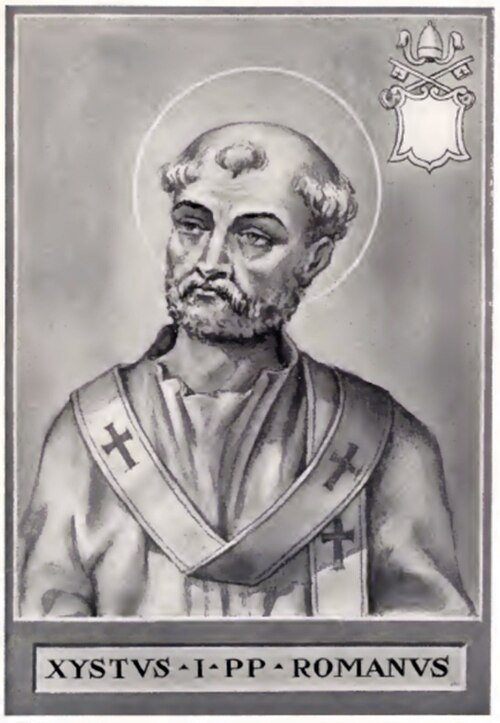
Saint
Sixtus I
Bishop of Rome
Bishop of Rome in the early second century, of Greek descent, successor of Alexander I.
Life
Pope Sixtus I (also spelled Xystus) was bishop of Rome in the first half of the second century, in the time of Emperor Hadrian. A saint of the undivided Church, he is commemorated in the Western calendar and in English-language Orthodox calendars, which sometimes call him a martyr.
He was a Roman, of Greek descent according to the Book of the Popes (Liber Pontificalis), and succeeded Alexander I; Telesphorus followed him. The years of his ministry are uncertain: the Liberian catalogue gives 117 to 126, Eusebius 119 to 128, and modern historians think he died around 125. Saint Irenaeus lists him as sixth after Peter among the bishops of Rome.
Almost nothing is known of his life. The Book of the Popes credits him with liturgical rules (that only ministers may touch the sacred vessels, that the priest recites the Sanctus with the people after the Preface), but historians regard these as anachronistic. He is said to have died a martyr, yet Irenaeus names only Telesphorus a martyr, so the martyrdom is not firmly attested. Tradition holds that he was buried near Peter's grave on Vatican Hill. The Romanesque crypt at Alife keeps relics venerated as his.
He is commemorated on 6 April in the Western calendar, and the calendar of pre-schism Western saints used by English-speaking Orthodox lists him on 3 April.
Commemorated the same day April 3
 Nicetas of MedikionConfessor · Abbot of Medikion MonasteryApr 3
 Agape of ThessalonicaMartyrApr 3
- UlphianusMartyrApr 3
- Nectarius of BezhetskVenerableApr 3
- Aristus of SicilySaintApr 3
- Attalus of TaorminaVenerableApr 3
- Benignus of TomisMartyrApr 3
- BithoniusMartyrApr 3
 BurgundofaraVenerable · Abbess of FaremoutiersApr 3
- Chrestus and PappusHoly MartyrsApr 3
- Comman son of DomainghinSaintApr 3
- DiusMartyrApr 3