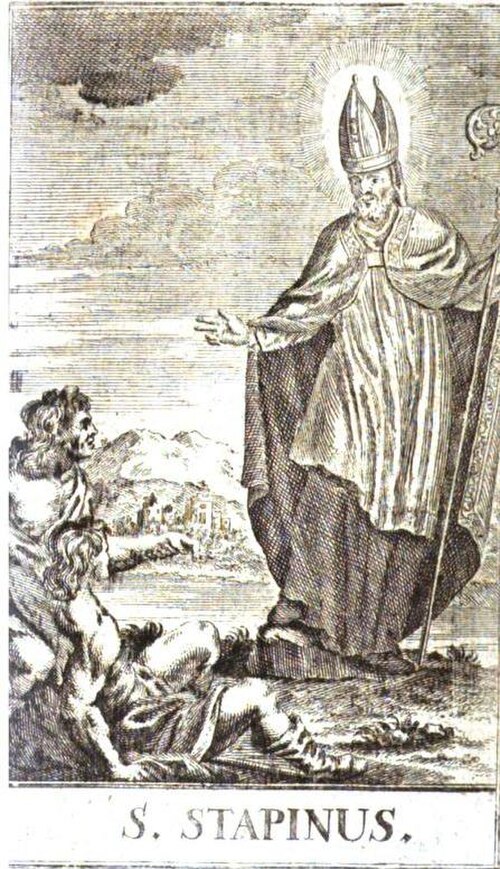
Saint
Stapinus
A saint honored at Dourgne in France, who reposed in 720.
Life
Stapin (Stapinus, Étienne, Estève) was a hermit and then bishop of Carcassonne, born in the 7th century in the hamlet of En Lanet near Dourgne, and died around 720 at Dourgne. He is venerated as a saint in the Western Church and commemorated on 6 August.
There is no reliable historical source about his person. The hamlet of En Lanet keeps the memory of his birth, at a place called Les Mirgues or Les Mourgues. An uncultivated piece of land in the middle of the fields bears the name "Camp de Sant Estapi"; there is a well there said to give fertility to women who wish to be mothers. Stapin chose the hermit's life in a deserted place called St. Ferréol, southeast of Dourgne, on the rock of the Abbade, where today stands a monument with a statue, built after the Second World War. He became known for his long hours of prayer, a rock being said to keep the mark of his knees, and for his ability to heal ailments of the legs.
Around 685 he was invited to become bishop of Carcassonne, but the thought frightened him; he was sought at Dourgne but hid in the caves of the region, among others in the Trou Cruzel. In the end he followed the call. According to another interpretation, he would have had to leave the bishopric between 719 and 725, at the Moorish conquest of Carcassonne. The village of Dourgne still celebrates its patron every year on 6 August.
He was venerated in the Middle Ages and modern times in several European countries, especially in southern France, Belgium and Germany, as protector of those suffering from gout. His cult is recorded in the Acta Sanctorum of the 17th century; in the 17th century chapels were dedicated to him at Milan and Lyon, and the Saint-Stapin brotherhood at Lyon was recognized by a brief of Pope Alexander VII in 1661. At Dourgne pilgrimages were made until the end of the 19th century; in the gorges of the Taurou stands a chapel dedicated to him, moved to the mountain in 1860.
Commemorated the same day August 6
 HormisdasSaint · Bishop of RomeAug 6
 Innocent the DeaconHieromartyr · Deacon at RomeAug 6
- Athanasius YegorovVenerable Martyr · ArchimandriteAug 6
 Habakkuk of ThessalonicaVenerable Martyr · Monk, New Martyr of ThessalonicaAug 6
- Cainnear of Cluain da SaileachSaintAug 6
- FelicissimusMartyrAug 6
- GlisenteVenerableAug 6
- HardulfVenerableAug 6
- Holy Martyrs of CardeñaHoly Venerable MartyrsAug 6
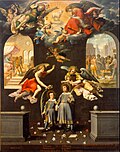 Justus and PastorHoly MartyrsAug 6
- Lughaidh of Cluain FobhairSaintAug 6
- Molioba of Gort ChirpSaintAug 6