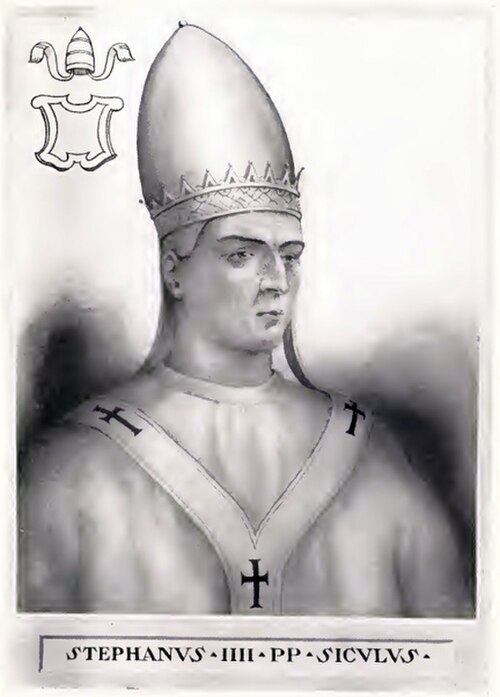
Saint
Stephen III of Rome
Bishop of Rome
Bishop of Rome from 768 to 772, a former monk at the Lateran.
- Reposed
- 7728th century
- Place
- Rome
- Order
- Hierarchs
Life
Stephen III of Rome was bishop of Rome from 7 August 768 to 24 January 772. Born around 720, he was a monk and a servant of the Lateran palace, and was elected in the midst of years of fierce struggle between the parties of Rome. In some sources he is called Stephen IV, because the Stephen elected in 752, who died before his consecration, is sometimes counted as well. He was honoured as a saint only locally, in Sicily, and was never canonized by the Church of Rome.
Early life
He was born in Sicily (according to some sources at Syracuse), to a Greek family, the son of Olivus. He came to Rome in the time of Pope Gregory III and entered the monastery of Saint Chrysogonus, where he became a monk. Under Pope Zachary he was ordained a priest, and the pope kept him at the Lateran palace. He rose gradually in the service of the Church under several bishops of Rome, and he stood at the deathbed of Pope Paul I, when rival parties had begun to prepare their own election.
His election
The year 768 was shaken by the claims of two antipopes: Constantine II, a layman put on the throne by a faction of Tuscan nobles, and Philip, the candidate of the Lombards. They were removed by Christophorus, head of the notaries, and by his son Sergius, treasurer of the Roman Church. Christophorus arranged an election according to the canons, to which clergy, army and people were summoned, and on 7 August the assembly chose Stephen, who was escorted through Rome to the Lateran palace and consecrated a few days later.
After the election the supporters of Stephen turned on Constantine's party with cruelty. Constantine himself was blinded, and many of his allies were blinded or mutilated, as were the people of Alatri, who had revolted. Stephen's part in these deeds is unclear: some historians say he was only a helpless bystander, others that he gave the orders himself, and others that he did not order them but did not oppose them either.
The Lateran council
In 769 Stephen asked for the help of the Frankish kings Charlemagne and Carloman, who sent twelve bishops to the Lateran council. The council condemned Constantine, annulled the clerical appointments he had made, and set strict rules for papal elections so that the nobles could no longer decide at will. Laymen could no longer be chosen, only those who had risen through the ranks of service to the diaconate or the priesthood. The council rejected the decisions of the iconoclast council of Hieria and confirmed the veneration of the holy icons.
Final years
In 770 Stephen refused to confirm the election of the layman Michael as archbishop of Ravenna, made with the support of the Lombard king Desiderius, and stood by Leo, who had been elected first. After more than a year, with the help of a Frankish envoy, Michael was removed and Leo was consecrated. Stephen feared the plans of the Lombards and tried to reconcile Charlemagne and Carloman, but in his last years he was in many ways bound to King Desiderius. Christophorus and Sergius, who had raised him to the throne, were brought down by Lombard intrigue and blinded, and Christophorus died after three days.
He fell asleep on 24 January or 1 February 772 and was buried in Saint Peter's Basilica, and Adrian I succeeded him. In the Middle Ages he was counted a saint in Sicily, where the old calendars commemorate him on 1 February. The people of Syracuse asked the Holy See to endorse his sainthood officially, but the request was not granted.