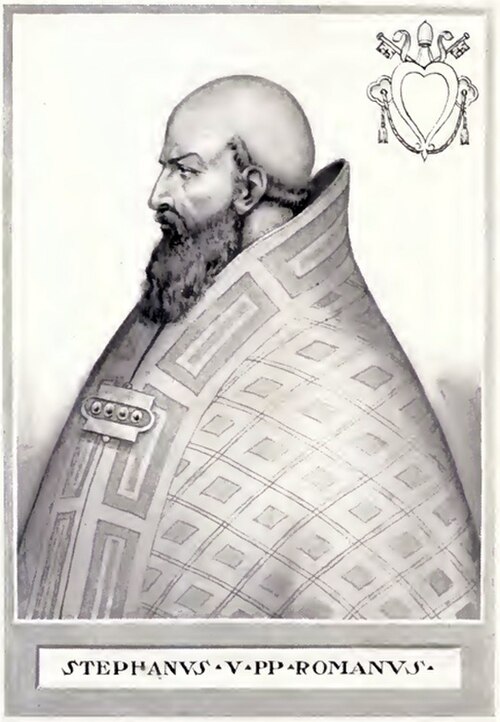
Saint
Stephen IV of Rome
Bishop of Rome
Bishop of Rome from 816 to 817, who crowned Louis the Pious.
- Reposed
- 8179th century
- Place
- Rome
- Order
- Hierarchs
Life
Stephen IV of Rome was bishop of Rome from 22 June 816 to 24 January 817. He is known above all for anointing and crowning the Frankish king Louis the Pious as emperor at Reims in 816. Some lists count him as Stephen V, because an old way of counting also places in the series a Stephen who was elected but died before consecration. He lived before the separation of the Churches, in the ninth century.
Youth and election
He was born at Rome around 770, into a noble family, the son of Marinus. The later popes Sergius II and Adrian II came from the same family. While still young he was brought up at the Lateran palace, in the time of Pope Adrian I, and Pope Leo III made him subdeacon and then deacon. He was loved by the people of Rome.
Leo III died on 12 June 816, and ten days later, on 22 June, Stephen was elected and consecrated bishop of Rome. It is thought that the very quick election was an attempt by the Roman clergy to keep the emperor Louis from interfering.
At Reims
Immediately after his consecration, Stephen ordered the Romans to swear loyalty to the emperor and informed him of the election through envoys. In August 816 he set out for the lands of the Franks, and in early October he met Louis at Reims, where the emperor threw himself to the ground three times before him.
At the liturgy on Sunday, 5 October 816, Stephen anointed Louis as emperor and set on his head a crown said to have belonged to Constantine the Great. At the same time he crowned his wife Ermengarde. Louis had already been made emperor in 813 without a pope, so many historians see in the act at Reims an attempt by the papacy to win a place in the crowning of emperors. The two renewed the pact between the popes and the Frankish kings, and Louis gave the Church of Rome an estate. The pope also asked for the release of Roman political prisoners, exiled after the troubles of Leo III's time.
On the way back he passed through Ravenna and reached Rome before the end of November. He fell asleep on 24 January 817 and was buried at Saint Peter's. Paschal I followed him.
Veneration
A Russian encyclopedia calls him a saint and says that he was canonized in the Roman Catholic Church, but the other sources consulted mention no veneration of him, and he has no day of commemoration in the Orthodox calendars. We therefore present him as a hierarch of the undivided Church, known above all for his deeds at Reims.