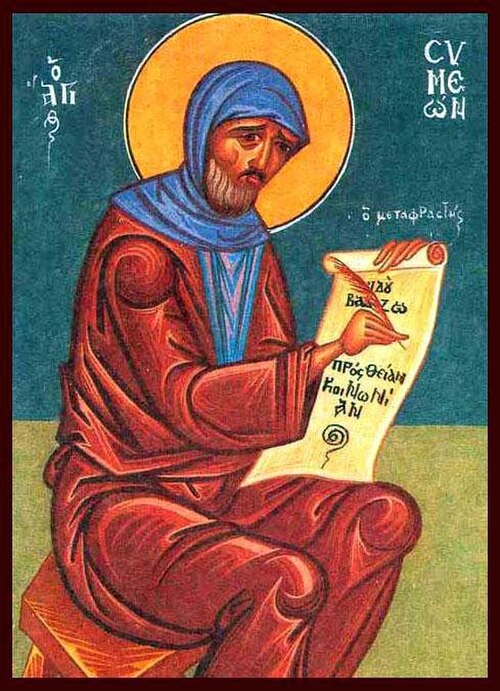
Venerable
Symeon Metaphrastes
Byzantine hagiographer
Byzantine writer and official who reworked the lives of the saints, and who died around the year 1000.
- Feast
- November 9old style November 22
- Reposed
- 98710th century
- Place
- Constantinople
- Order
- Venerables
Life
The venerable Symeon Metaphrastes was a Byzantine writer and official, known above all for his collection of lives of the saints, the Menologion. He lived in the second half of the tenth century. He is commemorated on 9 November.
His life
Little is known of his life. He is thought to have been born at Constantinople, in a distinguished family, and to have received a good literary education. He was an official of the court, secretary, then grand logothete, under several emperors, among them Nikephoros Phokas, John Tzimiskes and Basil II, and was sent on diplomatic missions. It is said that he saved the city of Thessalonica from the devastation with which the Arabs threatened it. Towards the end of his life he became patrician and magister, then, by some sources, a monk. It is told that myrrh flowed from his body.
His writings
Symeon wrote mainly hymns and lives of saints. He composed canons, stichera and a hymn to the Trinity, collected passages from the holy Fathers, above all from Saint Basil the Great, and it seems that some of the prayers of preparation before Holy Communion and of thanksgiving after it are his. His chief work, however, is the Menologion, in ten volumes, a collection of about a hundred and fifty lives of saints, arranged by the days of their commemoration in the Orthodox calendar. According to tradition it was commissioned by the emperor Basil II. Symeon was not content to gather and arrange old lives, but reworked them, smoothing the language and adorning the style after the Atticism of the day, hence the name Metaphrastes, that is, the one who changes the expression. He did not change the content of the lives, and historical errors were left. The work was widely read in monasteries and numerous illuminated copies were made in the eleventh century. Michael Psellos wrote an encomium to him.
Veneration
The Orthodox Church venerates him as a saint; Michael Psellos composed his life and office, around 1050.
Commemorated the same day November 9
 Nektarios of AeginaSaint · Metropolitan of PentapolisNov 9
 John the DwarfVenerable · Desert FatherNov 9
 Antoninus of ApameaMartyrNov 9
- Agrippinus of NaplesSaint · Bishop of NaplesNov 9
 Onesiphorus and PorphyryHoly MartyrsNov 9
 Alexander of ThessalonikiHieromartyr · Archbishop of ThessalonicaNov 9
 Theoctiste of LesbosVenerableNov 9
 Parthenius BryanskikhHieromartyr · Bishop of AnanyivNov 9
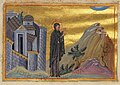 Matrona of ConstantinopleVenerableNov 9
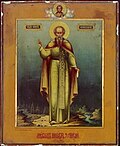 Onesiphorus the ConfessorVenerable · Monk of the Kiev CavesNov 9
- AedhnatSaintNov 9
- Alexis ZadvornovVenerable MartyrNov 9