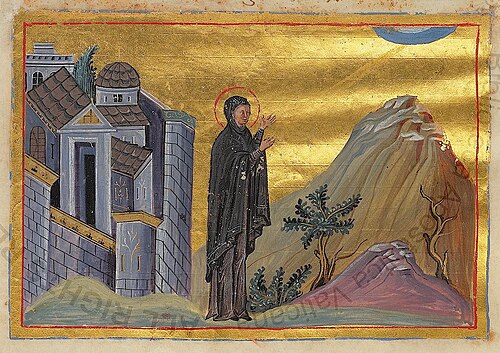
Venerable
Matrona of Constantinople
Venerable woman born around 392 at Perge in Pamphylia, who lived as an ascetic in Constantinople.
- Feast
- November 9old style November 22
- Reposed
- 4925th century
- Place
- Constantinople
- Order
- Venerables
Life
Venerable Matrona of Constantinople (also called of Perge) was born around 392 at Perge, in Pamphylia, in Asia Minor, and died around 492, at Constantinople, at nearly a hundred years of age. She was an ascetic, first hidden among monks, then an abbess. The Orthodox Church remembers her on 9 November (22 November on the new calendar).
Leaving home
She was married to a wealthy man, Domitian. After the birth of their daughter, Theodotia, she moved to Constantinople. She was devout, always went to church and prayed there for her sins. She knew ascetics of the Church and followed their way of life. She strove above all to humble her flesh, but her husband prevented it, and with it her ascetic life. Soon she decided to leave her family for her faith. First she left her daughter to be raised by Susanna, another ascetic. According to tradition, after she prayed to the Lord to learn whether her decision was pleasing to Him, she received as an answer a vision in a dream, in which she hid from her husband in a crowd of monks, and he did not find her.
Then Matrona decided to go to a monastery of men, so that her husband would not think of looking for her there. She cut her hair, put on men's clothes and passed herself off as the eunuch Babylas (in another source Babilos). There she lived almost constantly in silence and labour. Once a brother of her obedience saw that her ears were pierced. Matrona lied: "My tutor loved me so much in childhood that he wished to adorn me and pierced my ears." Another time the abbot of the monastery, Venerable Bassian, had a prophetic dream that the eunuch Babylas was a woman. The same dream was had by the abbot of another monastery, the blessed Acacius. So she was exposed, confessed everything, but was forgiven, since her intention was judged good, and was sent to a convent of women.
Abbess and wonderworker
She came to a convent in the city of Emesa. There she soon became abbess and later "healed many by her prayers". The fame of her and her labour spread through the neighbourhood and reached her husband, who came there. Then Matrona decided to withdraw into solitude, by way of Jerusalem, Mount Sinai and Beirut, and settled in an abandoned pagan temple, where she turned pagans to the Christian faith. Around her dwelling women began to settle and soon a monastery was founded. Later she founded a monastery at Constantinople as well, known for the strictness of its rule and the virtuous life of its sisters.
She is said to have lived almost a hundred years. According to tradition, before her death a vision was shown her in which she was granted a place in paradise for her seventy-five years of monastic labour. The sources relate miracles: she anointed with holy myrrh the eyes of a blind man, who saw. The glory is given not only to the healing myrrh of Saint John the Baptist (the second finding of his head), but also to Matrona, since the hands of others who had anointed him with the same myrrh had not given him sight. She fought with demons in an idol shrine and defeated them. She was tempted by a demon in the form of a beautiful woman, who urged her to give up her labour, but she did not yield, and the woman was turned into an old woman with fire coming from her eyes, and then vanished. She "found" a spring for herself: having no water, she dug a hole and, moving away, prayed, and in that place a spring wonderfully appeared and grain grew all around. She had the gift of healing by touch: for example the noblewoman Euphemia was healed of a grave illness by a touch of her hand.
Commemorated the same day November 9
 Nektarios of AeginaSaint · Metropolitan of PentapolisNov 9
 Symeon MetaphrastesVenerable · Byzantine hagiographerNov 9
 John the DwarfVenerable · Desert FatherNov 9
 Antoninus of ApameaMartyrNov 9
- Agrippinus of NaplesSaint · Bishop of NaplesNov 9
 Onesiphorus and PorphyryHoly MartyrsNov 9
 Alexander of ThessalonikiHieromartyr · Archbishop of ThessalonicaNov 9
 Theoctiste of LesbosVenerableNov 9
 Parthenius BryanskikhHieromartyr · Bishop of AnanyivNov 9
 Onesiphorus the ConfessorVenerable · Monk of the Kiev CavesNov 9
- AedhnatSaintNov 9
- Alexis ZadvornovVenerable MartyrNov 9