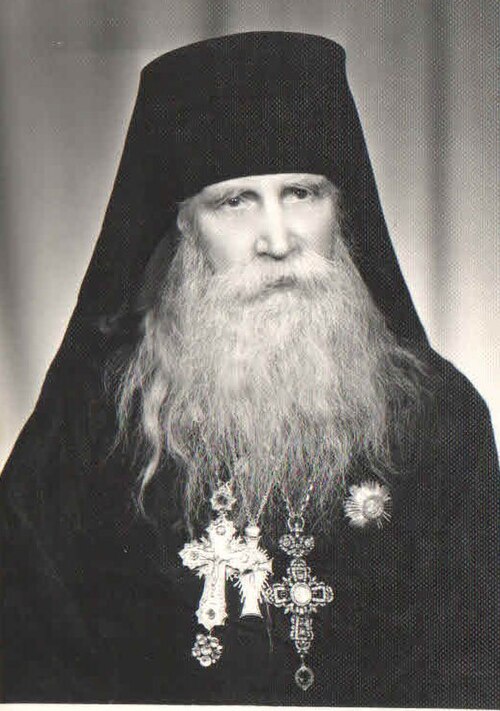
Saint
Tavrion Batozsky
Elder of the Transfiguration Hermitage
An archimandrite, elder of the Transfiguration Hermitage in Latvia, who reposed in 1978; venerated by the faithful, not formally canonized.
- Reposed
- 197820th century
- Place
- Spaso-Preobrazhenskaya Hermitage, Valgunde, Latvia
Life
Archimandrite Tavrion Batozsky (in the world Tikhon Danilovich, 1898-1978) was confessor of the Transfiguration Hermitage near Riga in Latvia, a confessor of the faith who spent long years in prisons and camps. He is venerated by the faithful as an elder, without synodal canonization.
Early life and monastic beginnings
He was born on 10 (22) August 1898 in Krasnokutsk, Kharkov province, the sixth child, among ten sons, of the treasurer of the town council. He attended the zemstvo school and the teachers' seminary. From childhood he served in church and dreamed of the monastery. In January 1913 he went to the Glinsk Hermitage, where he worked in the icon workshop of Father Seraphim Amelin and took missionary courses. He was mobilised in the First World War, then returned to Glinsk and was tonsured a monk in 1920. After the hermitage was closed, in 1922, he went to Moscow, to the Novospassky Monastery, where he was hierodeacon from 1923 and hieromonk from 1925 and finished a school of painting. In 1925, when that monastery was closed, he served at Rylsk, then was abbot of the Markov monastery in Vitebsk (1926), and from 1927 served at Perm, where he fought against Renovationism and in 1929 was raised to archimandrite by Bishop Pavlin.
Prison and camps
In the autumn of 1929 he was arrested and sentenced to three years, served at the building of the Berezniki chemical works in the Vishera camps. Released in 1935, he lived at Kaluga, Kursk and Lipetsk, worked as a painter and guided secret Orthodox communities. On 27 December 1940 he was arrested again, held in the prison at Kazan and sentenced in March 1941 to eight years, served in a camp in the Sverdlovsk region, first felling timber, then as a painter. He was released early, in August 1948, and sent into exile in the Kustanai region of Kazakhstan, where he worked as a painter in a workshop and then as a school watchman. He was freed from exile in April 1956 and then served at the Trinity Cathedral in Perm.
Service after release
On 14 March 1957 he was appointed abbot of the Glinsk Hermitage. There he came into conflict with the council of elders, who had supported him at first, over the changes he made to the customs of the place, among them services with part singing and prayers after Vespers, against the rule of monastic silence, and in January 1958 he was transferred to the Pochaiv Lavra. From April 1959 he was secretary of the diocesan administration of Ufa and rector of the Protection church, which he restored; proposed for the episcopate in 1960, he was approved by the Holy Synod, but the authorities prevented the ordination and withdrew his registration. From 1961 he served in the Yaroslavl diocese, at Nekrasovo and, from 1964, at Novy Nekouz, where he became known as a confessor.
The elder near Riga
From March 1969 he was confessor of the Transfiguration Hermitage, belonging to the Holy Trinity convent in the diocese of Riga, on the proposal of Bishop Leonid Polyakov. Under his direction the ruined hermitage was restored: two churches were repaired, a refectory and cells for pilgrims were built, and pilgrims came from all over the country, with 150 to 200 people receiving communion daily in summer. He served the Liturgy every day and preached often, beginning with the words "My children, what love the Lord has shown us," and after the reading of the Gospel he read it again and explained it plainly. The faithful ascribed to him the gift of foresight. Metropolitan Anthony of Sourozh, who met him in Latvia, recounted that the father told him of his gratitude to God for the years in prison and camp, spent among those who needed a priest.
He suffered from cancer, refused an operation and passed to the Lord on 13 August 1978, at the Transfiguration Hermitage. There is talk of his canonization, and studies about him have multiplied.