Martyr
The 377 Martyrs of Adrianople
Three hundred and seventy-seven Christians executed in the year 815.
- Reposed
- 8159th century
- Order
- Martyrs
Life
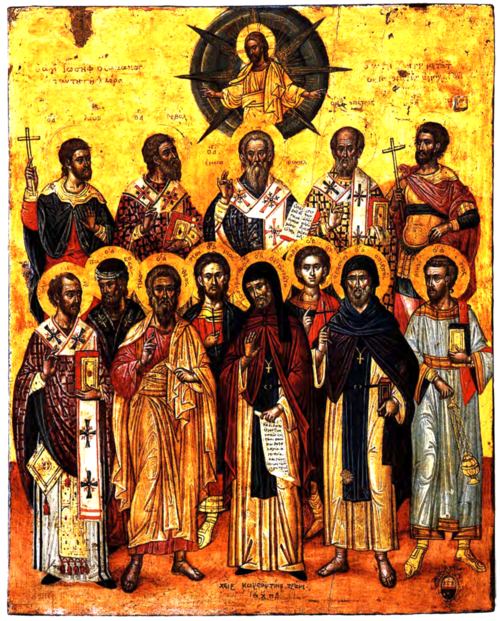
The 377 Martyrs of Adrianople, also known as the 377 Martyred Companions in Bulgaria, were three hundred and seventy-seven Christians put to death for their faith in the year 815 by the Bulgarians. They are commemorated in the Orthodox Church on 22 January.
The emperor Nikephoros I invaded Bulgaria and sacked the capital Pliska in 811, but was killed, and his army annihilated, at the battle of the Varbitsa Pass, as he returned to Roman territory. Khan Krum's peace offer was rejected by the emperor Michael I Rangabe, and the Bulgarians invaded the empire in the spring of 812. Krum conquered Develtos and transplanted its population to Bulgaria in June, and seized Adrianople in September 813. At Adrianople Krum threw Manuel, archbishop of Adrianople, to the ground and trampled on his neck.
According to the Menologion of Basil II, Krum began the persecution of Christians before his death, and it was continued by a certain Čok (Tzok) who had all Christians who refused to renounce their faith executed. The Synaxarion of Constantinople, however, says that the persecution began after Krum's death, in April 814, on the orders of Khan Ditzevg, the successor of Dukum, who ruled briefly after Krum. Omurtag later became khan and ordered the execution of all Christians who refused to renounce their faith. Three hundred and seventy-seven Christians were killed, of whom the following are known by name: Manuel, archbishop of Adrianople (according to the synaxarion, Ditzevg had him cut in two, his arms cut off, and his remains fed to dogs; afterward Ditzevg was afflicted with blindness and killed by his own soldiers; according to the menologion, Krum had Manuel killed and subsequently became blind and was strangled by his soldiers); George, archbishop of Develtos (he had negotiated the surrender of Develtos to Krum in 812 and had been transplanted to Bulgaria with the city's population; he was clubbed to death and decapitated); Leo, bishop of Nicaea in Thrace (a eunuch, whose stomach was cut open); Peter, bishop (clubbed to death and decapitated); John, strategos (a renegade, who had served under Tuk, ichirgu boilas, with Bardanes on the Bulgarian right flank in the battle of Versinikia, but was beheaded for his faith); Leo, strategos (also a renegade, who had served under Krum's brother, at the centre of the Bulgarian army at Versinikia, and was beheaded); Parodos, priest (stoned to death); Gabriel and Sionios (both beheaded); Loubomiros and Chotomiros (Slavs, named in a canon composed by either Saint Joseph the Confessor or Saint Joseph the Hymnographer, which shows the spread of Christianity among the Slavs of Bulgaria); Koupergos and Asfir (who may have been Bulgars).
An original account of the martyrs was probably made on the basis of the testimonies of prisoners of war released by Bulgaria after the treaty of 816, in the first half of the ninth century, at the Monastery of Stoudios at Constantinople, on which the menologion and synaxarion are based. Sophoulis suggests that the story of the martyrdom was Roman propaganda to deter officials from collaborating with the Bulgars and to strengthen the resolve of cities vulnerable to Bulgar attack, and that the number of martyrs may be exaggerated.