Saints
The Myrrhbearers
The women of the Gospels who took part in the burial of the Lord and first found the empty tomb.
- Era
- unknown
Life
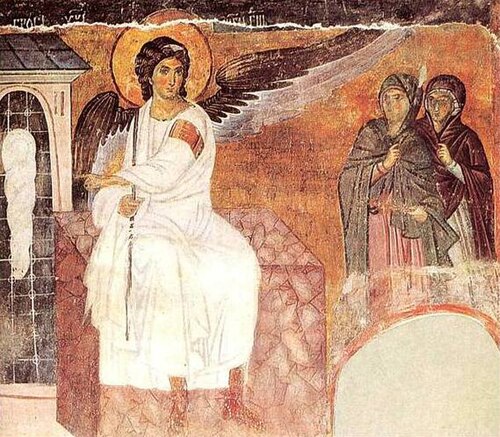
The Myrrhbearers are the women and disciples of the Gospels who were present at the burial of the Lord or who found the tomb empty after the Resurrection. The term refers above all to the women who came at dawn after the Sabbath to the tomb with spices to anoint the body of Jesus and found the tomb empty. The Church honours them on the third Sunday after Pascha, called the Sunday of the Myrrhbearers, which is also a day devoted to all Christian women.
They followed Jesus in His ministry in Galilee, supporting Him and His disciples from their own means. They stayed faithful even during the arrest and crucifixion, stood by the cross and accompanied the body to the tomb, seeing where it was laid. Because of the approaching Sabbath, the burial preparations were hurried. After the Sabbath they came to the tomb as early as possible, bringing myrrh to anoint Him. Then the Resurrection was revealed to them by an angel and they were sent to tell the apostles. For this reason they are called "apostles to the Apostles", and Mary Magdalene especially is sometimes called equal to the apostles. In Matthew, Mary Magdalene and the other Mary meet Christ, who sends them to tell the disciples. John shows that Mary Magdalene came first, while it was still dark, and Christ appeared to her, whom she at first took for the gardener, asking her not to touch Him and to tell the disciples. The apostles did not at first believe. According to Holy Tradition Jesus appeared first to His Mother, and on Orthodox icons the Mother of God is always shown with the myrrhbearers.
The Myrrhbearers are traditionally listed as Mary Magdalene, Mary the mother of James and Joses, Mary the wife of Cleopas, Martha of Bethany, sister of Lazarus, Mary of Bethany, sister of Lazarus, Joanna, wife of Chuza, steward of Herod Antipas, Salome, mother of James and John, the sons of Zebedee, Susanna, and other women whose names are not known. Also counted among them are Joseph of Arimathea and Nicodemus, who took the body down from the cross, anointed it with myrrh and aloes, wrapped it in clean linen and laid it in a new tomb. Joseph of Arimathea was a secret disciple of Jesus, a rich and respected man, an honourable counsellor, who asked Pilate for the body. Nicodemus, a Pharisee, came to Jesus by night, defended His right to a hearing before the Sanhedrin and took part in the burial.
On the third Sunday of Pascha, the Gospel readings and the hymns of Holy Saturday are repeated. The following week is called the Week of the Myrrhbearers. Many of the myrrhbearers also have separate feast days in the Menaion. On every Sunday at Matins and the Midnight Office a special hymn is chanted, whose name means "sent", about the myrrhbearers sent to announce the Resurrection to the Apostles. Several Orthodox cathedrals and churches are dedicated to the Myrrhbearers.