Saints
The Seven Deacons
Deacons of the Jerusalem Church
The seven men chosen by the Jerusalem church to serve at table so the Apostles could pray and preach.
- Era
- unknown
Life
The Seven Deacons are the seven men chosen by the Church in Jerusalem in the first years of Christianity to serve at tables, so that the Apostles could remain at prayer and at the ministry of the word. They are named in the sixth chapter of the Acts of the Apostles: Stephen, Philip, Prochorus, Nicanor, Timon, Parmenas and Nicholas of Antioch. Of them, the Church commemorates as saints Stephen, Philip, Prochorus, Nicanor, Timon and Parmenas; Nicholas is remembered only as one who fell away from the faith.
Their choice
The Book of Acts says that in those days, when the disciples were multiplying, a murmuring arose of the Hellenists against the Hebrews, because their widows were overlooked in the daily distribution. The Hellenists are usually understood as Jews who had come to Jerusalem from the diaspora and spoke Greek. The Twelve called the multitude of the disciples and said that it was not right for them to leave the word of God and serve tables. They asked that seven men of good report, full of the Holy Spirit and wisdom, be chosen from among them, whom they would set over this task; thus the Apostles would remain at prayer and the ministry of the word. The community chose Stephen, a man full of faith and the Holy Spirit, and Philip, Prochorus, Nicanor, Timon, Parmenas and Nicholas of Antioch, a proselyte. The Apostles set them before themselves and, praying, laid their hands on them.
In the text the seven are not called "deacons", and their ministry has a single duty, unlike the epistles of Saint Paul; but their service is described as "diaconal", so they are regarded as the forerunners of the order of deacons. The word "deacon" appears first in the Epistle to the Philippians and in the First Epistle to Timothy. According to the "Apostolic Church Order", the deacons urged the members of the community to generosity and good works, and the "Apostolic Tradition" commanded the deacon to inform the bishop of all the sick, so that he could visit them and give them the Holy Mysteries. According to a later tradition they are also counted among the Seventy disciples.
Who they were
Only Stephen and Philip are treated at length in Acts. Stephen was the first martyr of the Church, killed by a mob, and at his death Saul of Tarsus, the future Apostle Paul, was present. Philip preached in Samaria, where he converted Simon Magus and baptized the Ethiopian eunuch, so tradition regards him as the beginner of the Ethiopian Orthodox Church; he is called "the evangelist". Tradition says nothing more of Nicanor and Parmenas.
Prochorus is regarded by tradition as the nephew of Stephen and a companion of Saint John the Evangelist, who ordained him bishop of Nicomedia in Bithynia; the authorship of the apocryphal Acts of John is ascribed to him, and it is said he ended his life as a martyr at Antioch in the first century. Nicanor, according to the Annals of Caesar Baronius, now considered inaccurate, was a Jew from Cyprus, who returned to his island and died a martyr in the year 76; other accounts say he was killed at "Berj", an unidentified place, perhaps confused with Botrys. Timon is said to have been a Hellenized Jew who became bishop in Greece or at Bosra in Syria; in the latter account his preaching roused the anger of the governor, who burned him. Parmenas, after preaching for years in Asia Minor, where Hippolytus of Rome says he was bishop of Soli, is said to have settled in Macedonia, where he died at Philippi in 98, in the persecution of Trajan; according to another Orthodox tradition, he died of illness.
Nicholas, from Antioch, is described in Acts as a convert to Judaism. Some early writers did not speak of him kindly. According to Irenaeus, the Nicolaitans, a sect condemned already in the Apocalypse, took their name from this deacon; according to Hippolytus, he inspired the sect by his indifference to life and to the pleasures of the flesh, which his followers took as licence for debauchery. The Catholic Encyclopedia preserves a story that, after the apostles rebuked him for treating his beautiful wife badly out of jealousy, he left her and allowed anyone to marry her, saying the flesh must be mistreated; Clement of Alexandria says the sect corrupted Nicholas's words, meant to restrain the pleasures of the body, to justify licentiousness. The historicity of this story is debatable. Among later deacons the Eastern tradition also counts Lawrence of Rome and Euplus.
Veneration
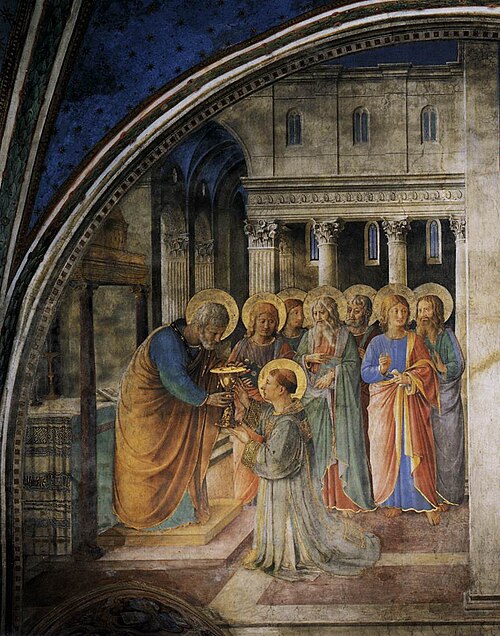
On the painting on the wall of the Niccoline Chapel in the Vatican, Fra Angelico shows Saint Peter laying hands on the seven deacons, with Saint Stephen kneeling.