Righteous
The Shunammite Woman
Hostess of the prophet Elisha
Woman of Shunem who received the prophet Elisha into her home, mentioned in the Second Book of Kings.
- Era
- unknown
- Order
- The Righteous
Life
The Shunammite Woman is an unnamed woman of the Old Testament, from the town of Shunem, who received the prophet Elisha into her house. The Fourth Book of Kings names her only after the town. The Orthodox Church venerates her among the righteous women of the Old Testament, and the reading about her is one of the paremias of Great Saturday. Her feast is on the Sunday of the Forefathers, before the Nativity of Christ, according to a Greek source.
Hospitality
Her name is not in the biblical text; she is called only after her place of origin, Shunem (in Greek Soman, whence Somanitis; the town may be identified with the present village of Sulam). She is not to be confused with the Shulammite of the Song of Songs, whose name comes from a variant of the same town's name. The Fourth Book of Kings (4:8) describes her as a "great" and wealthy woman of Shunem, childless, who hosted Elisha whenever he passed through her town. She had a small room built on the roof for the prophet, that he might have a place to stay, and the idea came from her and was supported by her husband. One day the prophet called her and wished to thank her for her kindness. She answered that she needed nothing, and Elisha, learning from his servant that she had no children, prophesied that she would have a son. According to the biblical account the prophecy was fulfilled and a year later the woman bore a son.
Raising of her son
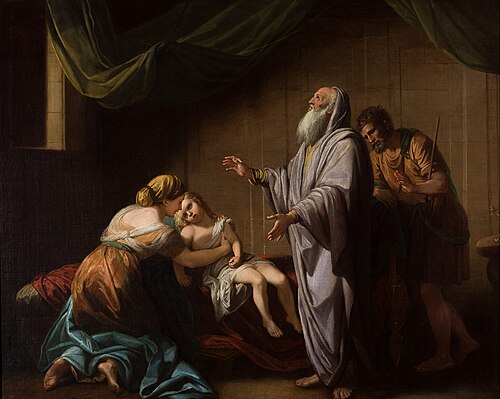
When the child had grown, one day, at harvest time, he felt ill in the field beside his father, was carried to his mother and died on her knees. The Shunammite, trusting in the power of the prophet Elisha, set out to him, to Mount Carmel. Asked by the prophet's servant whether all was well in her family, she answered yes. But the prophet had understood, and when she told him of her son's death, he sent his servant ahead with his staff to lay it on the child's face, without result. At her request Elisha himself went to her house, stretched himself on the child seven times, and the child came to life. Elisha gave him back to his mother (4 Kings 4:18-37).
The land restored
The Shunammite appears again in chapter 8 of the same book. Elisha warns her of the coming famine and advises her to leave the country with her family. Accustomed to trust the prophet, she moves to the fertile land of the Philistines, where she lives seven years. Returned to Israel, she finds that her house and field have been taken and asks King Joram to give them back. The king, who at that moment was speaking with Elisha's servant about the prophet's great deeds, hears of her son's raising, and she enters with her son at that very hour. Impressed by the story of the raising, Joram ordered an official to help her recover her house and the produce of the field for the time she was away. The Bible says nothing more of the Shunammite woman.
Commentary
Abraham Kuyper sees in the woman of Shunem a typical example of pious people in Israel who loved and respected the prophets, and believes the narrative shows her "independence and readiness". Carol Meyers observes that, unlike almost all women in biblical narratives, she is not presented as someone's "wife". Claudia Camp describes her as "both independent and maternal, powerful and pious".