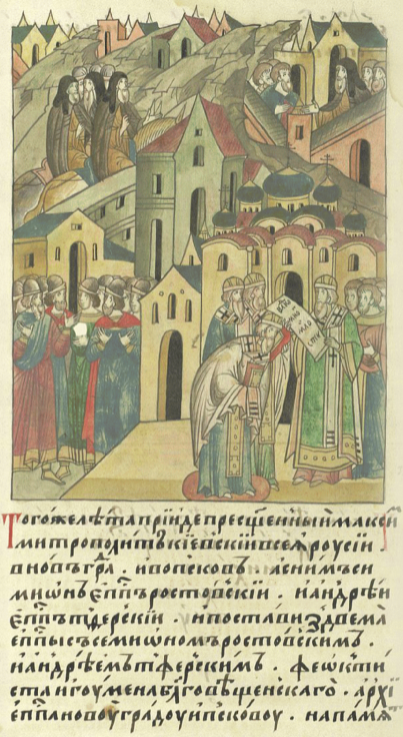
Saint
Theoctistus of Novgorod
Archbishop of Novgorod
Archbishop of Novgorod and Pskov, who died in 1310, honored in the Synaxis of the Saints of Novgorod.
- Feast
- December 23old style January 5
- Reposed
- 131014th century
- Order
- Hierarchs
Life
Saint Theoctistus (died 23 December 1310) was Archbishop of Novgorod and Pskov. He was canonized among the hierarchs in 1664 and is commemorated on 23 December, on 23 January and on the third Sunday after Pentecost, in the Synaxis of the Saints of Novgorod (the Serbian source gives 23 December by the old calendar, 5 January by the new).
Life
The time and place of his birth are not known. He may have been a cleric of the Saint Sophia cathedral in Novgorod. He received monastic tonsure at the Annunciation monastery near Novgorod. By monastic labors and good deeds he earned the respect and love of the brotherhood, who chose him as their abbot. The election to the see followed the burial of Archbishop Clement, who died on 22 May 1299 (the Serbian source says 1300), and, according to the chronicle, was accompanied by long disputes and hesitations, before all the Novgorodians settled with complete unanimity on Theoctistus, "a man marked by God, humble and good". It is not known when the veche was convened at Sophia; the elect was solemnly seated at the archiepiscopal court and began to govern the diocese, awaiting consecration, for which Metropolitan Maximus had to be found, who had left Kiev at that time to found a see in another place. From his stay at the archiepiscopal court until the consecration only one trace remains, in a contemporary note in the manuscript "collection of lives of saints and instructions": "these books were written at the bidding of master Theoctistus, named archbishop of Novgorod, for our monastery".
In 1300 Metropolitan Maximus arrived at Novgorod, with Bishops Simeon of Rostov and Andrew of Tver (Gerdenev), and on 28 June Theoctistus was "marked" in the church of Boris and Gleb, and the next day consecrated in the Saint Sophia cathedral; "and there was, says the Novgorod chronicle, joy in Novgorod for their master and they made a bright feast". The celebration was truly unusual for Novgorod: for the first time the master of Novgorod was consecrated in the church of Saint Sophia in Novgorod.
Archbishop Theoctistus gave much attention to the building and repair of churches and monasteries. In 1301, with his blessing, the foundation of the stone church of the Archangel Michael was laid, consecrated two years later. Two other churches consecrated by him, in Novgorod, remain monuments of his episcopal zeal: one dedicated to the holy martyr right-believing princes Boris and Gleb and one to the holy fathers of the First Ecumenical Council, in the prince's court. Under Saint Theoctistus the monastery on the island of Valaam was set in order, and the Serbian source says that in his time the monastic community on the Valaam archipelago was founded. In 1305 the blessed archpastor took part in the treaties of Novgorod with Grand Prince Michael of Tver for preservation of good relations. In 1307 the chronicle mentions his name in connection with some "non-peace" with the Pskovians, by which is most probably meant disputes about the payments due from Pskov to the benefit of the Novgorod see (visitation, judicial fees and so on), which arose often under his successors. The saint suffered painfully all the quarrels between princes.
According to the Novgorod chronicle, in winter 1308 Saint Theoctistus left the archiepiscopal court because of his health. Blessing David, his spiritual father, in his place, he returned to the Annunciation monastery, where he struggled in silence. After two years of unceasing work of prayer, having acquired from the Lord many spiritual gifts and revelations, on 23 December 1310 Saint Theoctistus passed into eternity. He was buried in the church of the Mother of God.
Veneration and canonization
In 1653 the first miracle known to us took place at his relics. The wonderful healings at the tomb of Saint Theoctistus were the basis for his numbering among the saints in 1664. In 1668 a canopy was placed over his burial place and under it a shrine. In 1682 the church in which the relics rested was renewed. In 1702 a cover with the saint's image was made for the shrine. On 23 January 1786 the relics of Saint Theoctistus were moved to the Yuriev monastery near Novgorod and placed in the cathedral dedicated to the holy Great Martyr George the Victorious, by the north wall, near the altar. In the first half of the nineteenth century, through the labors of the abbot of the Yuriev monastery, Archimandrite Photius, and the benefactions of his spiritual daughter, Countess Anna Orlova-Chesmenskaya, the monastery came into flourishing condition; Archimandrite Photius made a side chapel dedicated to Saint Theoctistus, and in 1847, beside his tomb, in an arch of the wall, a silver shrine was placed. The silver shrine marking the burial place was taken by the Soviet authorities. In 2015, during archaeological work in the Saint George cathedral, the tomb was opened: the one buried was found covered with a brocade cover, the skeleton lay on a silk cloth with a cross embroidered in gold thread, unique eighteenth-century fabrics, which were preserved. After examination the remains were moved for veneration and kissing to the Savior cathedral of the monastery.
Commemorated the same day December 23
 Dagobert IIRight-Believing · King of AustrasiaDec 23
- Nephon I of ConstantinopleSaint · Patriarch of ConstantinopleDec 23
- Niphon of CyprusSaint · Bishop of Constantia in CyprusDec 23
- Paul of NeocaesareaConfessor · Bishop of NeocaesareaDec 23
- Antonina of TismanaVenerable · Nun of Tismana MonasteryDec 23
- David of DvinskMartyrDec 23
 Saturninus of CreteMartyrDec 23
- AgathopusMartyr · Martyr of GortynaDec 23
- Agathopus of CreteMartyrDec 23
- Anfadan of Ros IngiteSaintDec 23
- Basil SpasskyHieromartyrDec 23
- BasilidesMartyr · Martyr of GortynaDec 23