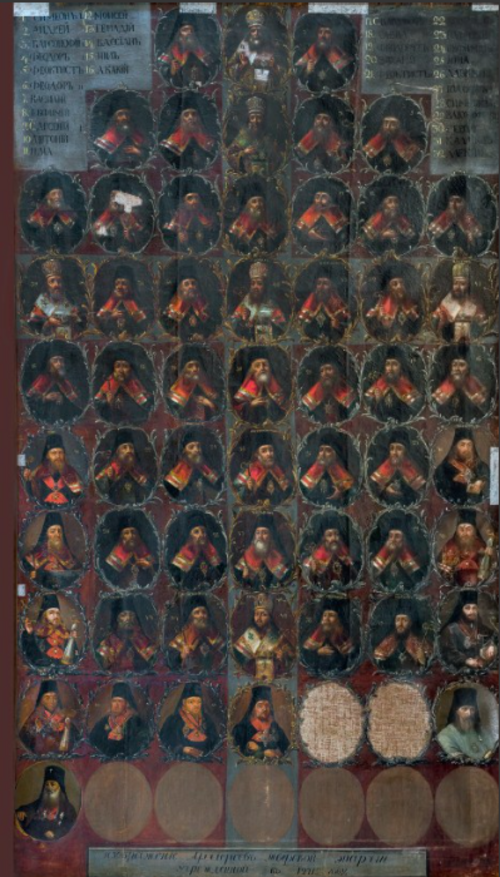
Hieromartyr
Theoctistus of Tver
Archbishop of Tver and Kashin
Archbishop of Tver and Kashin, born around 1540 and died in 1609; canonized in 2000.
- Reposed
- 160917th century
- Order
- Martyrs
Life
Holy Hieromartyr Theoctistus was archbishop of Tver and Kashin, born about 1540 and killed in 1609, in the Time of Troubles. He was numbered among the holy hieromartyrs by the Council of Bishops of the Russian Church in the year 2000. Our sources do not give his feast day.
Abbot of Boldino
Nothing is known of his childhood and youth. He was, from an unknown time, abbot of the Holy Trinity monastery at Boldino, near Dorogobuzh. In the time of his abbacy great building was done there, under the direction of the best architect of the Muscovite state of the time, Fyodor Savelyevich Kon: the cathedral of the Holy Trinity with the side chapel of Venerable Sergius of Radonezh, the refectory with the church of the Entry into the Temple, and the bell tower, all in stone. In 1598, as abbot, he took part in the work of the Assembly of the Land which elected Boris Godunov tsar in February, remained that spring and summer with the new tsar and ended on 1 August with the signing of the charter of election. During the Assembly a hieromonk gave him notes on the life of Venerable Nilus of Stolobny, from which the life of this saint was afterwards composed at the Boldino monastery.
Archbishop of Tver
The time at which he was made archbishop is not known with certainty. In the surviving income book of the Boldino monastery for the years 1603 and 1604 there are entries of sums coming from him, as abbot, from January until 13 June 1603. Then his name appears once more, on 12 February 1604: "the most reverend Theoctistus of Tver sent to the table two rubles". On 14 November 1603 the first entry was made of money from the new abbot, Cornelius, just come from Moscow. From these entries it may be concluded that in June 1603 Theoctistus was called to Moscow and consecrated archbishop of Tver before November of the same year, which is most probable, or a little later, but not after the beginning of February 1604.
In the time of False Dmitry I he was entered in a list of June 1605 of the ranks of the senate planned by the new government, in which, in the "spiritual council", he was to hold the sixth place. On 1 June 1606 he took part in the services at the coronation of Tsar Vasily Shuisky and, during the coronation, brought into the cathedral and gave to the metropolitan performing the coronation first the tsar's crown, then the sceptre and orb. In the same year he was at Tver and stood there for the power of the new tsar. When Rzhev, Staritsa, Zubtsov and other towns of the Tver region swore allegiance to False Dmitry II and in the Tver district a rebel movement began, Theoctistus, "putting his hope in God", called to himself the whole priestly council, the tsar's officials, the boyar sons of his archiepiscopal court and all the Orthodox Christians of Tver, and all were strengthened in one mind, fighting for the churches of God, for the Orthodox faith and for the oath of allegiance to the tsar. They beat many of the enemy band beneath the city of Tver and brought to Moscow many robbers alive. The result was the return of the rebel towns of the Tver region under the rule of Tsar Vasily.
Capture and death
In June 1607 Theoctistus came from Moscow to Staritsa for the burial of Patriarch Job and received for this a marten fur coat of the deceased, lined with silk. In the spring of 1608 he was seized at Tver by a detachment from the camp at Tushino and taken to that camp, where he was now dishonoured and tortured, now they tried by various "temptations" to turn him to their "delusion". It seems that in 1609 he fled from the camp toward "the reigning city", but was overtaken on the road and killed. His body, disfigured by weapons and by beasts, was taken by the faithful "according to military custom".