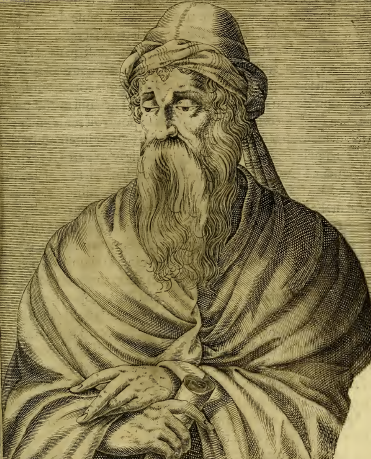
Saint
Theodoret of Cyrrhus
Bishop of Cyrrhus
Bishop of Cyrrhus from 423 to 457, theologian of the school of Antioch and commentator on Scripture.
- Reposed
- 4585th century
- Place
- Cyrrhus
- Order
- Hierarchs
Life
Blessed Theodoret of Cyrrhus was bishop of Cyrrhus in Syria from 423 to 457, a theologian of the school of Antioch, a commentator on Holy Scripture and a church historian. Some Orthodox call him Blessed Theodoret. He has no fixed commemoration in the general calendar, and some of his writings against Saint Cyril of Alexandria were condemned after his death by the Fifth Ecumenical Council. His writings, above all his Scripture commentaries, remain valued.
Childhood and youth
According to the historian Tillemont, he was born in 393 at Antioch, to a prosperous family. We learn of his life mainly from his letters and from the Religious History (Philotheos historia). By his account his mother, childless for twelve years of marriage, was cured of a serious eye complaint through the ascetic Peter the Galatian. His birth was promised by another hermit, Macedonius the Barley-Eater, on condition that the child be dedicated to God. From this he was named Theodoret, "gift of God".
He received a wide education. His writings show good knowledge of classical literature: he quotes Homer, Sophocles, Euripides, Aristophanes, Demosthenes and Thucydides. He knew Greek and Syriac, but neither Hebrew nor Latin. From childhood he was a lector at Antioch and was raised in the tradition of Diodore of Tarsus and Theodore of Mopsuestia. By the age of twenty-three, after his parents died, he gave his fortune to the poor and became a monk at the monastery of Nicerte near Apamea, where he stayed about seven years.
Bishop of Cyrrhus
In 423 he was appointed bishop of Cyrrhus, then a small town, with a diocese of some 1,600 square miles and 800 parishes. He is said to have brought more than a thousand Marcionites back to the Church, along with many Arians and Macedonians. He removed more than two hundred copies of Tatian's Diatessaron from the churches, built new churches and furnished them with relics. From the revenues of the see he built baths, bridges, halls and aqueducts, worked to relieve the people from taxation and brought rhetoricians and physicians to the city. He sent letters of encouragement to the persecuted Christians of Persian Armenia and sheltered a Carthaginian who had fled the Vandals.
The Christological controversies
Theodoret was a prominent figure in the Christological disputes of the fifth century. He joined the petition of Patriarch John of Antioch asking Nestorius to accept the term Theotokos, and at John's request wrote against the Twelve Anathemas of Saint Cyril of Alexandria. He was one of the eight deputies of Antioch called to Constantinople in 431 after the First Council of Ephesus, and he did not assent to the condemnation of Nestorius. Toward the end of 434 he worked for reconciliation among the Eastern churches. After Cyril's death, Dioscorus, his successor, turned against him and obtained a court order confining him to Cyrrhus.
There he wrote the Eranistes ("The Beggar"), a Christological work in three dialogues against the Eutychians. The emperor Theodosius II excluded him from the Second Council of Ephesus in 449, where he was condemned without a hearing and excommunicated, and his writings were ordered burned. He was forced to retire to the monastery at Nicerte and appealed to Pope Leo. Only after Theodosius died and Marcian and Pulcheria took power in 450 were the judgments revoked. At the Council of Chalcedon (451) he first sat as an accuser, but on 26 October 451 the council fathers pressed him to pronounce an anathema against Nestorius. He did so with a reservation: the anathema applied to the teaching of "two Sons in Christ" and the denial of the title Theotokos. The council declared him orthodox and restored him to his see.
Writings
His commentaries make up the largest part of his writings and his most important contribution to theology. By the scholars' reckoning they were written in this order: the Song of Songs, Daniel, Ezekiel, the Minor Prophets, the Psalms, Isaiah, Jeremiah and the Epistles of Saint Paul, and around 452 to 453 the Questions on the Octateuch and on Kings and Chronicles. His method is usually grammatical and historical, avoiding both over-strict literalism and unrestrained allegory. Almost all of them survive.
In the Ecclesiastical History, which begins with the rise of Arianism and ends with the death of Theodore of Mopsuestia in 429, he preserved many lost sources, especially letters from the Arian dispute. The Religious History, finished around 444, gives the lives of thirty Syrian ascetics. Other important works are the Ten Discourses on Providence, the Cure of Greek Maladies in twelve books, which shows the truth of the Gospel from Greek philosophy, and a survey of heresies. Of more than five hundred letters, 232 survive.
His end
After Chalcedon he stayed at Cyrrhus. He died around 458, traditionally dated between 458 and 460. His writings against Cyril were condemned by the Second Council of Constantinople (553) in the dispute of the Three Chapters, although he had been judged orthodox at Chalcedon. The Monophysites hated him as much as they hated Nestorius.