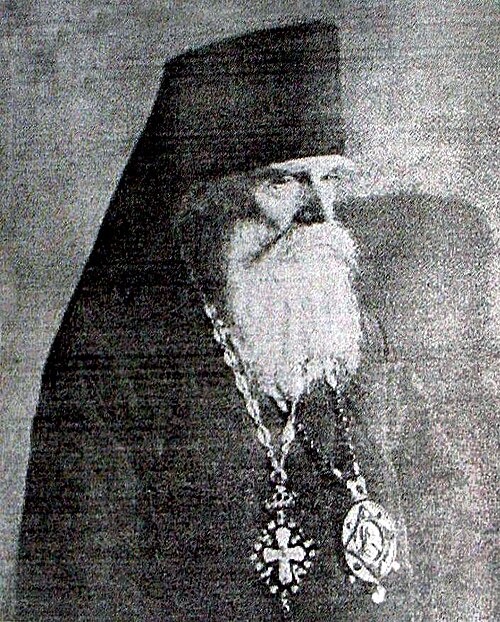
Saint
Theodosius Kirika
Bishop of Nikolaev
Bishop of the Russian Church, born in Varnița, Bishop of Nikolaev and later of Kursk and Kostroma, who died in 1937.
- Reposed
- 193720th century
- Place
- Mykolaiv
- Order
- Hierarchs
Life
Bishop Theodosius (Kirika) was a bishop of the Russian Orthodox Church from the region of Bessarabia and Kherson, who served for decades as a priest and missionary in the dioceses of Kherson and Kishinev and, in the years of Soviet persecution, became Bishop of Nikolaev, of Kursk and of Kostroma. He was shot in Nikolaev in December 1937, on the same night as his son, the priest Sergius.
Origins and schooling
In the world he was Theodosius Fyodorovich Kirika. According to some sources he was born in 1866 in the village of Varnița in the Bender district of Bessarabia, into the family of the church singer Theodore Kirika; according to others, on 11 January 1866 in the village of Velikaya Kondratovka in the Ananiev district of the Kherson province, where his father was a church reader. Some modern works trace him to the Bessarabian noble family of Kirika, while he himself gave his nationality as Ukrainian in a questionnaire. He studied at the Odessa Theological Seminary and then at that of Kishinev. He was married and had five children.
Village priest in the Kherson province
In 1890 he served as deacon at the church of Saint Nicholas in the village of Stanislav in the Kherson province, and the same year he was ordained priest for the church of Saint John the Merciful in the village of Olshanka in the Yelisavetgrad district. From 1891 to 1894 he served at the church of the Icon Not Made by Hands in the village of Demidovo in the Tiraspol district; in 1893 he made a donation to the diocesan committee of the Orthodox Missionary Society. On 23 May 1894 he was transferred to Novokrasnoye, and on 6 June 1896 to the house of prayer of Saint Basil in Adrianovka. In 1899-1900 he was the first rector of the new Dormition church in Blizhny Khutor. He received the epigonation (1898) and the skufia (1901) as awards.
The missionary
From his first years as a priest he encountered the spread of Stundism and Baptism among the faithful of the Kherson province and became convinced that the propaganda came partly through the German colonists, though the Baptist leaders of Odessa denied it. From then on he devoted his life to opposing the sects. In 1901 he became diocesan missionary for the Kherson district, assistant to the well-known missionary Mikhail Kalnev, and moved with his family to Nikolaev.
There he met the preachers Archpriests Ignaty Zubov and Pyotr Yelansky; the latter left him by will his theological library of more than 2,000 volumes. Father Theodosius preached among Stundists, Innocentists and Adventists, held public debates with Old Believers and gave lectures for the faithful, above all within the Saint Andrew Brotherhood of Odessa. From June 1905 to July 1906 he taught religion at the Alexander boys' gymnasium in Nikolaev.
In 1907 he was transferred as missionary of the Yelisavetgrad deanery. In these years he published several missionary works, among them a book on the “Ioannites” and their spread in the diocese of Kherson (Odessa, 1909) and a work against Adventism (Saint Petersburg, 1909), and he wrote for the Kherson diocesan gazette and the Missionary Review. For his work he received the Order of Saint Anna.
Missionary of the diocese of Kishinev
On 22 November 1910 he was appointed diocesan missionary of Kishinev and Khotin and moved to Kishinev. A few days later, at the annual meeting of the Brotherhood of the Nativity, he spoke of his struggle with the sects and proposed missionary conferences for priests in every deanery. In 1911 he visited all 34 deaneries of the diocese, speaking to the priests about the history, teaching and worship of the sects in Bessarabia, especially the Innocentist movement, which was then spreading. Church singers and lay people from the parishes also attended these meetings.
He taught the history of sects to the senior classes of the Kishinev Seminary, often spoke after the services in the cathedral, organised missionary courses for priests in the district towns and guided one missionary priest in each deanery. For his zeal he was raised to the rank of archpriest at Pascha 1913. With the priest Alexander Skvoznikov he wrote a work against the Innocentists, published in Romanian in the journal Luminătorul in 1916 and in Russian in the diocesan gazette in 1917. His last article in the Bessarabian church press appeared in Luminătorul in February 1918.
Revolution and civil war
In 1918, after the union of Bessarabia with Romania, he refused to come under the Romanian Orthodox Church and settled in Odessa and then in Kherson, where he served at the Greek church of Saint Sophia. Later he tried to return to Bessarabia, where two of his children lived, but did not succeed.
In August 1919, when the Volunteer Army occupied the Kherson region, he was elected to the committee of the society “For a United and Indivisible Russia” and signed telegrams of greeting to Admiral Kolchak and General Denikin. After the Red Army entered Kherson at the end of January 1920 he was arrested by the Cheka, but was released after three days without charge.
In the Renovationist schism
In 1922, when the Renovationist schism broke out with the support of the Soviet authorities, Archpriest Theodosius believed that the Church needed reform. At a meeting of clergy and laity in Kherson on 31 August 1922 he spoke in favour of, among other things, second marriage for the clergy and welcomed the Living Church as an impulse that had moved the Church out of deadlock, while calling for the reforming currents to unite around their best aims. In October 1922 he was elected chairman of the group of “progressive clergy” in Kherson, whose statute, however, the authorities did not recognise.
In 1923 he belonged to the provisional Renovationist church administration in Kherson, which fell apart within a month as priests withdrew under pressure from their parishioners. Those who remained loyal to Patriarch Tikhon regarded its members as heretics. A believer who knew him nevertheless wrote that at that time he was inspired by good intentions and placed the good of the Church above his own interests.
Return and episcopate
By the beginning of 1925, isolated, Father Theodosius had adopted a waiting stance. Archbishop Prokopy (Titov) of Kherson, released from prison in Odessa and exiled to Moscow, stayed in contact with the Kherson clergy and did much to turn them away from Renovationism. From 1925 to 1933 Archpriest Theodosius served in the Patriarchal Church.
Having been widowed, he was tonsured a monk and raised to the rank of archimandrite. On 14 October 1933, in the church of the Ascension in Odessa, he was consecrated Bishop of Nikolaev, vicar of the diocese of Odessa. From 23 May to August 1937 he was Bishop of Kursk and Oboyan, and at the beginning of August 1937 he was appointed Bishop of Kostroma.
Death
On 26 August 1937 he was arrested. Archpriest Mikhail Romanovsky, arrested with him, was accused of having held a dinner for the clergy at his home on the occasion of the bishop's visit, at which the tsarist order had supposedly been praised and the struggle against Soviet power discussed; Father Mikhail admitted that there had been a dinner but denied any talk against the regime.
On 18 November 1937 the NKVD troika in Nikolaev sentenced Bishop Theodosius to death. He was shot in Nikolaev on the night of 2 December 1937. On the same night his son, the priest Sergius Kirika, a cleric of the diocese of Kherson, was also shot.